
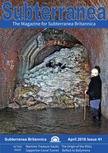
Manod Mawr is a substantial mountain lying to the north-east of Blaenau Ffestiniog, riddled beneath its surface with the great chambered workings of Manod Slate Quarry. Unlike the open-cast terraces of nearby Dinorwig or the dramatic tips of Penrhyn, Manod was worked principally underground, its galleries driven deep into the mountain to extract the fine-grained blue-grey slate for which the region became world-famous. Commercial extraction began in earnest during the nineteenth century, the quarry eventually being operated by the Welsh Slate Company. By the time working ceased, the caverns extended over a considerable area, with individual chambers reaching heights of up to 70 feet — vast, cathedral-like spaces supported by pillars of solid rock left in situ, their floors dry and their temperatures remarkably stable throughout the year.
It is this unusual combination of qualities — size, stability, dryness, and consistent cool temperature — that brought Manod to the attention of the British government in the darkest period of the Second World War.
Wartime Repository for the National Collection Following the fall of France in June 1940 and the commencement of the Blitz, the directors of the National Gallery in London, under Sir Kenneth Clark, were faced with an acute and urgent problem: the evacuation of the national art collection to a location of sufficient safety. Initial dispersal had seen paintings stored across a number of country houses in Wales and elsewhere, but these temporary arrangements were considered inadequate. The paintings were vulnerable to damp, temperature fluctuation, and, should the war take a worse turn, the enemy.
After an extensive search for a more permanent solution, Manod was identified as the ideal site. The caverns were requisitioned in 1941, and a remarkable engineering undertaking began. To gain access, the single-track mountain road leading to the quarry had to be substantially widened and reinforced to take the weight of lorries carrying the most precious cargo in the country. In places the road passed through tunnels, the entrances to which had to be raised and enlarged to allow the removal vans — adapted to carry the largest canvases — to pass through. One particularly large painting, Van Dyck’s Equestrian Portrait of Charles I, required special arrangements even with these modifications.
Inside the mountain, brick-built enclosures were constructed within the caverns to house the paintings, and heating and humidification equipment was installed to maintain the precise environmental conditions required for their long-term preservation. The result was what amounted to a state-of-the-art underground art gallery, invisible from the outside world.
Between 1941 and 1945, some of the most significant works in Western art resided within Manod Mawr, including paintings by Rembrandt, Rubens, Velázquez, and Leonardo da Vinci. The collection’s chief restorer, Ian Rawlins, lived nearby and monitored the works throughout. Famously, Churchill is reported to have suggested that selected works be displayed publicly in London during the war to boost morale — a suggestion which led to the famous single-painting exhibitions at the National Gallery, where one work at a time was brought down from Wales for display. The collection was returned to London following the end of hostilities in 1945, and the underground infrastructure was subsequently dismantled.
Current Status The quarry has been the subject of periodic interest from historians and heritage groups. The cavern infrastructure relating to the wartime use has largely been removed, though the chambers themselves survive.
The site is managed as an active slate facility in places and is not accessible to the public. The environment is becoming progressively less safe.
#An interpretive display relating to the wartime story can be found at the nearby National Slate Museum at Llanberis.
References & Further Reading
- Rawlins, F.I.G., The Evacuation of Pictures from the National Gallery, Studies in Conservation, 1954.
- Conlin, Jonathan, The Nation’s Mantelpiece: A History of the National Gallery, 2006.
- Sayer, Karen, Country Retreats: The National Collection in Wartime Wales, 2016.
- Shenton, Caroline: National Treasures: Saving The Nation’s Art in World War II, 2021
