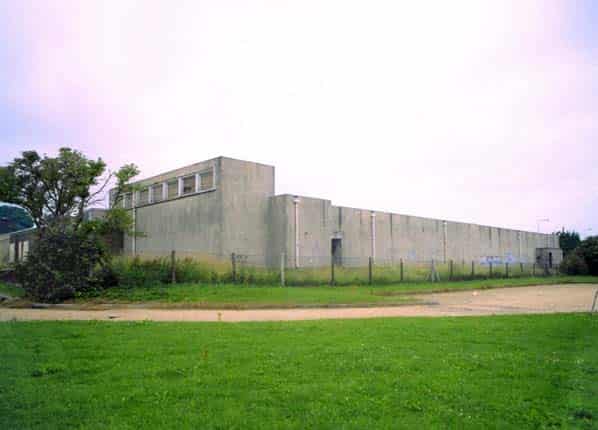
The PR2 BT repeater station at Warmley near Bristol was built around 1951 and is located in a residential area just off the A420. It’s a 2 storey building with one story below ground and the other on the surface. The building is divided into 3 distinct parts: 1. Office section 2. Above ground protected area 3. Below ground protected area
Entry off the road is through a pair of double wire mesh gates. On entering the site there is a large hole on the right hand side approx. 125ft across. At the bottom of this hole you can see the fuel tanks for the bunker. The site owner informed us that these were being removed in a few days by a mobile crane in preparation for the building work that will be taking place (more on that later). There is a small parking area to the left of the main doors which are of traditional heavy wooden construction. Once inside these you are standing in a small room. A doorway to the right leads to 2 small rooms which are completely empty apart from building materials and are not re-enforced in any way.
Going back into the entrance room and turning left leads to a huge pair of yellow steel blast doors approx 9ft tall on the right hand wall. The doors still swing easily on their hinges. On the left is a crane well for lowering objects to the lower floor. Passing through the blast doors doors you enter the bunker proper.
You are now in a rectangular area. To the right are stairs down to the lower level and a blast door that leads to the office area. Across to your left is another set of yellow blast doors that lead into the upper floor. The bunker is very well equipped with blast doors and the owner tells us that the walls are 2 feet thick. The whole building has a very secure feel about it.
Let’s turn right and pass through the blast door into the office area. We are now standing at the end of a short corridor. Passing along this corridor there are a couple of rooms on each side (all empty) and at the end we reach the ladies and gents toilets. This was the scene of a forced entry by local kids last night and there is much broken glass on the floor and the windows have been boarded up. The owner told us how on a previous break-in, 3 children had become trapped in this section and in an attempt to get out ended up in hospital due to injuries sustained. One of the rooms off the corridor was a kitchen and had some worktop-type units left. This room had been damaged by fire on a previous break-in.
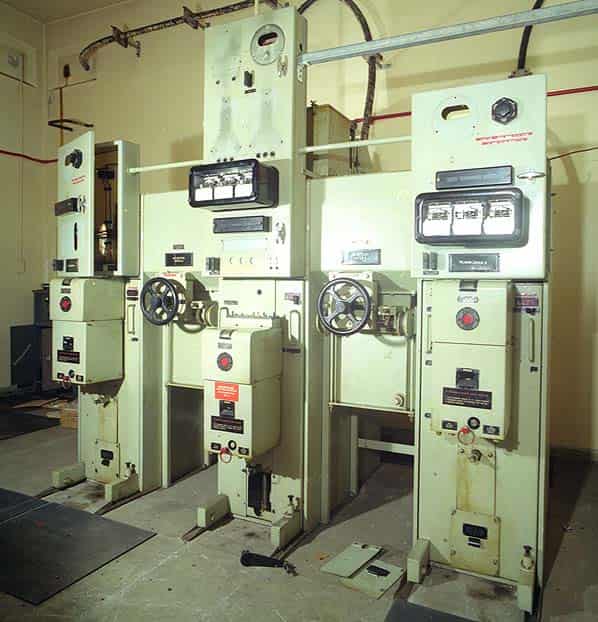
We walk back past the entrance blast doors and go through another set of yellow blast doors and into the top floor of the bunker. We are now standing in a large room which contains a number of power distribution boxes the size of large filing cabinets. The contactors still have a reassuring ‘chunk’ to them when moved.
Walking to our left we pass into another room which has an emergency escape door at the back of it. There is evidence of vandalism in this area with the partition wall showing holes where the local kids have practised being Bruce Lee.
The emergency exit leads through 2 security doors to the rear of the bunker. The internal emergency exit door is blast proof and the short passage to the outside world is a dog leg to reduce the force of the blast. We walk back past the power distribution equipment and on the left hand side of the room is a door which leads into the old battery room. All batteries have been removed but the marvellous red tiled floor still remains. Notices on the doors confirm that this was the back up power supply. Off the battery room were 2 smaller rooms which were empty. Passing back into the room where we entered this section of the bunker we turned right and entered the air plant room.
The scale of this room has to be seen to be believed. The air intake ducts are large enough for someone to walk through and contained all the damping shutters and draughting fans still intact along with filtering. The fan turned gently in the draught from the intake and the dampers still operated perfectly. This room showed minor signs of vandalism with some broken glass on the floor but everything was in place and intact. It is interesting to note that all rooms on this level, and indeed throughout the bunker had massive amounts of power fed around the walls in heavy duty steel conduit. Fuse boxes were sited every few feet on these conduits (fuses still in place) and there was extensive labelling as to the supply available and voltage etc. Two of the rooms had markings on the floor which led us to believe that there may have been racks of telecomm equipment sited in them at one point.
We returned to the entrance room and descend the 3 flights of stairs to the lower level. At the bottom of the stairs we are at the end of a short corridor. On the left hand side of the corridor are 4 doorways. The first 2 lead into a high voltage power room where the HV substation could be monitored. The Co2 fire extinguisher system was still in place and appeared in working order.
The next 2 doorways (which were double with heavy steel doors) led into a small area that contained 2 independent HV transformers that were the size of a small car and about 6 ft tall. They were very similar to the type normally found at small local electricity substations. It was becoming obvious that there was a lot of power available at this site.
At the end of this corridor on the left was a space where loads could be lowered from the upper floor via a now-missing winch system which could run along a beam in the upper level entrance room.
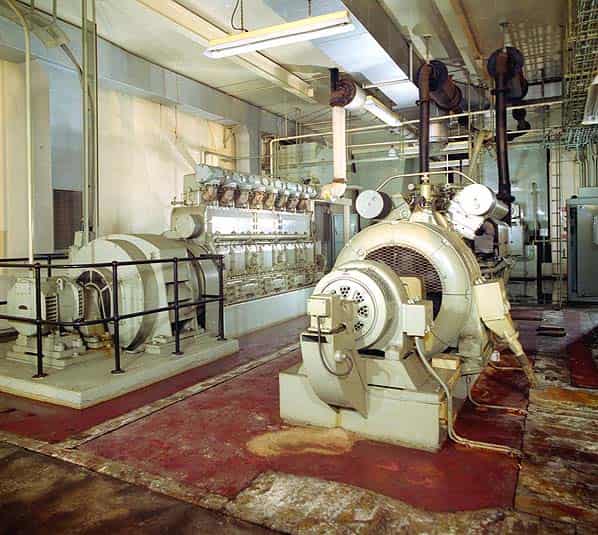
On the right was another set of huge blast doors - we entered into the final area of the bunker. We emerged into the plant room. This contained 2 huge generators, power boards, control plant, air compressors, distribution panels etc all in perfect condition and full working order so the owner told us. The site had been shut in 1995 but there had been regular maintenance until its recent sale and the generators could be started if needed.
The generators were a 215KVA auto start and a 250KVA air start. The power distribution around the building together with the battery back up meant that in the event of mains power failure the batteries would take over whilst the generator ran up to speed to power the telecom gear. A second generator provided back up and could be used to run the housekeeping functions such as air con and lighting etc. The fuel tanks outside held enough fuel to run in ‘closed down’ mode for around a month. At the end of this room was a door leading to an emergency escape shaft with a steel rung ladder leading to the surface. Close to this was a blast door into the air intake which ran to the very top of the building and contained all the air cooling gear etc. This was separated from the bunker by a blast door and all intakes to the generators were fitted with dampers and filters.
Going back past the entrance door we entered the largest room in the bunker. It’s the size of 3 tennis courts and obviously was the main equipment room. Marks on the wooden block floor showed were a substantial number of racks had been sited and there was a colossal number of ceiling lights and vents together with endless power ducting and fuse boxes. There was some water on the floor here - how it entered the bunker is unknown but it was being mopped up whilst we were there. At the end of this room to the right was another escape shaft to the emergency exit for the floor above and then at the end was a final room.
This is the room where the cables entered from outside. It was flooded to a depth of 4 inches but still had a substantial amount of rack and cable glands intact and had 2 sealable doors (one at either end) connecting it into the main equipment room. The entire building has been extensively photographed and a number of items have been recovered. Externally the building is in average condition with the windows to the office section boarded up. It is interesting to note that the protected areas did not have any toilets or showers.
We had a long chat with the owner who informed us that the site will soon be developed for flats. He intends to retain the basement structure which will be converted into underground car parking whilst everything above ground will be flattened. All the plant will be removed and sold for scrap or donated to a museum.
The upper storey of the building was demolished in the summer of 2001.
Those taking part in the visit were Nick Catford and Andrew Smith.