|
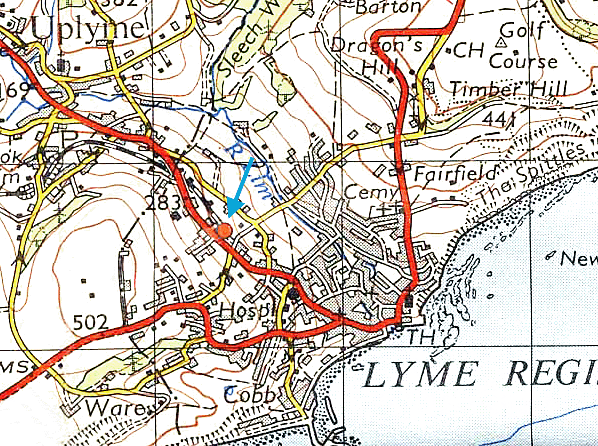
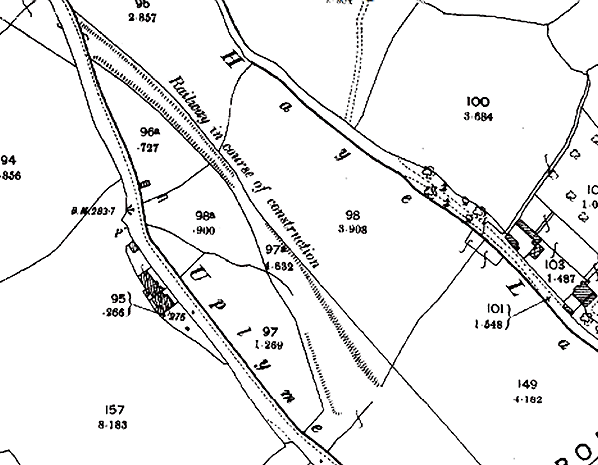
Notes: The station was located ¾-mile inland as it would have been impossible to site it nearer the town centre because of the steep gradient.
 |
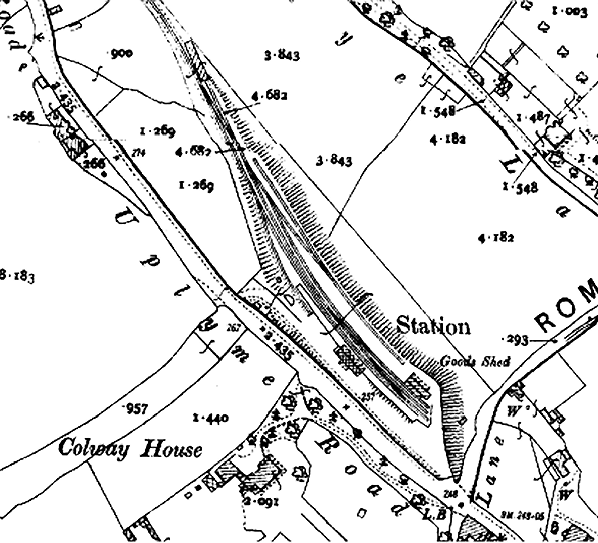
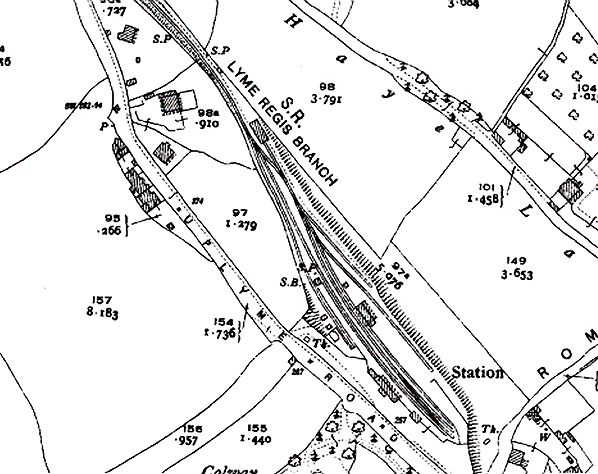
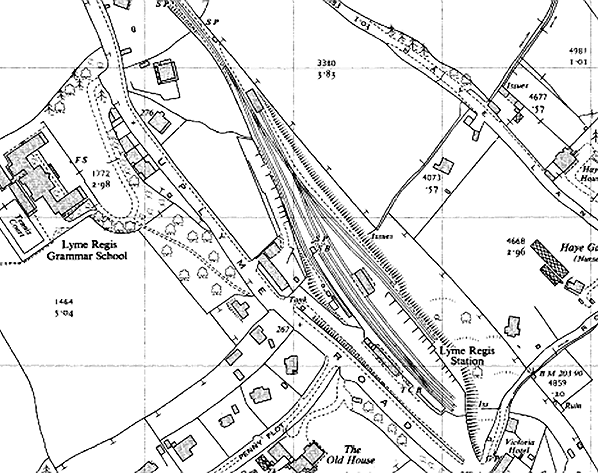
The town and surrounding area had little industry so goods traffic was not substantial, but coal, bagged cement and goods for the local shops were handled. As built, the yard comprised four sidings, all accessed from the run-round loop. Two sidings were parallel to the loop, running to the goods shed which was opposite the south end of the platform. The shed was |
raised off the ground to deter vermin and had a canopy on both sides. The other two sidings ran diagonally south-east across the yard, one of them running behind the coal bins. The modest 15-cwt yard crane was placed at the divergence of the two pairs of sidings. A short siding on the up side served a cattle dock behind the platform. In later years a dormitory coach was parked at the and of a short siding behind the goods shed. It was a 12-wheeler former LNWR sleeping car. Dormitory facilities were also available in the cabin at the south end of the goods shed.
The station building was of timber construction as were all the original buildings including the engine shed. Until 1939 the station was favoured with a W H Smith & Sons’ kiosk. The station had a single curving platform on the up side of the line. Initially the line operated under 'one engine in steam' arrangements, but full signalling was installed in 1906. At this time a bay platform was added which could accommodate two coaches, and a signal box was provided between the two passenger lines at the north end of the platform. The bay platform now also acted as an enlarged cattle loading dock which brought additional agricultural traffic. The station building was also extended at its north end a this time with the addition of a timber store room.
The original goods shed was later dismantled and re-erected, opposite the north end of the platform, close to the crane. The engine shed also had to be replaced after it was destroyed by a fire on 28 December 1912. It was rebuilt on the same spot using sheet asbestos. There was an adjacent coal stage.
|
 |
The station was improved by the Southern Railway: the building was extended and a new roof of steeper pitch was added. The platform was also lengthened to handle summer excursions. Southern Railway signage was installed, which was retained until closure. (Axminster received British Railways [Southern] totem signs, unusually in wood rather than enamel, and Combyne received at least one totem.)
The sidings were quickly lifted after closure of the goods yard on 3 February 1964. In December 1966 the shed at Lyme Regis was destroyed when flames leapt from a brazier that had been left too close to it. The remaining track was lifted by 28 June 1967. The station building remained intact for the next decade and was eventually dismantled in 1979 and re-erected at Alresford Station on the Mid
Hants Railway, where it acts as the West
Country Buffet and bookshop..
BRIEF HISTORY OF THE AXMINSTER & LYME REGIS RAILWAY
In earlier times, Lyme Regis had been a busy sea port, but as larger vessels came into use its business declined. In the nineteenth century railway travel gained importance, and a number of schemes to construct a railway were promoted; these included a line from Bridgwater (on the Bristol Channel) to Lyme Regis, and another connecting Bridport and Axminster or Chard Junction, serving Lyme Regis en route.
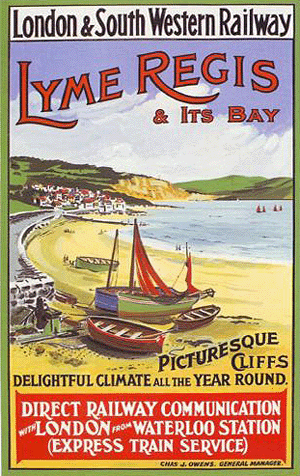
On 19 July 1860 the London & South Western Railway (LSWR) opened its main line between Yeovil and Exeter, giving the area rail transport to London; a horse bus operated between Lyme Regis and Axminster. The London & South Western Railway and Great Western Railway jointly proposed a branch to the resort but this failed to materialise.
| In the 1870s the LSWR was ready to support further plans for a branch, but this time only to thwart any proposed competition from the Great Western. The Lyme Regis Railway Company obtained an Act of Parliament in 1871 for a line to Lyme Regis from a junction with the LSWR at Axminster, and the LSWR agreed to work the line. Further proposals were |
 |
lodged with parliament for a later extension of the line to Bridport. The LSWR's support for the line was only lukewarm and, although construction started on 29 September 1874, it soon stopped again and eventually the powers lapsed. The hilly terrain and sparse population militated against the financial viability of these projects, and a petition in 1898 with 1,630 names inviting the LSWR to build a branch line to Lyme Regis prompted no response.
 |
The Light Railway Act came into force in 1896, encouraging the development of more modest and cheaper railway schemes. There was renewed local pressure in 1898. In an attempt to force the LSWR to support the line, and under the Axminster and Lyme Regis Light Railway Order of 15 June 1899, powers were once again granted for a line from the station at Axminster to a site ¾-mile from the town centre at Lyme, with one intermediate station at Combpyne.
The Act authorised a share capital of £55,000, supplemented by £24,000 in loans. A contract for the construction of the railway was let to |
Baldrey and Yerburgh of Westminster, for a tender price of £36,542; Arthur C Pain was appointed the company's engineer. The LSWR subscribed £25,000 to the cost of the construction and agreed to manage and work the line in perpetuity. It was to take up to 55% of receipts for expenses plus 4% on the cost of works it provided; the owning company would take the balance unless that proved inadequate to pay 4% on the shareholders' £55,000, in which case the LSWR would rebate 10% on through traffic.
Construction began on 19 June 1900. The route of the line was sinuous, generally followed contours, and there was only one major engineering feature, the Cannington Viaduct: this was a ten-arch concrete structure 600ft in length with a maximum height of 92ft. During its construction the west abutment and the adjacent pier slipped badly, delaying the opening. |
 |
Other difficulties during construction contributed to the delay. An extension of twelve months was authorised, and an application had to be made to the Board of Trade for an additional £10,000 in share capital and £3,000 in loans.
A special train was run on 22 January 1903 with VIP passengers to inspect the nearly-complete line, but difficulties with the Cannington Viaduct prevented the planned opening at Whitsun. The LSWR arranged a horse-bus connection from Axminster to Lyme Regis in the intervening period.
The line was finally passed by Board of Trade inspector Major Druitt on 21 August,opening three days later on 24 August 1903. The first train left Lyme Regis at 9.40 a.m., and at 12.25 p.m. a special train for dignitaries left Lyme, also carrying 200 children whose fare had been paid for by public subscription; the train returned at 1.15 p.m.
 |
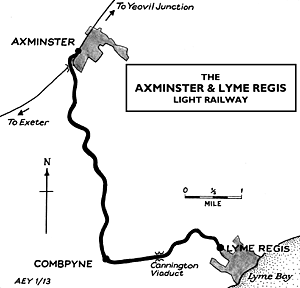
The line was 6 miles 45.6 chains long. Starting from Axminster station, at the level of the River Axe, it climbed, running broadly southwards in a succession of reverse curves to Combpyne, the only intermediate station. Turning broadly east, it now descended to Lyme Regis, crossing an arm of the River Lim on Cannington Viaduct, and passing through the village of |
Uplyme: the gradient was too steep to permit a station there. The station at Lyme Regis was inconveniently located on the northern edge of the town, because immediately beyond the line's buffer stops the land falls steeply towards the sea.
The branch was almost entirely in Devon, entering Dorset for the last few hundred yards before the Lyme Regis terminus . The ruling gradient was 1 in 40 in each direction. It was single throughout, with a passing loop at Combpyne. At Axminster passenger trains were accommodated on the up (north) side of the station in a bay platform, and the line swung south across the main line by a bridge. However Axminster’s goods yard was on the down side, and at first there was a goods line access to the branch line on that side, controlled by two ground frames, one at the yard exit and one at the connection onto the single line, higher up. This required departing goods trains to stop and restart on the steep gradient twice while the ground frame was operated. This difficult arrangement was taken out of use on 5 September 1915, after which down goods trains shunted to the up side at Axminster and used the branch line itself.
At first the line was operated on the 'one engine in steam' principle, with the run-round and yard points at Lyme Regis operated by a key on the train staff; in 1906 Tyers no.6 instruments were installed, enabling electric train token working, with two sections meeting at Combpyne. The LSWR operated the branch from the beginning. The permanent way was very light, and |
 |
permissible axle loads were limited to 12 tons.
The initial euphoria was sadly unwarranted as the traffic was disappointing, though it proved sufficient to put the local horse-drawn bus and coastal carriers out of business: the train could travel from Axminster to Lyme Regis in only 25 minutes, half the horse-bus journey time. When the branch opened there were six return journeys every weekday. Financial difficulties dogged the light railway, and on 1 January 1907 the company was entirely absorbed by the LSWR which rapidly brought improvements, especially with the carriage of agricultural goods. Two daily return journeys were added, and in 1908 there were nine, of which two were goods trains and one was mixed. Excursions proved popular and through trains to the resort increased steadily. This traffic was severely curtailed by the First World War but resumed in 1919.
Summer Sunday trains were put on from 1930, and they peaked at eleven in 1938. The winter Sunday service was discontinued in 1951.
 |
In February 1920 buses were introduced between Axminster, Charmouth and Bridport, siphoning off traffic from Charmouth that had used Lyme Regis as the railhead. By the following summer buses connected Axminster and Lyme Regis: a more direct threat to railway passenger traffic which, consequently, dwindled. In the 1950s the public continued to desert |
the trains owing to the increased use of private cars. By 1952 the Lyme Regis branch recorded fewer than three passengers per train in winter and seven in summer. Excursions continued to sustain the line in summer but during the winter it was uneconomic. Despite this, a reasonable service was maintained with ten down and eleven up trains running in 1961. During winter months a single carriage was usually sufficient, but in the summer there were sufficient passengers for two carriages with a third on those services that had through coaches for Waterloo. The last through workings were in the summer of 1963. On 4 November 1963 steam traction on the branch gave way to operation by a single-car diesel, though at busy times a three-car DMU was used; the engine shed closed at the same time.
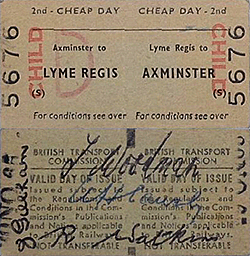
Passenger numbers were not helped by the inconvenient siting of the terminus, 250ft above and a considerable distance from the town centre. It came as no surprise when closure was proposed in the Reshaping of British Railways (‘Beeching’) report of March 1963. Freight services were withdrawn on 3 February 1964 and the signal box was closed on 20 July 1965, the line once again operating under 'one engine in steam' regulations. The sidings were quickly lifted. On 20 August 1964 the formal proposal of closure had been published and despite local protests, consent from the Minister of Transport, Tom Fraser, was given on 6 September 1965. The final trains ran on Saturday 27 November (Sunday trains having ceased in September, to be replaced with buses). The normally quiet Lyme Regis station was so crowded that passengers intending to catch the 3.39 pm to Axminster were unable to reach the platform. Meanwhile civic dignitaries from Lyme Regis and Axminster were on the train, some sporting period costume, and they enjoyed afternoon tea at Axminster while the DMU returned to Lyme Regis to uplift passengers who had failed to board on the earlier trip. The last round trip left Axminster at 6.48 pm. The line officially closed two days later on 29 November 1965.
The track-lifting was completed by 28 June 1967. The wooden main station building at Lyme Regis was dismantled in 1979 and re-erected at Alresford station, on the Watercress Line in Hampshire. The imposing Cannington Viaduct is a Grade II listed structure.
| In 1976 there was an ambitious scheme by Minirail to reopen the line from Lyme Regis to Axminster using 15-inch gauge stock. The Axe & Lyme Valley Railway established its operating base at Combpyne. They laid about half-a-mile of track, and second hand rolling stock was delivered from other lines - they had at least one locomotive. The scheme was abandoned in 1977/8 |
 |
through monetary problems and various land issues.
MOTIVE POWER
The LSWR operated the branch from the beginning; the permanent way was very light and permissible axle loads limited, at 12 tons. The locomotives used at first were numbers 734 and 735, Terrier (A1) class 0-6-0T engines; they formerly belonged to the London Brighton & South Coast Railway (LBSCR) for suburban work. However they were not entirely successful due to their limited power. From 1906, the LSWR’s own O2 class were employed; these were more powerful 0-4-4T locomotives, but they were not permitted to run with the engine water tanks more than half full to remain within the axle load limit, and they suffered badly from twisted frames and other wear defects owing to the sharp line curvature.
From 1913, William Adams' design of unsuperheated 4-4-2T engine, the 415 class, usually referred to as 'radial tanks' was brought in. The class had been employed on suburban work in London, and two members of the class were allocated to work on the branch. The trailing axle was designed to move laterally in guides that also rotated it so as to accommodate the curvature of the track.
With a modification to reduce the water capacity to 800 gallons to reduce axle loads, these locomotives, built in 1885, proved surprisingly successful. Trials in the 1920s with former LBSCR D1 class 0-4-2Ts and an ex-South Eastern & Chatham Railway P class 0-6-0T were unsuccessful, and the Adams tanks soldiered on. As other members of the class were scrapped because of age and obsolescence, the Radial Tanks became inextricably identified with the Lyme Regis line.
 |
The two locomotives operated all the passenger and goods services on the line, and both were required to be operational except at the quietest times. In 1946 there was concern that overhaul of them was pressing, and a third locomotive of the class was procured. The LSWR had sold this engine to the East Kent Light Railway (then still independent); the Southern Railway |
(as successor to the LSWR) purchased it back for £800.
In British Railways days, there was again concern about the age and maintainability of the now elderly locomotives, and a former Great Western Railway 14XX 0-4-2T no. 1462 was trialled on the branch, but it was underpowered for the demands of the line.
 In 1959 certain sections of track were renewed and some of the sharpest curves were eased, and the following year a former London, Midland & Scottish Railway 2-6-2T no 41297 was tried on the line (on 18 September 1960), and showed itself to be able to negotiate the curved line. Sister locomotive 41308 visited on 13 November 1960 and was tested with gradually increasing train loads up to six coaches, which she achieved successfully. Having enough power to obviate double-heading of the heaviest trains on the branch, engines of this class took over the work from 1960-1961. In 1959 certain sections of track were renewed and some of the sharpest curves were eased, and the following year a former London, Midland & Scottish Railway 2-6-2T no 41297 was tried on the line (on 18 September 1960), and showed itself to be able to negotiate the curved line. Sister locomotive 41308 visited on 13 November 1960 and was tested with gradually increasing train loads up to six coaches, which she achieved successfully. Having enough power to obviate double-heading of the heaviest trains on the branch, engines of this class took over the work from 1960-1961.
Regular steam operation ceased in November 1963 when diesel multiple units took over, although there was a brief return of steam during a shortage of serviceable diesel units: 41291 and a Hawksworth auto-trailer operated the line in February 1965. The following month single-car diesel multiple units arrived and took over until closure of the line on 29 November.
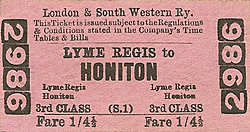
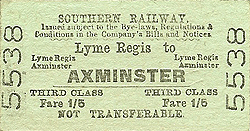
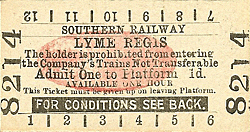
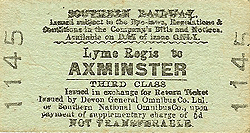
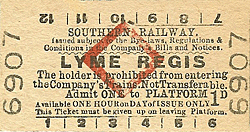
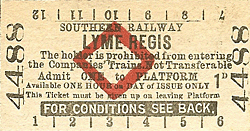
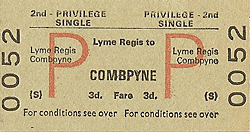
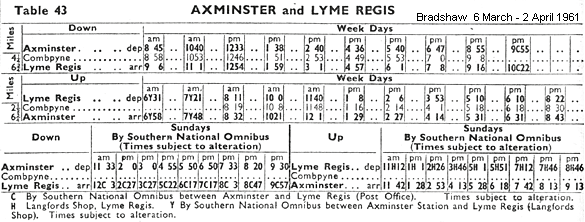
Tickets from Michael Stewart, except 5676 John Morris - this ticket is issued on the last day of public service and is signed by driver Tom Woodman, station mater Arthur Causley, signalman Ralph Warkins and J Gillam (unknown). Bradshaw from Nick Catford, Route map drawn by Alan Young
Source: Wikipedia - some text copied under creative commons licence
Other sources and further reading:
George Reeve & Chris Hawkins Branch Lines of the Southern Railway Volume
2 - Wild Swan 1983 ISBN
906867 14 2
Colin G Maggs The branch lines of Dorset (Amberley revised edition 2012 ISBN 978 1 84868 325 5)
See also Combpyne
Station
|

regis50.jpg)
regis49.jpg)
5.jpg)
regis60.jpg)
3.jpg)
4.jpg)
regis62.jpg)
6.jpg)
regis21.jpg)
7.jpg)
 Home
Page
Home
Page
regis75.jpg)