The Tower Subway’s chief claim to fame is that it is the world’s first tube railway, that is, an underground railway constructed in a tube rather than in a brick tunnel. That said, given the number of admirable websites already devoted to the Tower Subway (listed at the end of this survey), one might query the need to create another one. The answer is simple! Here you can read plenty of interesting material unavailable on the other sites, drawn almost entirely from primary sources rather than articles based on earlier articles. If you don’t have time to read all the text just enjoy the illustrations. And now read on…
PERIOD DESCRIPTIONS
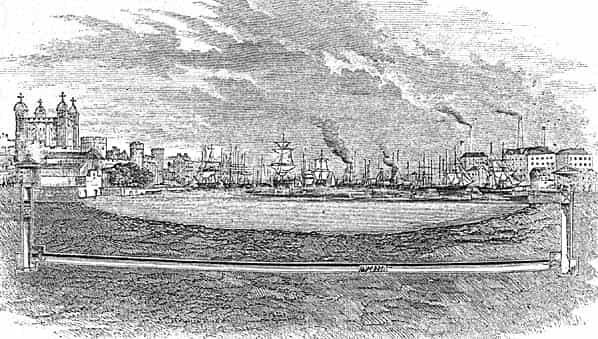
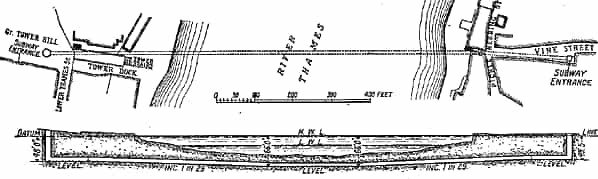
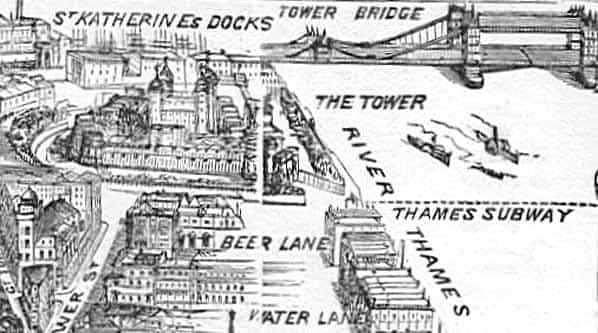
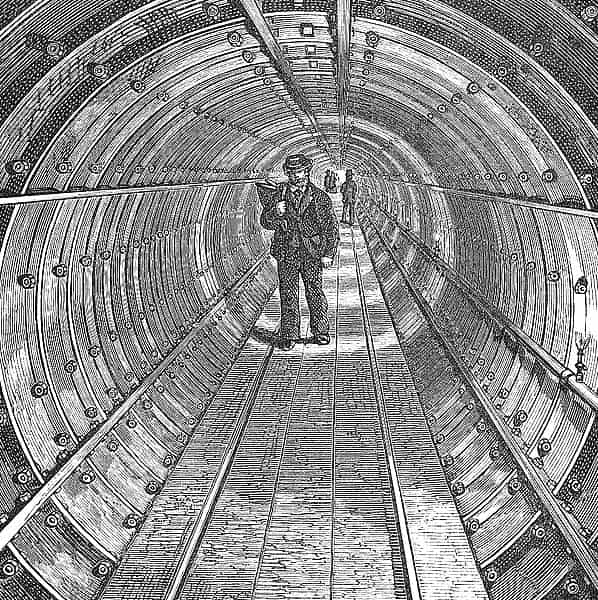
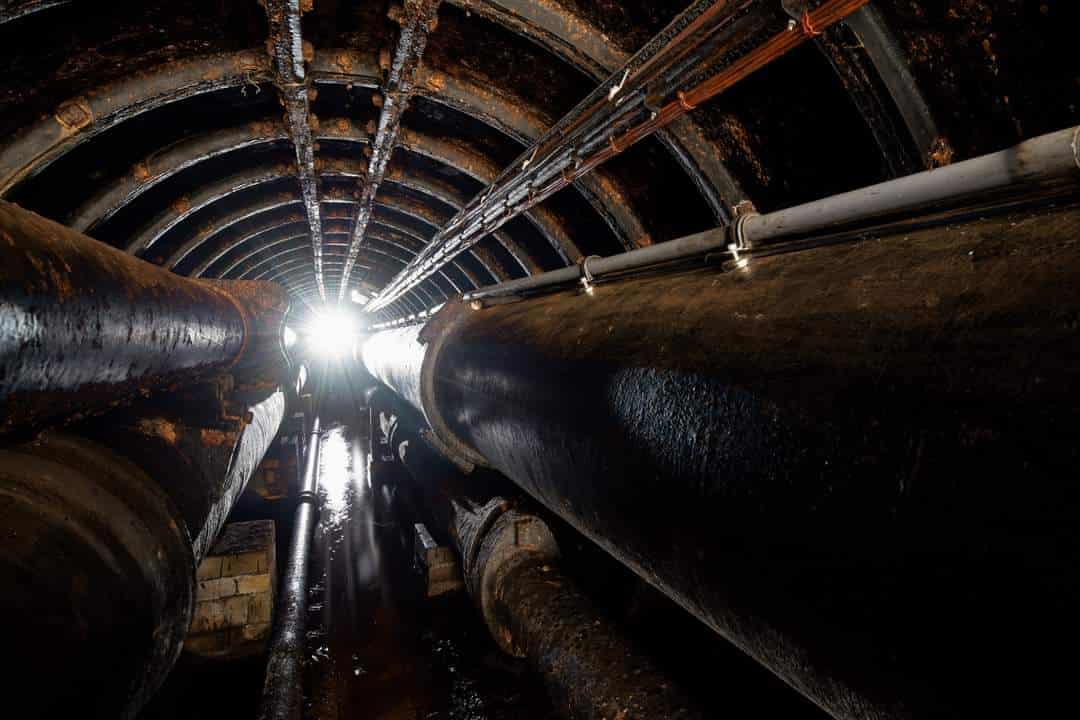
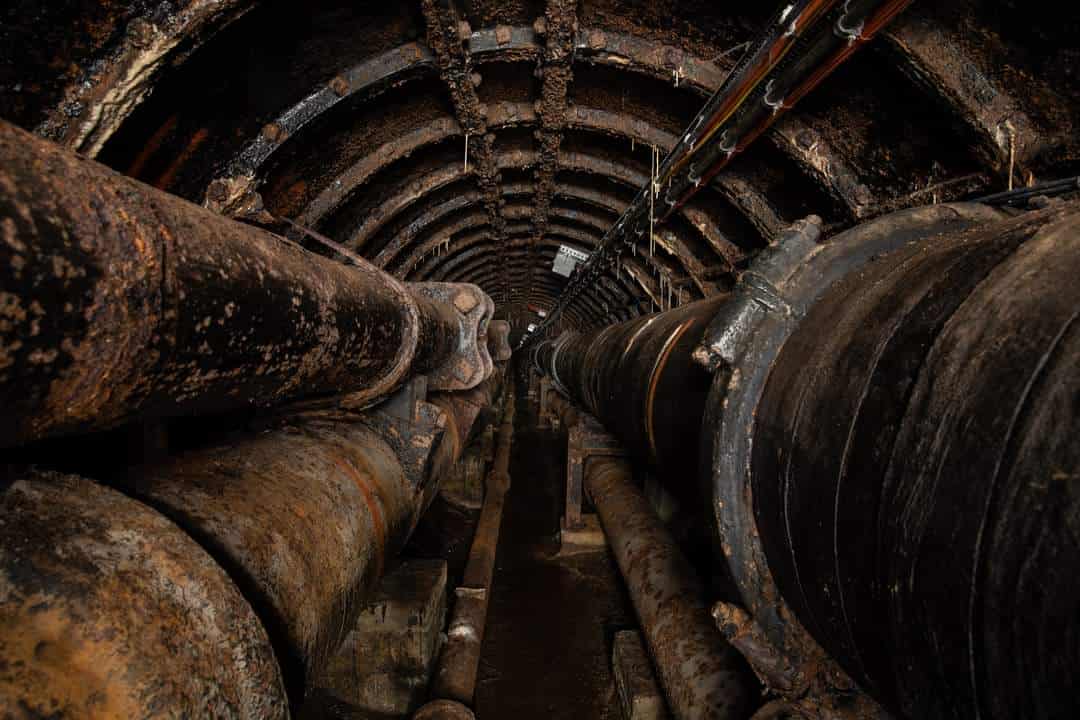
The Tower Subway consists of an iron tube, 7 feet in diameter and about 1235 feet in length, laid some 18 feet below the bed of the Thames. It runs between Great Tower Hill on the north side of the river, and Tooley Street on the south. It belongs to a Limited Liability Company, and was opened for tramway traffic on the 12th April, 1870. Being a losing speculation, the tram cars ceased to run on 7th December, 1870; but it was opened for foot-passengers (toll, one halfpenny) on the 24th of that month, and the Company have successfully continued it only as such. It is reached at each end by a spiral staircase of 96 steps. The Subway is well lighted up with gas, the average heat by the thermometer being 65 degrees Fahr. Those, however, who are afflicted with chest complaints should not attempt to make use of it, owing to the extreme closeness of the atmosphere and the limited space in the tube, which renders stooping necessary. It is open from 5.30 AM. till midnight. [Collins' Guide to London and Neighbourhood, no date.]
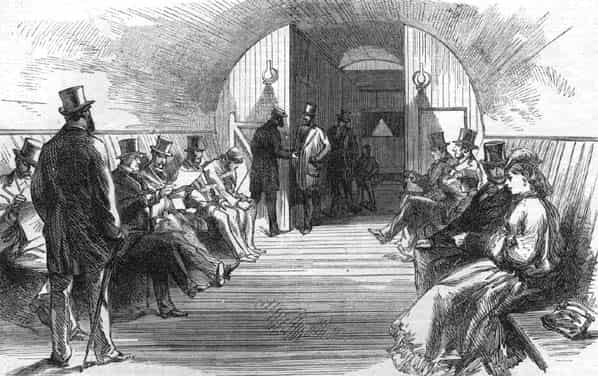
The tunnel commences at Tower Hill, where a hoarding encloses a small square of ground, not larger than an ordinary sitting-room, for which, however, the Government made the Company pay at the rate of about £240,000 an acre. In the centre of this is a little circular shaft, about fourteen feet diameter and sixty feet deep, and at the end of this, facing south, a clean, bright, vaulted chamber, which serves as a waiting-room. At the end of this chamber is the tunnel, a tube of iron not unlike the adit of a mine, which, in its darkness and silence, heightened. by the knowledge that. this grim-looking road runs down deeply below the bed of the river, gives it at first sight anything but an inviting appearance. The length of the whole tunnel is about 1,340 feet, or as nearly as possible about a quarter of a mile. From Tower Hill it runs in a south-west direction, and, passing under Barclay’s brewery, opens under a shaft similar to that at entering, but only fifty feet deep, and out of this the passengers emerge within a few yards of Tooley Street, close to the railway station. [Old and New London, by Walter Thornbury (1897)]
CONSTRUCTION
The works were begun on February 16th 1869, by ‘breaking’ ground for the shaft on the north side of the river; in February 1870, numerous visitors were conveyed from one shaft-head to the other. [Old and New London, by Walter Thornbury (1897)]
A tunnel, crossing beneath the river from Tower Hill to Tooley Street, near the London Bridge railway station, has been constructed in the present year [1869]. It is not a brick archway, but a circular iron tube, 7 ft. in diameter, laid deep in the clay of the river bed. The engineer is Mr. Barlow, Jnr., son of the Mr. Barlow who constructed the Lambeth Suspension Bridge.
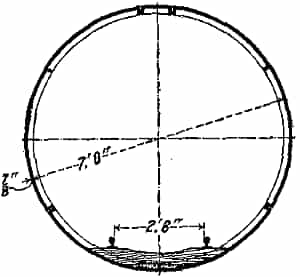
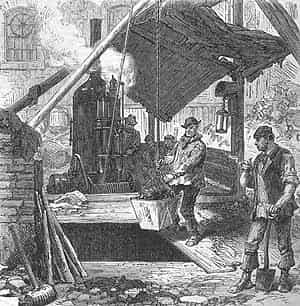
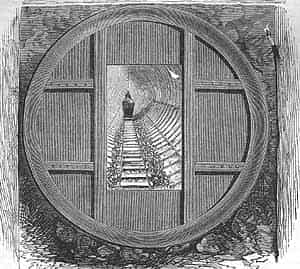
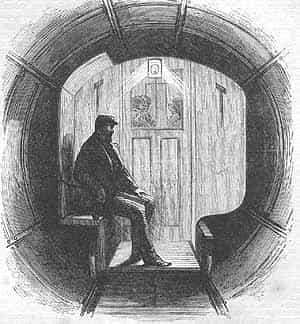
The contractor is Mr. Greathead; and the cost, it is said, will scarcely exceed £16,000. The works, of which we give several illustrations, may be approached from Tower Hill by going down a circular iron shaft, 10 ft. in diameter and 60 ft. deep. The upper part of the shaft is lined with powerful rings of cast iron, the lower part with ordinary brickwork, which will be coated with glazed tiles. There the visitor sees before him an iron tube 7 ft. in diameter, and lined closely along the inside with iron :flanges, or rims, nearly 2 in. deep. This tube has much the appearance of one of the large clean main-drainage sewers, except that it is built of iron and has a greater incline and curve. Candles, few and far between, twinkle in the distance and just make darkness visible. The whole length of the tube is 1320 ft.
A rather steep incline of 1 in 40, curving from north-east to south-west that is to say, from Tower Hill to near Tooley Street soon leads the visitor from the London clay beneath the land to the London clay beneath the water, and a difference of temperature between the two is at once perceptible. It is so dry throughout that every drop of water wanted for the works has had to be sent down in buckets. The tunnel, from the north to the south shores, makes a dip to pass under the water and its line of curve is rather deep. At its nearest point to the river water it has a thickness of not less than 22ft of London clay between the bed of the river and the top of the tube, while at its furthest point it has a thickness of 32 feet. Sounds from above are distinctly heard in the tunnel.
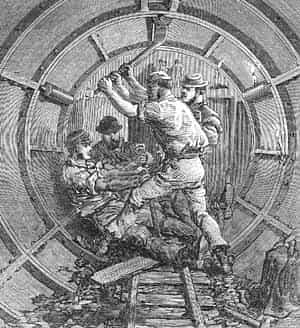
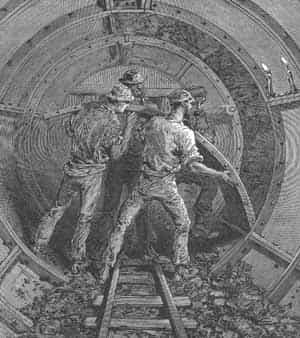
The shield which is advanced to cover the driving of the tunnel is a light circular piece of mixed cast and wrought iron, weighing 2 1/2 tons, and having an outer diameter of 7 ft. 3 in. The tube of the tunnel itself is built by means of three segments of a circle of cast iron, each of great strength and weighing 4 cwt., with a centre key-piece at the top weighing 1 cwt.
Each segment or ring when bolted together is only 18 in. long, but no fewer than six of these rings are bolted on in every twenty four hours, so the tunnel is advancing at the rate of 9 ft. a day. As the cap or shield is pushed on for a length of 18 in. it leaves within its tube or rim a space 1 in. greater all round than that occupied by its own tube on the outside. This, therefore, leaves ample room to fit in the segments of the tunnel-tube easily. It is done very rapidly. The bottom segment is laid in its place, and the two side segments above it, and between these at the top the key-piece is slid in. Between the long horizontal flanges a layer of white pine is placed before they are screwed close up, and it is to be regretted that some such indestructible material as gutta-percha was not chosen for this work.
The spaces between the circular flanges of each segment are regularly caulked in with tow and cement. Still, the shield or cap is 1 in. wider all round than the diameter of the tunnel-tube within it, which comes afterwards to occupy it, leaving an opening of that space between the clay and the iron. This interstice, when the segment-ring is fixed, is closed by pumping in blue lias cement, which, as it quickly sets, forms a ring of stonework, not only impervious to the water, for that, indeed, the tube itself is, but impervious to the action of water on the iron tube itself, which is a very important matter. It takes some time to explain all these details, but in practice they are an very quickly done.
Thus the men excavate the ground in front of the shield, move forward the shield and fill in another segment behind it every four hours and as the work is continued day and night in three relay gangs working eight hours each spell, it follows that the tube advances 9 ft. every twenty four hours.
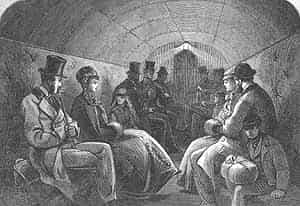
This circular tunnel is not intended for foot passenger traffic; it is meant for a tramway of 2ft. 6 in. gauge, on which is to run a light iron omnibus of 10 1/2 ft. long, 5 ft. 3 in. wide and 5 ft. 11 in. high. This will accommodate fourteen people with the most perfect ease. Ordinary lifts will take them down and up the shafts at each end, and at the end of the shaft the ‘bus’ will be waiting. For the first hundred feet or so the omnibus will be pulled by a rope fixed to a stationary engine; after that it will descend by its own velocity down the incline and up the incline on the other side to the foot of the shaft. The whole transit, including time for descent and ascent, is not to exceed three minutes. [Illustrated London News, 30th October 1869]
OPEN FOR TRAFFIC
Several illustrations were lately given of the works in progress for the construction of the subway or tunnel under the Thames, from Tower Hill to Tooley-street, Southwark, designed and carried through by Mr. W. H. Barlow, the engineer. It is now complete and ready for traffic.
The subway consists of a narrow tunnel uniting two vertical shafts, the mouth of one being on Tower Hill and the other in Vine Street, Tooley Street. The tunnel is lined with iron tubing, bolted together in short lengths by flanges projecting on the internal surface. This tube is 7 ft. in clear internal diameter, or 6 ft. 8 in. between the flanges, and carries a railway of 2 ft. 6 in. gauge. On the railway runs an omnibus conveying twelve passengers. The tube is about a quarter of a mile in length and sinks from both ends towards the centre with a gradient of about 1 in 30; the omnibus is of iron; light, but very strong, and runs upon eight wheels. It is connected with a rope of steel wire by means of a gripe that can be tightened or relaxed at will.
At each end of, the tunnel this wire runs over a drum, worked by a stationary engine. The declivity of the tunnel is such that, when once the omnibus is started, it requires only a small amount of traction, and the momentum acquired during its descent will carry it a. long way up the opposite slope. It is said that the strain on the rope will never exceed 2 cwt. The omnibus is provided with brakes, so that its motion is completely under the control of the man in charge. At each end of the tunnel it is received by buffers, or catches, which are connected with very strong springs of vulcanised indiarubber.
The shafts at each end of the tunnel are 60 ft. in depth, and are lined partly with brick-work and partly with iron tubing.
Within the shafts are lifts, carrying six passengers at once, and these lifts are raised and lowered by the same engines that work the drums. Each lift has a counerpoise equal to its own weight and to that of three average passengers, so that the weight of three paseengers represents the maximum of work that will be demanded from the engine, either for raising or loweing. At the top of each lift is a contrivance by which a breakage of the suspending chain would close iron claws upon the lateral guiding-rails and would bring the machine to a standstill in the course of a few feet. The ascent of these lifts is checked by springs of steel and indiarubber, which the engine employed would not be strong enough to break. The wheel over which the suspending chain runs is also dragged, so to speak, by revolving fans; and too great rapidity ascent or descent seems to be rendered impossible.
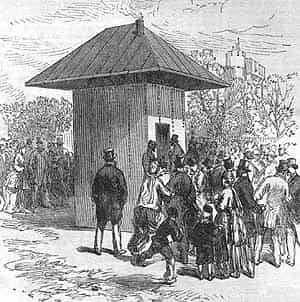
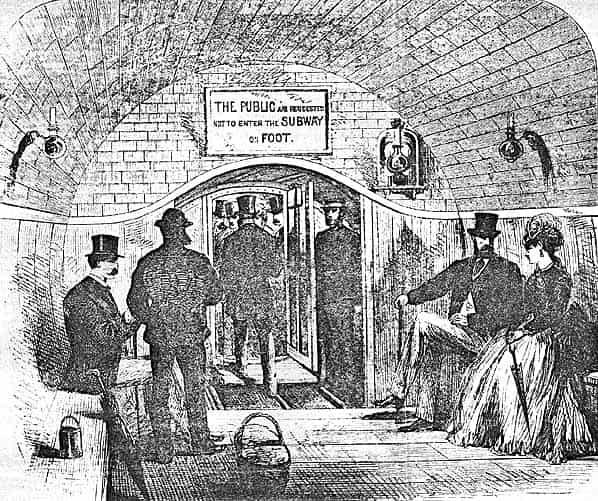
The arrangements visible from above are very simple. The upper opening of each shaft is covered by a small square building, at the door of which passengers take their tickets, then enter and descend in the lift.
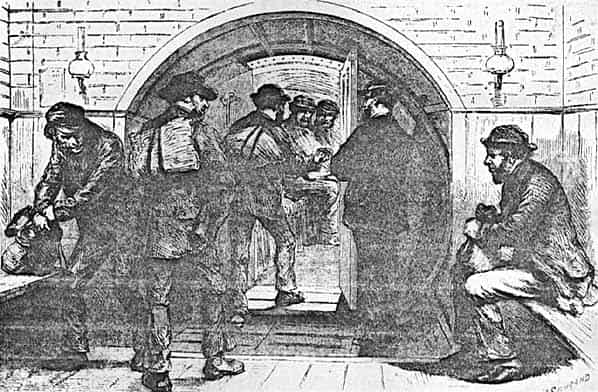
On reaching the bottom they find a space of a few feet between the shaft and the buffers fitted up with benches, as a waiting room. When the omnibus arrives and has discharged ‘its load’, those who are waiting step in and start off for the other end.
The descent of the shaft occupies 25 seconds and the omnibus journey 70 seconds; so that a [passenger may descend into the shaft at Tower Hill and emerge in Vine Street in a minute and three quarters from the time of his descent.Allowing for all ordinary causes of detention; such as missing the lift at the moment of its decent, or being just too late for the omnibus. The journey from point to point cannot occupy more than five minutes. The lifts, as they can only carry half as many passengers as the omnibus, will make twice as many journeys; and it is intended to give priority of ascent to first class passengers, who pay twopence, while the second-class passengers pay one penny.
AS A PEDESTRIAN SUBWAY
Although the press launch of the subway was held in April 1870, problems involving the difficulty of signalling between the engine drivers in the shafts and the conductor aboard the ‘omnibus’ took time to be resolved. Public service did not commence until August. In the event the whole affair was not a success as conceived and operated for barely three months before the lift and ‘omnibus’ service were abandoned after a number of mechanical failures and minor accidents. The company went into receivership in November 1870 and from then on passengers walked up and down wooden spiral stairs and made their own way through the tunnel. Gas lighting was provided, with stoneware tiles replacing the wooden planks in 1876. A new entrance on Tower Hill was opened in 1871.
Even this slimmed-down operation came to an end once Tower Bridge opened nearby in 1894. Given the opportunity to cross the river for nothing by bridge, people deserted the toll tunnel rapidly and either soon afterwards or two years later (accounts vary) the Tower subway closed to the public for good. In its heyday, however, the subway carried a million foot passengers a year, not bad going.
SUBSEQUENT HISTORY
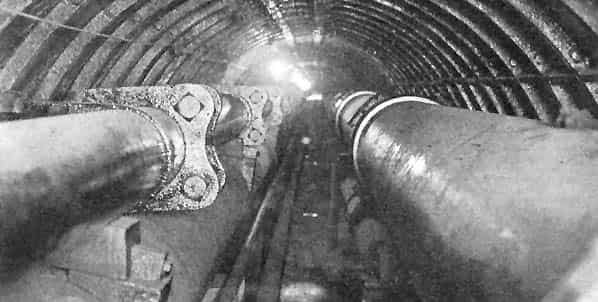
In 1897, after closure to the public, the subway was sold to the London Hydraulic Power Company (founded 1871), which used it to link its high-pressure mains on either side of the Thames. These mains delivered power to shops, factories, theatres and even car showrooms for powering lifts and other machinery. The hydraulic main through the Tower Subway was laid in 1903, from the Rotherhithe Pumping Station and was used as a feeder main for supply to the City. The Metropolitan Water Board leased space in the subway for two water mains as well (laid in 1898 and 1925).
Use of the LHP Company’s services declined after World War II as customers found electric power to be more flexible and the company eventually ceased operation in 1977. In 1981 a group of investors headed by Rothschild’s merchant bank bought the 150 miles of pipes, ducts and conduits and in 1985 this was sold the Mercury Communications Ltd, part of Cable & Wireless Ltd. In time some optical fibre cables were laid through the subway.
Electric lighting was installed and vertical iron ladders replaced the wooden spiral staircases in 1926. A near-miss by a German bomb in 1940 caused significant damage to the tube. Emergency repairs were made, enlarging the diameter of the repaired section to 10 ft.
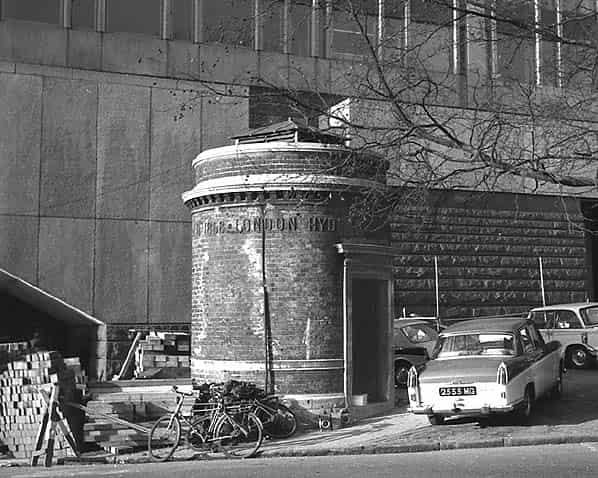
One of the two entrance kiosks, the one on Tower Hill, is still to be seen. It is not the original structure but a ‘handsome’ brick building erected by the LHP Co. in 1926 and inscribed with the date of the company’s founding, 1868.
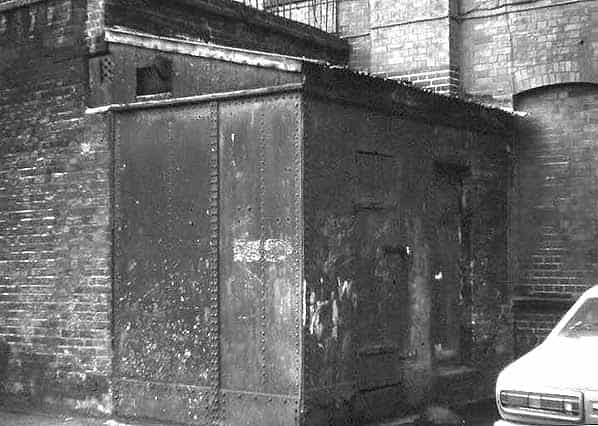
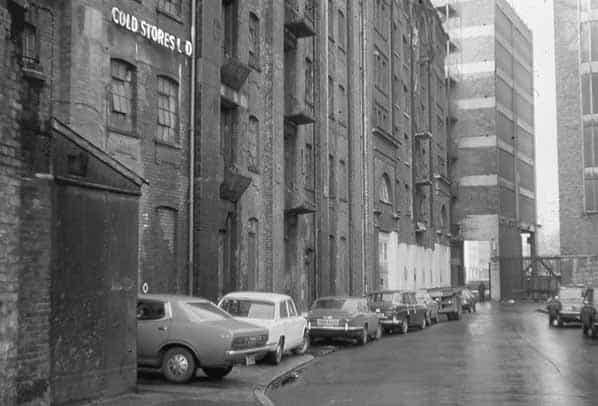
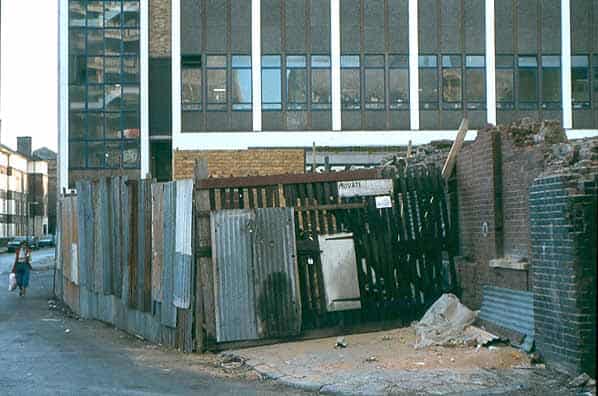
The southern entrance is said to have been demolished in the 1990s. Roger Morgan recalls: “The original cast iron kiosk in Vine Street survived long enough for me to photograph it for a lecture series I gave in 1978. Subsequently the empty warehouse that it abutted mysteriously burnt down and the wall collapsed onto the kiosk, destroying it. Difficult to remember the date, but it must have been about mid 1980s I should think. There is of course a modern replacement still standing in the middle of the building site to the south of Ken’s City Hall, and it appears from the published plans of the new ‘More London’ development that it will be incorporated inside one of the new office blocks.”
Sources:
- The First Tube Railway, by Charles E. Lee. Railway Magazine, Nov/Dec 1943, pp 331-336. Detailed text and photos (some reproduced here).
- The Tower Subway: The First Tube Tunnel in the World, by Charles E. Lee. Institution of Mechanical Engineers, 1970. Expanded and updated text.
- Omnibus for the Tower Subway. Engineering, 12th November 1869, p 319. Illustrations and technical description of the rolling stock of this railway.
- Technical descriptions of the work in Engineering, 21st January 1870 and 1st April 1870; The Engineer 18th February 1870, 15th April 1970, 29th April 1870 and 8th August 1870.
- Non-technical descriptions in the 9th April 1870 issues of Illustrated Times (p 226) and The Graphic (pp 452/453).