The Special Duties Organisation, branch of the Auxiliary Units, was formed after the sabotage side of the resistance had already been established. Its members were never told of the many patrols in existence all around the country. The Special Duties Organisation’s role involved radio communications and spying. The headquarters for the unit was located at Hannington Hall, Hannington, Wiltshire. The section’s personnel consisted of spies, cut-outs, out-station radio operators and the people who would operate the control and zero stations.
Unlike the sabotage-minded patrols both men and women could be chosen for the task of spying. The main people recruited for this role were people whose jobs allowed plenty of movement - doctors, midwives, postmen, vicars and farm workers. These people were trained separately in their own areas, being taught how to make simple intelligence reports. In the event of a German invasion they would have carried on their usual business or routine, making reports of any German troop movements, or anything else of interest they had observed. Once a report was completed the spy needed to pass the information on to a radio operator. This was achieved by use of a secret ‘letter box’. This could take many forms. For instance an old tin can, or hole in a tree or under a rock could be adopted. All that was required was a place where the report could be hidden and be accessible to the radio operator.
If the radio operator did not pick up the report himself, someone known as a ‘cut-out’ would pick it up and transfer it to a second secret letter box where it could be retrieved for transmission. The use of this system kept the identity of the spies and cut-outs from the radio-operators and vice-versa.
A radio operator along with his equipment was classified as an out-station. The radio’s whereabouts had to be kept totally secret. This was achieved by siting most of the radios in underground hideouts. The radio used by the Special Duties Organisation was purpose built to be basic in design and simple to use. The radio sets measured approximately 15 inches long, 6 inches high and 5 inches wide. They worked on the, then rarely used, frequency between 60 and 65 megacycles that was probably not even monitored by the Germans. A six volt car battery was used to power the radio set.
This needed a 40 feet long aerial to be able to transmit its messages. Had the Germans landed the radio operators would have carried on with their normal occupations, only visiting their out-stations to transmit short reports of information. These out-station operators would all be transmitting to their local control stations, of which Sussex had three. The purpose of a control station was to relay information gained from the various out-stations back to headquarters at Hannington Hall.
A control station was operated by three specially trained women of the ATS Auxiliary Unit, each station having two transmitters and two receivers. One set was for everyday use whilst the whole radio network was in training, the other to be used in the event of an invasion. The training set was often housed in a surface building. The other set would have been close by in an underground hideout known as a ‘zero station’, so-called because when the station’s code-name was used it was always followed by the code suffix ‘zero’. There were no transmitting schedules for the out-station operators to keep so the women would have to listen for messages coming in for long stretches of time. The purpose of a Zero Station was to receive coded information from the many out-stations in the surrounding area, passing on the details via a direct phone line to the Special Duties headquarters at Hannington Hall. Sussex had three underground Zero Stations, one in a wood in Heathfield, East Sussex, and two in West Sussex: the better-known of these was in the grounds of Wakehurst Place, near Ardingly, and the other near Shipley, about ten miles west of Haywards Heath, close to the A272 road.
All three were built to the same plan, the only variant being the length of the emergency exit tunnel. The women operatives of these Zero Stations were members of the ATS with Beatrice Temple as their Senior Commander. Miss Temple would often visit the underground sites around the country to check that the women were all right and generally monitor how the system was working. The Royal Corps of Signals were in charge of checking and maintaining the radio equipment.
Many years after the war, Beatrice Temple, a former Mayoress of Lewes, returned to the Heathfield wood that she had visited many times during the site’s operational years, to try to locate the switch that opened the entrance hatch. This switch was concealed behind a hinged piece of bark on a tree. When operated, the switch released the entrance hatch some 30ft away. However, despite a long search, no trace of the switch or indeed the underground Zero Station could be found.
With the Heathfield site gone and the one in the grounds of Wakehurst Place sealed up, the Zero Station at Shipley was the only accessible and complete site for investigation. The hideout is located on the east side of a bend in a public footpath 250 yards south from the A272 at its junction with Dragons Lane. The wood widens at the bend in the footpath, the hideout is located in this wider section of woodland.
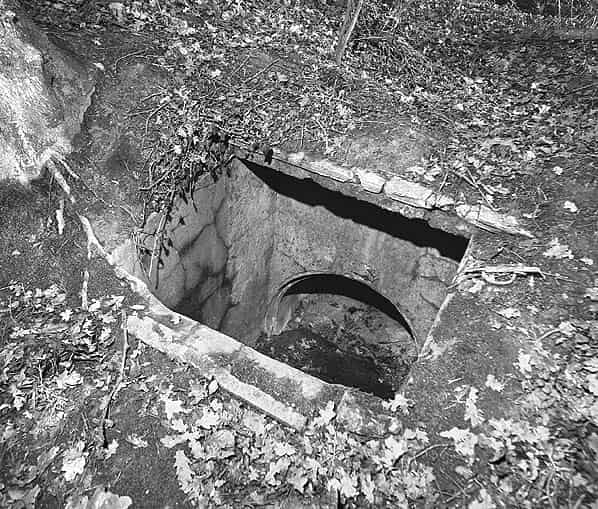
Built on a solid concrete base with corrugated iron arched across to form its roof, the hideout resembles, like many of the sabotage patrol hideouts, an underground Nissan hut. Entrance was gained by lifting a concealed earth-covered wooden trapdoor. At Shipley this had a counterbalance weight to assist opening. With the trapdoor open, a wooden ladder led down the entrance shaft, which opened out into a small room containing explosives and ammunition. This room was made to appear as if it were the only one, giving no indication of the main chamber, behind one of its walls, containing all the radio equipment. A system of shelves and carefully-stacked boxes hid the 5ft high door leading to this main chamber.
When a secret catch was lifted, a section of the shelving moved out of the way, allowing the door to be opened. Along with the radio equipment, the main chamber contained a small table with chairs, bunk beds, spare batteries with a generator to recharge them and a good supply of food. The batteries were used for powering the radio equipment and a simple lighting arrangement.
The other end of the main chamber led into another small room which contained a chemical toilet, a drain in the floor, storage space and the entrance to the emergency exit tunnel. The three feet wide emergency exit tunnel was 16 feet long and terminated by opening out into a square concrete structure that had an earth covered wooden hatch above it concealing its existence. Fresh air was supplied into the hideout by two one foot diameter asbestos pipes. One was positioned just off the floor and the other just below the roof. They ran along from the main chamber through the small end room until coming to the surface disguised as the holes of a badger sett. In fact when the site was visited in 1994 a badger had adopted part of the hideout as its home.
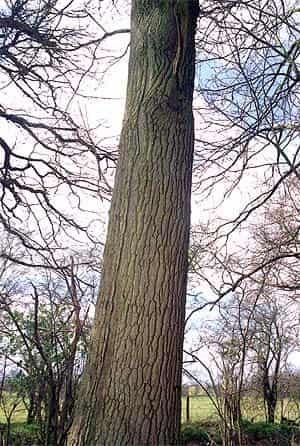
The 40 foot long wire aerial ran up an adjacent oak tree trunk. A groove was cut out of the tree bark and the aerial wire hidden in the groove. The bark would then have been put back into the groove and fixed in position. The groove is still clearly visible in the oak tree today.
The main chamber of the Shipley Zero station collapsed some time between November 1997 and March 1999. No other Zero Station’s in Sussex are currently accessible but a similar zero station hideout can be visited at Hollingbourne in Kent. (TQ864556)
For a detailed history of the Auxiliary Units in Sussex see Stewart Angell’s book The Secret Sussex Resistance. Published by Middleton Press ISBN 1 873793 820