Following the development of radar at Orfordness and at the Bawdsey Research Station in Suffolk during the mid 1930’s, the Air Ministry established a programme of building radar stations around the British coast to provide warning of air attack on Great Britain. A survey was undertaken in 1938 to assess the suitability of the local terrain for Air Defence Radar operations with the first of these new stations coming on line by the end of the year. This network formed the basis of a chain of radar stations called CHAIN HOME (CH).
These stations consisted of two main types; East Coast stations and West Coast stations. The East Coast stations were similar in design to the experimental station set up at Bawdsey in 1936. In their final form these stations were designed to have equipment housed in protected buildings with transmitter aerials suspended from 350' steel towers and receiver aerials mounted on 240' timber towers.
The West Coast stations differed in layout and relied on dispersal instead of protected buildings for defence. Thus the West Coast stations had two transmitter and receiver blocks with duplicate equipment in each. Transmitter aerials were mounted on 325' guyed steel masts with the receiver aerial mounted on 240' timber towers.
The majority of Chain Home stations were also provided with reserve equipment, either buried or remote. Buried reserves consisted of underground transmitter and receiver blocks, each with three entrance hatches (two for plant and one for personnel) set on steel rollers. Nearby were the emergency exit hatch, ventilation shafts and 120' wooden tower carrying the aerials. On some stations the transmitter and receiver buried reserves were together on an adjoining site (often the next field).At others the two buried reserves were separate but located close to their respective above ground building. Many of the West Coast stations had remote reserves some distance from the main station but utilising similar above ground transmitter and receiver blocks. The station at Netherbutton was a standard east coast style chain home radar station with buried reserves.
In January 1939 a radar station was proposed for Orkney as part of the defences for Scapa Flow which was the main anchorage for the British Fleet, this was to be an extension of the Chain Home network. The site chose was Netherbutton, an area of high ground four miles east of Kirkwall. This was not considered to be an ideal location but was the best site available on Orkney’s generally flat terrain.
13 Acres of land were acquired and the first construction on the site was accommodation for the workforce within the compound. A power house was built at Deepdale Farm to the north west of the site. As Netherbutton would not be connected to the mains supply this would provide the main power supply for the station. There were two 60kw generators driven by 175HP Blackstone diesel engines. In case the main power station was knocked out during an enemy attack as standby power station or ‘set house’ was also provided within the main compound.
Because of urgency of this new facility a decision was taken to equip the station from other redundant sites rather than wait for new transmitter and receiver sets to be manufactured. 90 foot guyed wooden towers for the transmitter and receiver aerials came from the radar station at Drone Hill in Berwickshire and the aerials, transmitter and receiver came from the redundant station at Ravenscar near Whitby in Yorkshire. Work started on the installation on 13th May 1939 and a test flight on 1st June 1939 showed that the station was functioning correctly with a Blenheim aircraft flying at 8000' being detected at a range of 60 miles. This temporary Advanced Chain Home (ACH) station was handed over to the RAF the following day.
Because of its poor location, RAF Netherbutton did not prove as reliable as had been hoped and Bill Hewison describes the station as ‘essentially useless’ in his book ‘This Great Harbour Scapa Flow’. The Air Ministry refuted these suggestions although the Admiralty claimed that long range data from the light cruiser HMS Curlew was “worth half a dozen Netherbuttons!”
In October 1939 there was a proposal to improve coverage by replacing the 90 foot towers with 240 foot wooden towers and converting the station to all-round coverage.
This work was completed on 29th October promoting the station from Advanced (ACH) to Intermediate Chain Home (ICH), a temporary stage before upgrading the station to a permanent Final East Coast Chain Home. At this time the transmitters and receivers were housed in sandbagged wooden huts but these were eventually replaced with protected brick transmitter and receiver blocks surrounded by blast walls and an earth traverse.
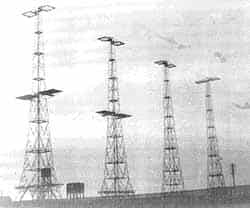
Four new 350' steel transmitter towers had been erected by February 1940 in an attempt to improve the performance of the station and final calibration work on the new all-round array was completed in July 1941. With all these modifications the stations performance was found to be greatly improved.
Initially, Netherbutton was linked to the operations room at Wick but from October 1940 the station relayed information on approaching enemy aircraft to the combined gunnery and sector operations room at Kirkwall from where the anti-aircraft guns located around Scapa Flow were controlled.
At the end of the war RAF Netherbutton was placed on care and maintenance but was later selected as one of 15 stations promoted to a ‘readiness chain home’.
The station was requipped with a Type 1 radar and two channels, as part of the first phase of the rotor programme. (Code BNT) In 1954 it was still listed as ‘readiness’ but with the introduction of Type 80 radar in 1955 RAF Netherbutton was redundant.
Television reception first came to the Orkneys in October 1955 when a new transmitter opened at Meldrum in Aberdeenshire. The Orkneys were never intended to be in the service area for this new transmitter and reception on the island was very unreliable, varying in quality according to weather conditions.
A year later there were only 36 television licences issued to Orkney residents and those that did have sets complained of interference from a station in Russia. In order to improve reception on the island the redundant radar station at Netherbutton was selected as a suitable site for a relay station early in 1957 and with the final closure of the radar station in 1958 the site became available.
Much of the land was sold back to the original landowners but the transmitter block and the four transmitter towers were sold to the BBC for use as a relay station for the Orkney Islands.
Only two of the steel masts were required, one of these was extended to 411 feet. Radio and television transmitters were installed in the transmitter block providing the Orkney Islands with 405 line TV reception and better radio reception. The two redundant masts were demolished at this time.
The new relay came on line with limited power in December 1958 and there was a pre-Christmas rush to buy sets. By December 1959 the station was on full power and there were nearly 2000 licenced television sets on the Islands, about one in every four households.
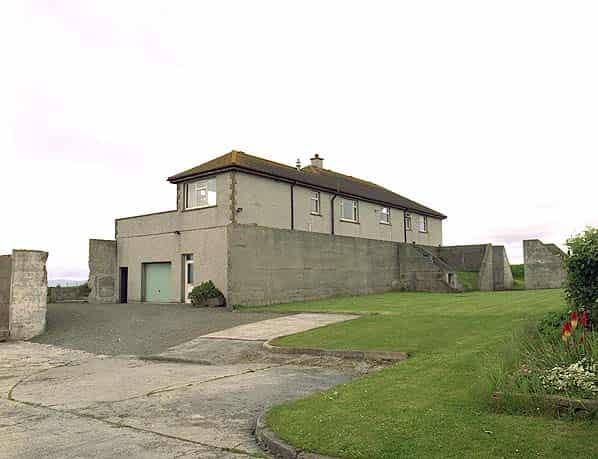
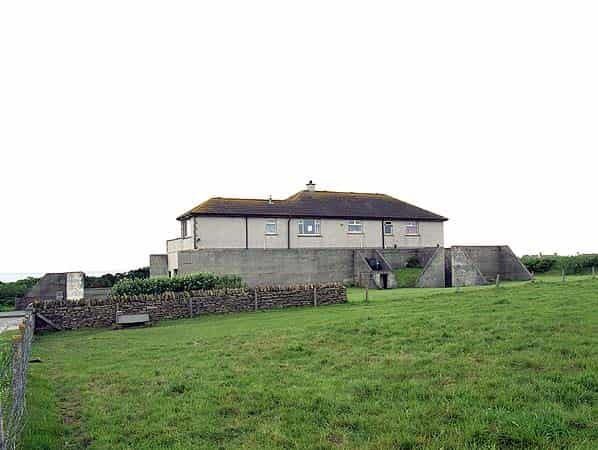
In 1986 the relay station became redundant when the BBC moved to a new location at Keelyang. The masts were sold for scrap and the land was auctioned. The transmitter block was later turned into a dwelling house.
The two remaining masts were dismantles by J.L. Eve Construction, the same firm that had erected them 47 years earlier.
RAF Netherbutton today
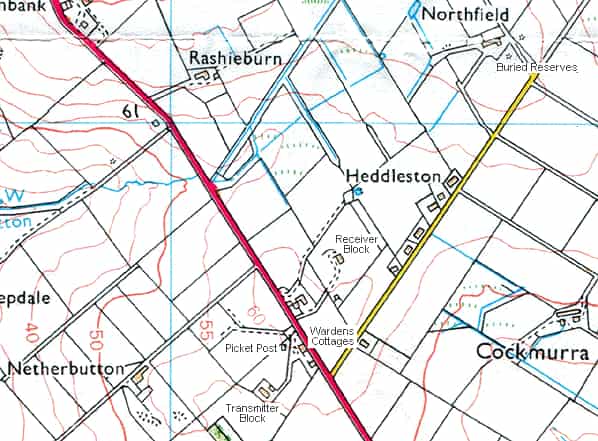
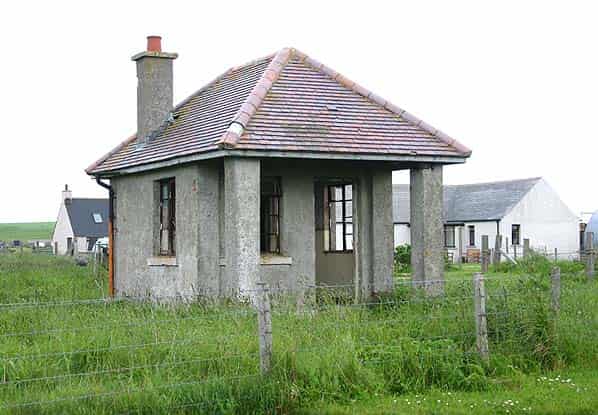
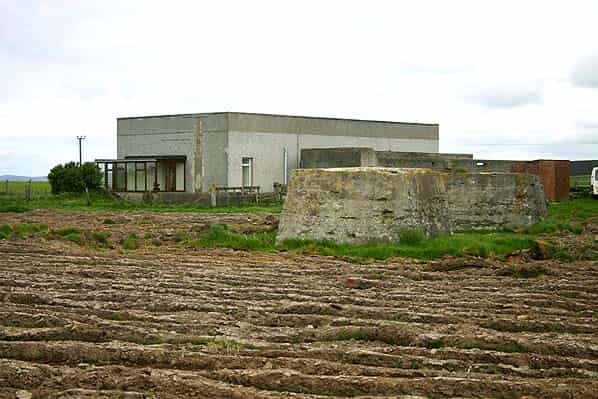
The technical site at Netherbutton is bisected by the A961. The transmitter block still stands on the west side of the road at the end of a short access drive. There is a derelict picket post at the end of the drive.
The transmitter block has been greatly altered, first for its use as a BBC transmitting station and then by its conversion to a dwelling. The earth traverse has been removed but three side of the blast wall surrounding the original brick building are still standing. It is difficult to say how much of the current building is original; it would appear that the shell of the building has now been incorporated into the new two storey dwelling.
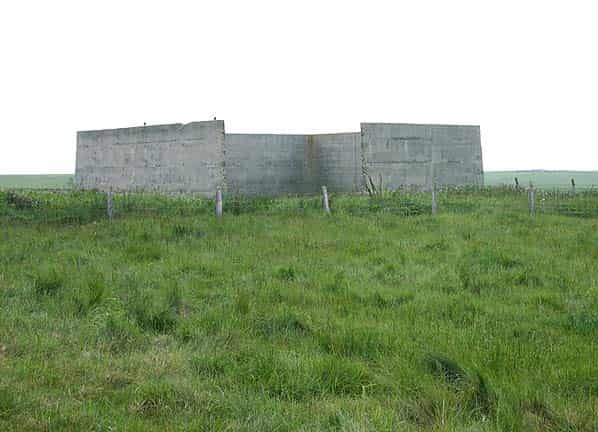
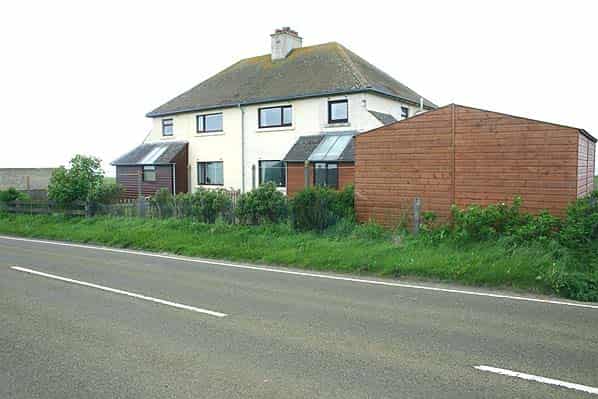
The two warden’s cottages still stand on the A961 and are now in private occupation. In the field behind the cottages there is a blast wall running around three sides of a square it is assumed a building once stood in the centre.
The receiver block stands on the opposite side of the road at the end of a drive; it too has recently been converted into a dwelling. It would appear that the blast wall itself now forms the building and the internal brick structure has probably been demolished. The bases of the wooden receiver tower can be seen in an adjacent field. The stand-by set house could not be found so it is assumed this has been demolished.
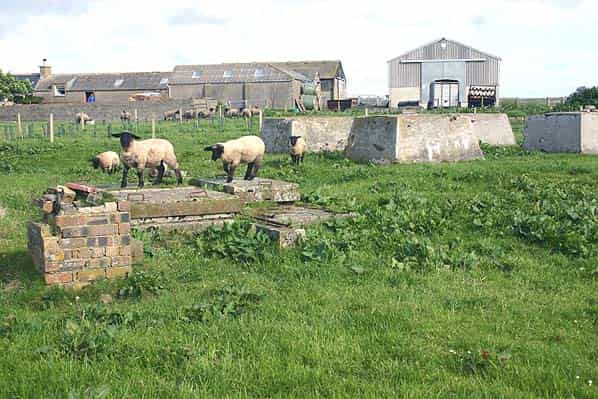
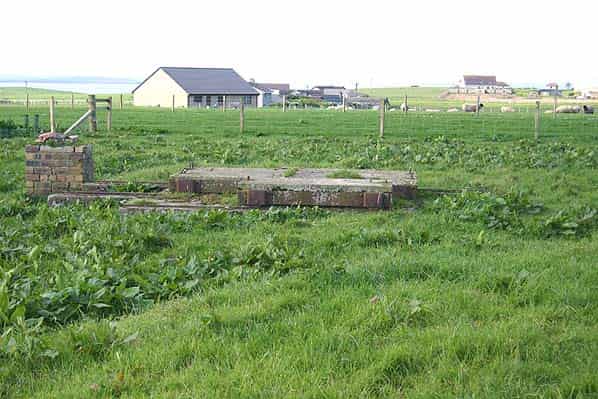
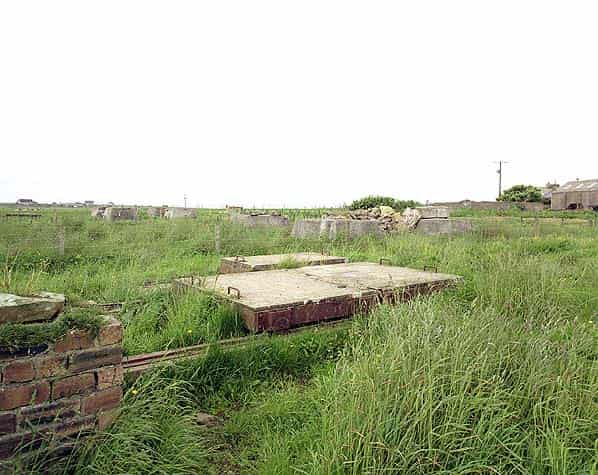
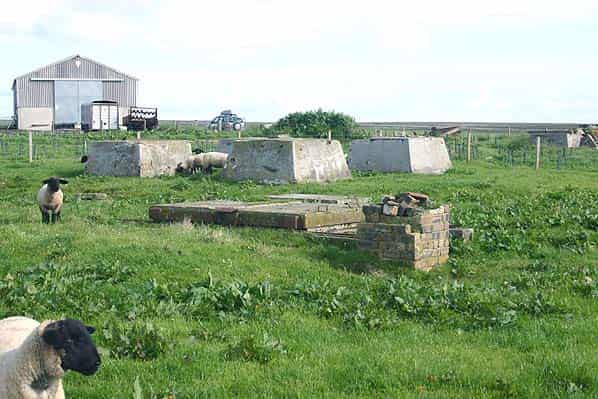
The buried reserve is located on the south side of Northfield Farm house, 400 yards north east of the receiver block. Both bunkers can still be seen together with their adjacent mast bases but only the stubs of the ventilation shafts are still extant.
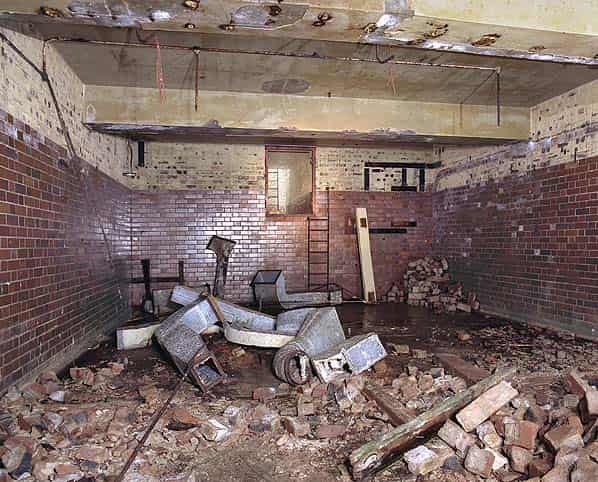
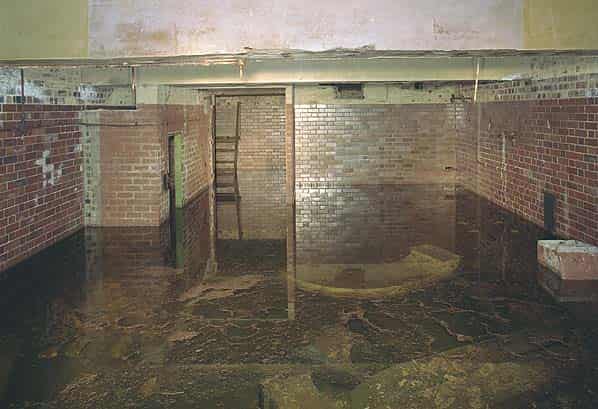
The transmitter reserve is flooded; the level of the water varies between 2' and 8' depending on weather conditions and the time of year. The internal walls are faced with red glazed bricks. Some ventilation trunking can be seen lying on the floor beneath the water level. The main transmitter room has been completely stripped; even the doors into the lobby and toilet have been removed.
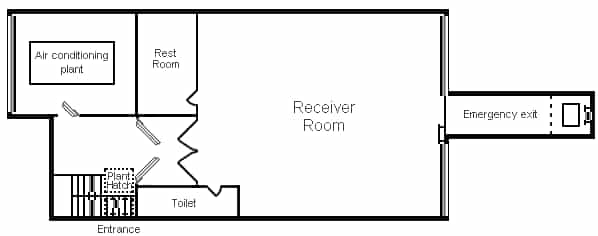
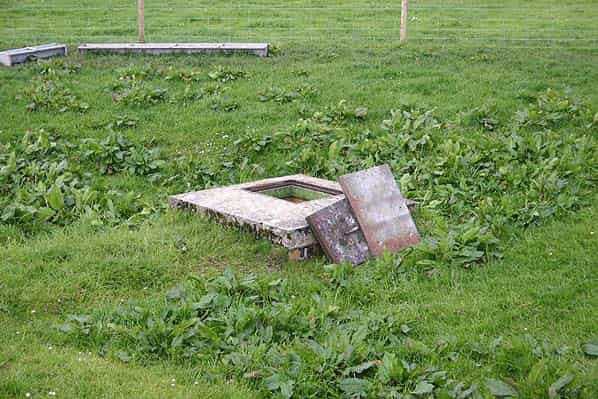
The receiver block is dry but strewn with rubble, much of it glazed bricks from the demolished internal partition walls. Both the toilet wall and the crew room walls have been demolished. The ventilation plant room has been stripped leaving only the concrete plinths where the plant was mounted. Both reserves still retain their three flat reinforced concrete covers on steel rollers and running rails.
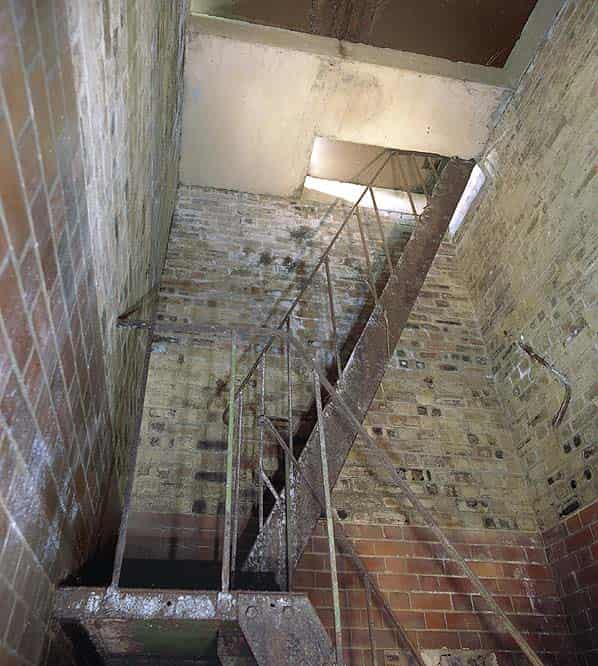
The two larger covers were for plant access and the smaller cover gives access to a steel staircase down 17' 5" into the bunker. All the hatches are closed but can be opened using farm machinery. The receiver reserve was entered by this method for this report.
Both reserves still retain their emergency escape shafts with their double interlocking waterproof hatches still in good condition. There is an eight foot vertical shaft giving access to a low passage that runs for 13 feet to a blast door (now removed) half way up the wall at the back of the operations room. A second offset ladder is fixed to the wall.
Sources:
- Bob Jenner
- The Orkney Wireless Museum
- The Orcadian
- PRO Files Air 25/681 & AVIA7/308