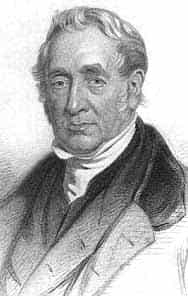
With the success of the Stockton & Darlington Railway, George Stephenson was once again employed to build a new line linking Manchester, the centre of the northern textile industry with the port of Liverpool. The proposed route posed a serious threat to the Bridgewater Canal which had a monopoly on the transportation of goods between Liverpool and Manchester.
Parliamentary wrangling lasted several years but eventually an act was obtained and George Stephenson started work on the Manchester and Liverpool Railway in 1826.
The proposed route proved a serious challenge with a number of difficult engineering problems along the 31 mile long line, including crossing the unstable peat bog of Chat Moss, a two-mile long, 80' deep rock cutting at Olive Mount and a viaduct across the Sankey Valley.
The Liverpool terminus was to be at Crown Street while in Manchester the terminus would be in Water Street.
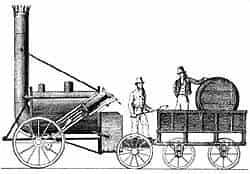
Another major consideration was whether to use stationary engines and cable haulage or locomotives which were still in their infancy. In order to reach a decision, a competition was arranged to try and find a locomotive that was sufficiently powerful to work on the line. A £500 prize was offered for the winning locomotive with the competition being held at Rainhill, on the completed line, in October 1829. Each competing locomotive had to pull a load three times its own weight up and down the track at Rainhill 20 times at a speed of at least 10 mph. In distance this approximated a return trip between Manchester and Liverpool. Initially ten locomotives entered for the Rainhill Trials but on the day only five arrived and two of them were unable to compete due to of mechanical problems. Of the remaining three ‘Sans Pareil’ and ‘Novelty’ achieved a good result but the clear winner was the ‘Rocket’ built by George Stephenson and his son Robert.
Following the successful outcome of the competition, locomotive haulage over the majority of the line was confirmed although the last section to the two Liverpool termini was cable hauled.
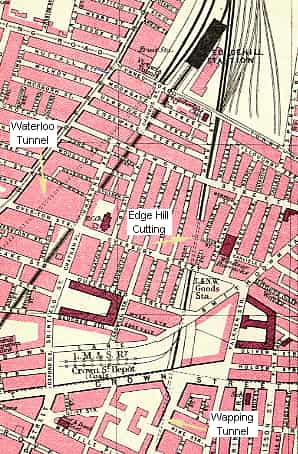
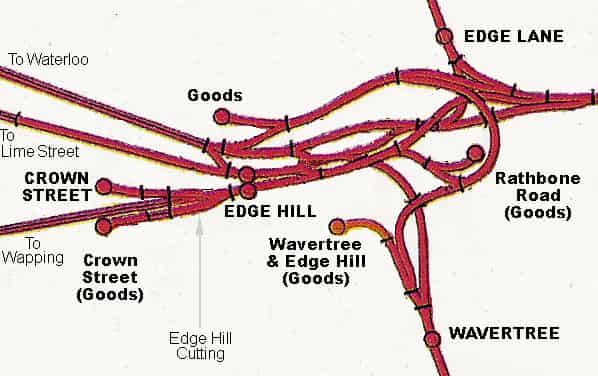
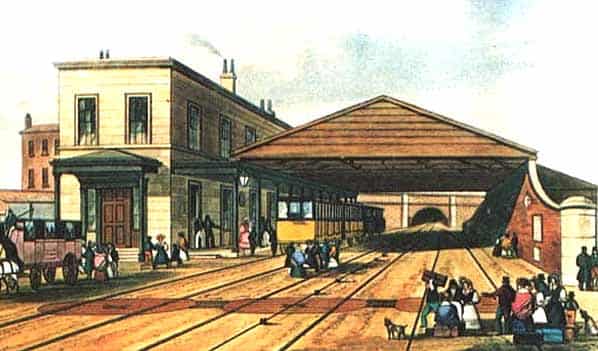
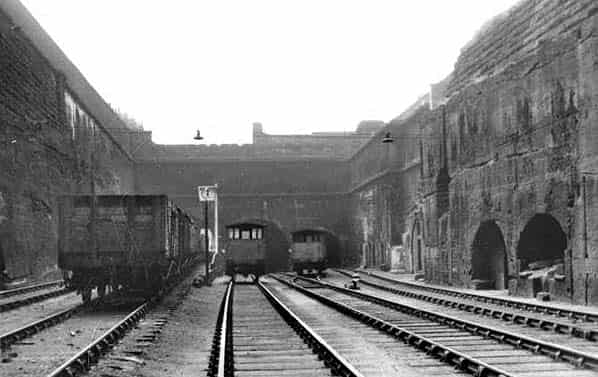
The locomotives would run as far as Edge Hill cutting where they would be detached with loaded coaches being cable hauled through a short tunnel by winding engines at the passenger terminus at Crown Street; returning coaches ran down to Edge Hill by gravity. Goods traffic was handled at the Wapping Goods station close to Liverpool Docks. This was reached by an impressive 2030 metre tunnel from Edge Hill cutting; wagons were cable hauled up from Wapping and descended by gravity.
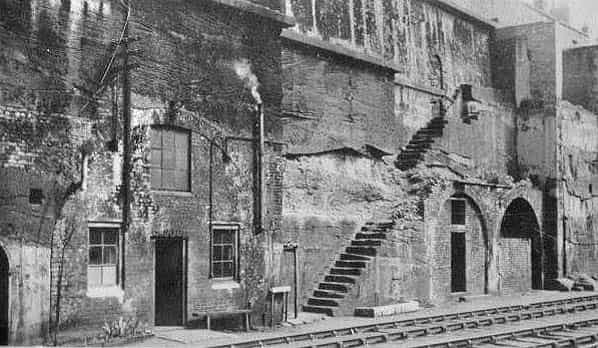
Horses were used for shunting at Edge Hill and their stables were cut into the sandstone walls of the cutting.
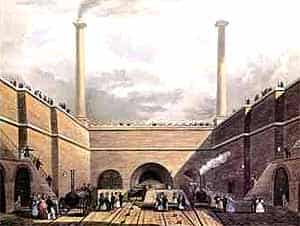
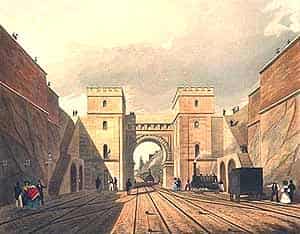
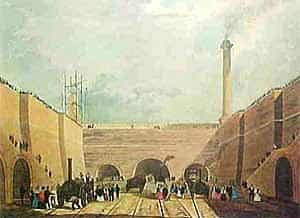
As well as the engineering achievements, Stephenson was asked by the directors to build something ornate on the line and he chose a Moorish Arch which was built over the line in the Edge Hill cutting. Stephenson skillfully used this arch to hide the two stationary engines which powered the incline into Wapping.
The Liverpool & Manchester railway opened on 15th September 1830 in the presence of the prime minister, the Duke of Wellington, and a large number of other dignitaries. The ceremony featured a procession of eight locomotives running between Liverpool and Manchester which included the ‘Northumbrian’, the ‘Rocket’, the ‘North Star ' and the ‘Phoenix’.
As well as the engineering achievements, Stephenson was asked by the directors to build something ornate on the line and he chose a Moorish Arch which was built over the line in the Edge Hill cutting. Stephenson skillfully used this arch to hide the two stationary engines which powered the incline into Wapping.
The Liverpool & Manchester railway opened on 15th September 1830 in the presence of the prime minister, the Duke of Wellington, and a large number of other dignitaries. The ceremony featured a procession of eight locomotives running between Liverpool and Manchester which included the ‘Northumbrian’, the ‘Rocket’, the ‘North Star ' and the ‘Phoenix’.
Despite the tragedy on the opening day The Liverpool & Manchester Railway quickly proved a great success carrying 445,047 passengers in 1831 with profits of £71,098; four years later profits had nearly doubled.
The Crown Street passenger terminus soon proved inadequate due to its size and distance from the city centre and it was closed on 15th August 1836 on the opening of a new terminus at Lime Street, much closer to the city centre.
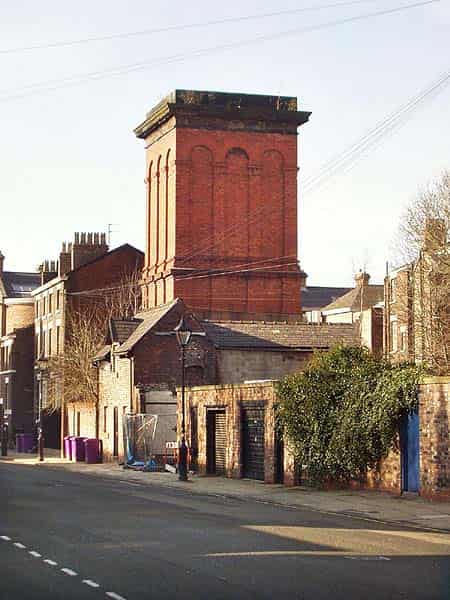
This was reached by a new double track 1006 metre tunnel; although the new line was less steep than Wapping it was still cable hauled. A new engine house was built at Edge Hill, in what is now the station building. Steam for this engine was supplied from a boiler in the old Edge Hill cutting through a long tunnel excavated through the sandstone on the north side of the cutting; this was known as the ‘steam tunnel’; the boiler was housed in a chamber cut into the cutting wall. Goods and coal traffic continued to be handled at the old Crown Street station and a second wider tunnel into Crown Street was driven in about 1846. In the 1860’s in order to facilitate a new track alignment the Edge Hill cutting was widened forcing the demolition of the Moorish Arch.
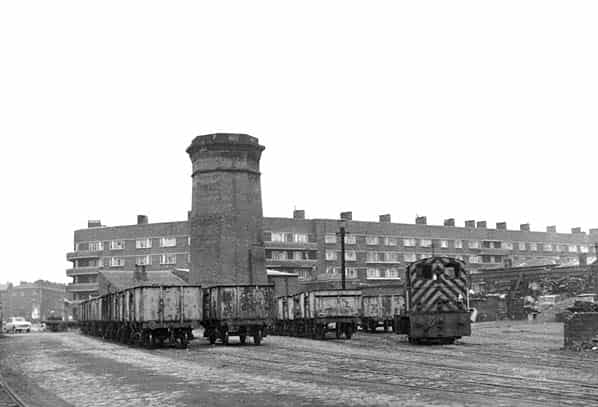
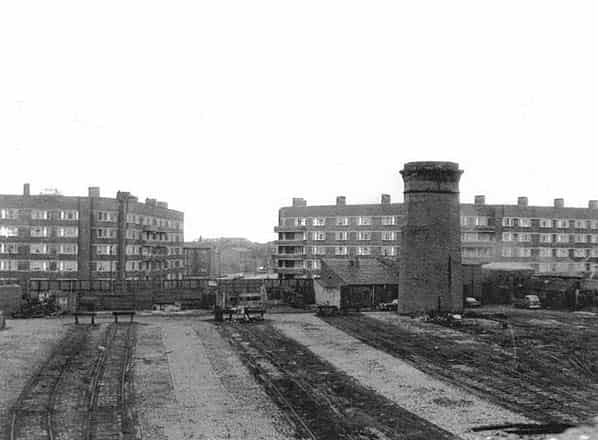
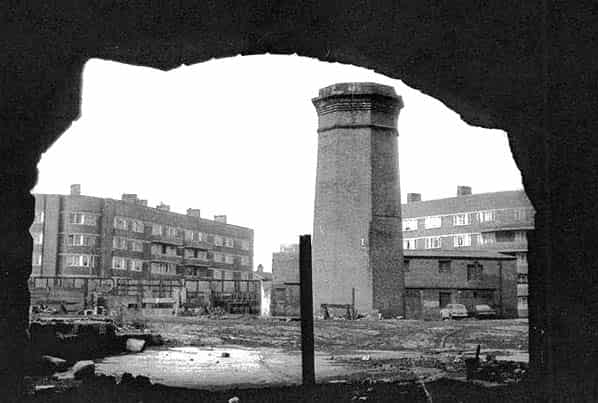
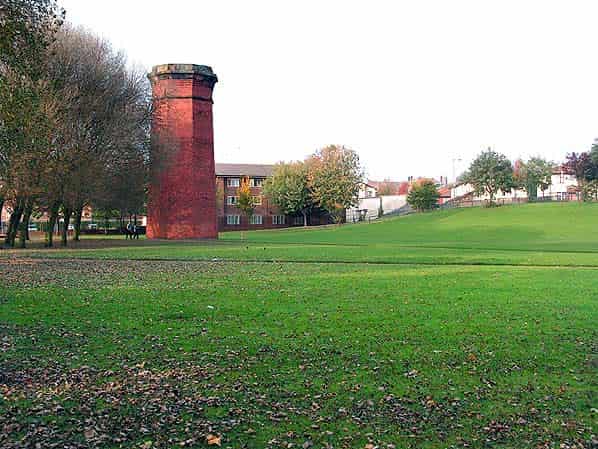
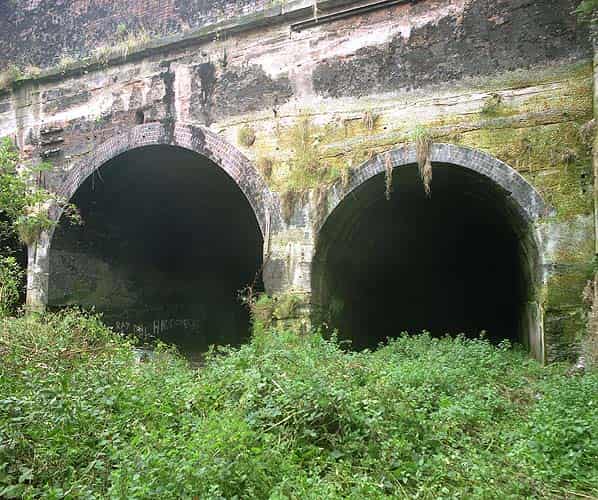
From 1870, the line into Lime Street was locomotive hauled and a huge chimney with a powered fan was built on Smithdown Lane, near Edge Hill. This was only used for a few years although the chimney lasted until just before WW2. Smoke in the tunnel was always a problem so after a couple of accidents and the need for increased traffic, the two track tunnel was opened up into a deep four track cutting with seven short lengths of tunnel remaining to support various roads and houses. At Edge Hill a further tunnel opened in 1849, north of the Lime Street tunnel. This was another ambitious undertaking comprising two end on tunnels collectively known as Waterloo.
The Waterloo Tunnel at 862 metres is, in reality, the shorter of the two tunnels. Immediately to the west of it is the longer Victoria Tunnel at 2475 metres. The tunnels ran north west to Waterloo Goods Station and the harbour railway system and were, again, cable hauled from Edge Hill.
Cable haulage continued through the Waterloo Tunnel until 1895 when it went over to locomotive haulage and the line was extended to a new passenger station, Riverside, near the pier head, The Wapping Tunnel went over to locomotive haulage the following year. Waterloo Goods Station remained in use until 1963 while Crown Street goods terminal lasted a further five years, closing in 1968; the site was landscaped in 1980.
INDUSTRIAL ARCHAEOLOGY
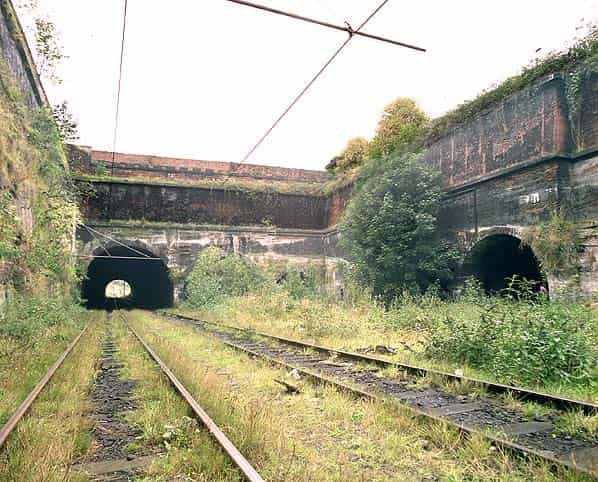
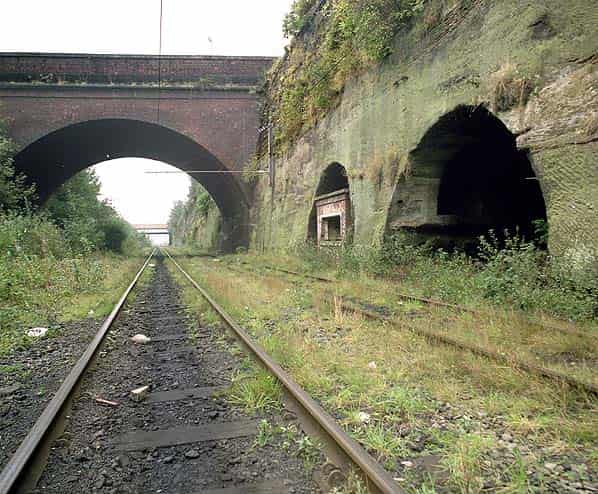
The Edge Hill cutting is rectangular in shape, bounded on three sides by the vertical walls of the cutting, and at the east by the Chatsworth Street overbridge. North of Chatsworth Street the tracks continue, still in a cutting, to join the main line north of Edge Hill Station.
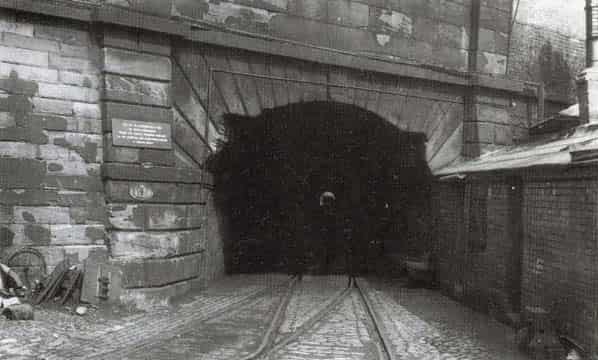
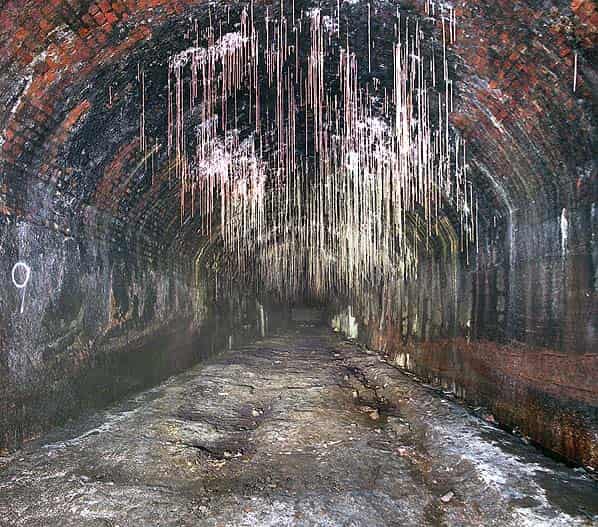
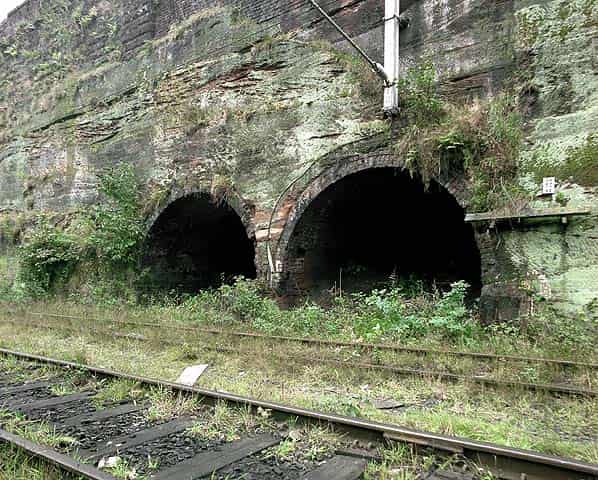
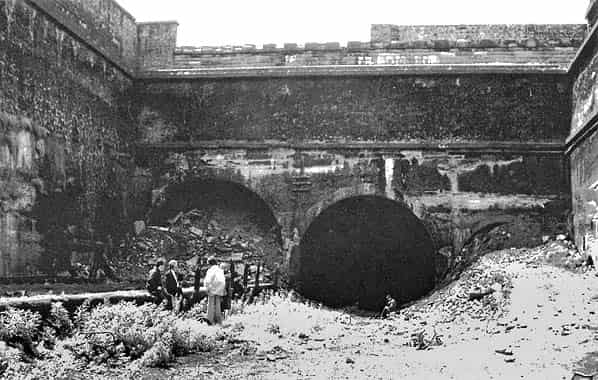
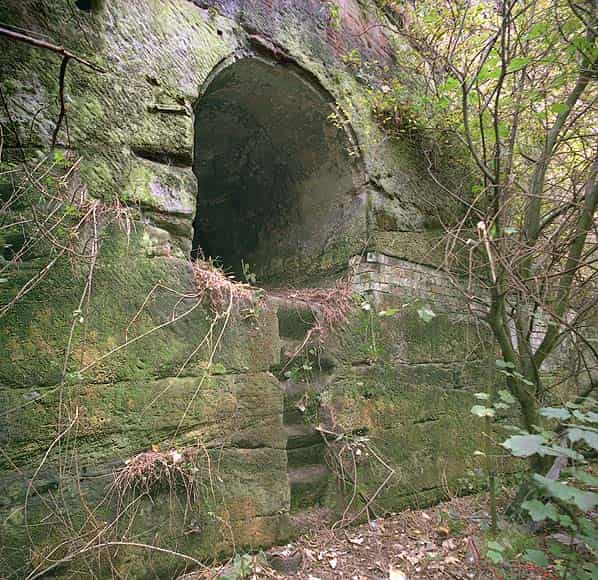
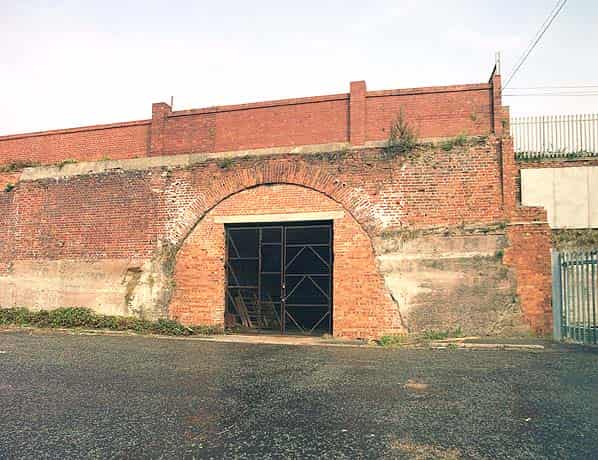
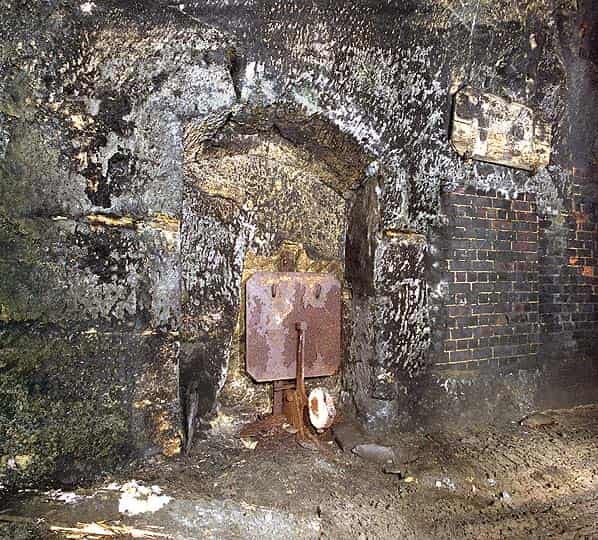
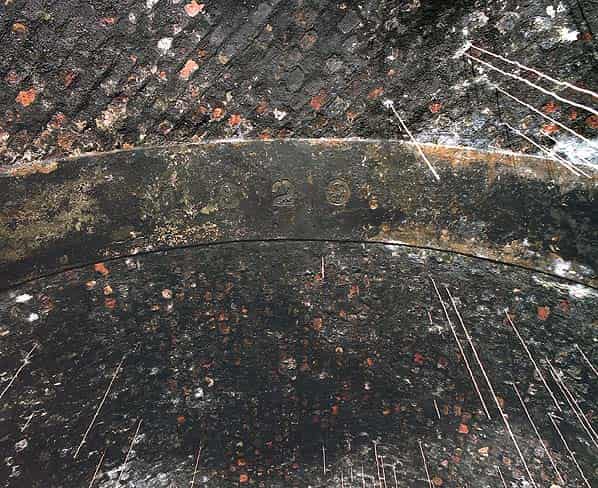
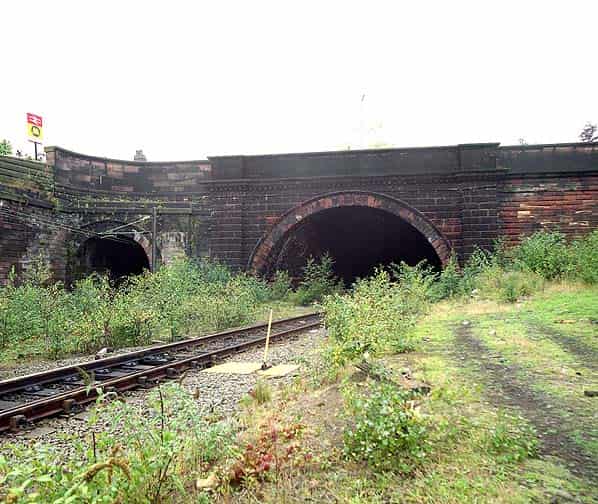
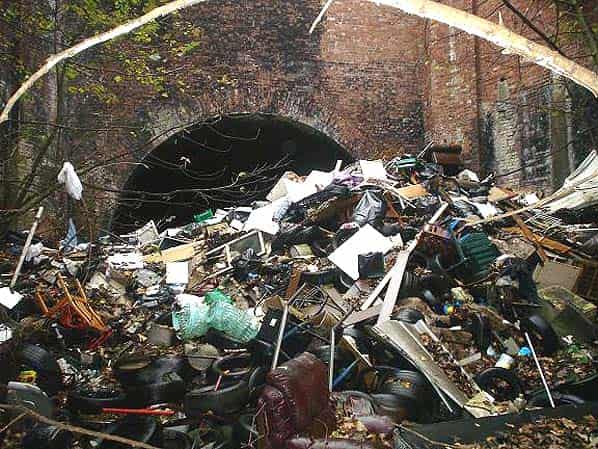
At the western end three tunnels enter the west wall of the cutting. The northernmost (the ‘Stephenson’ tunnel) to Crown Street and the central one to Wapping date from the opening of the line while the southernmost tunnel was driven through an original storage recess in about 1846 and was further opened up when the south cutting wall was cut back by three metres after 1864 to accommodate an extra track.. Of the three tunnels the Stephenson tunnel is the smallest, being 5.15 metres high to the crown of the arch, and 4.60 metres wide. At the far end, which is now blocked, there is a date stone of 1829 set into the roof. There is also a hole in the floor dropping down into the roof of the Wapping Tunnel. The tunnel is cut through solid rock and unlined with brick arching; internally it is in good condition with a large quantity of long stalactites hanging from the roof.
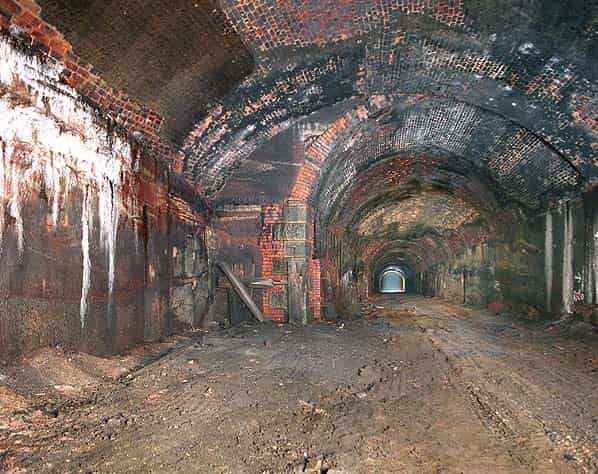
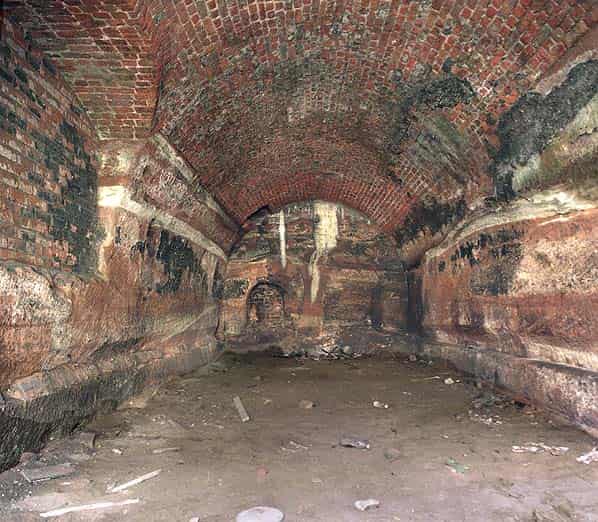
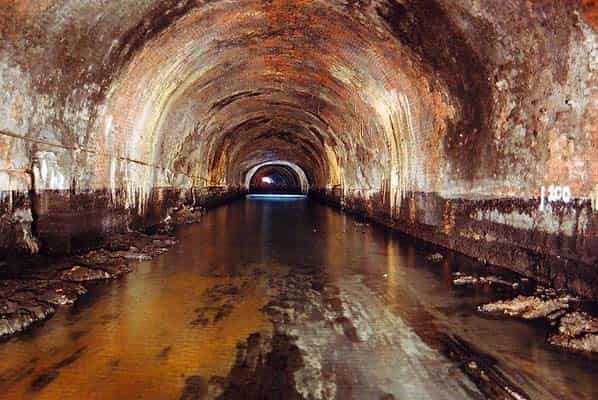
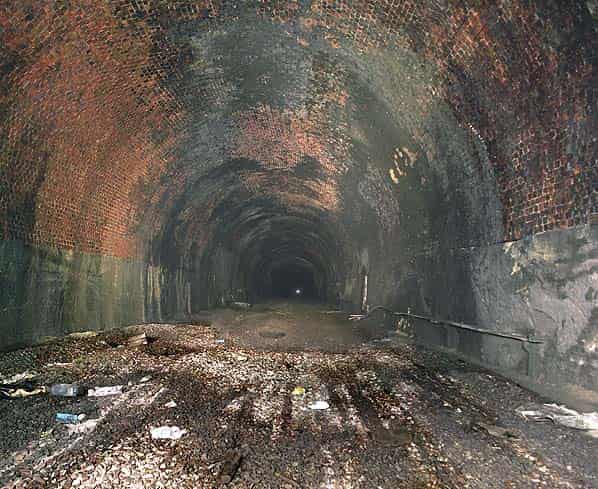
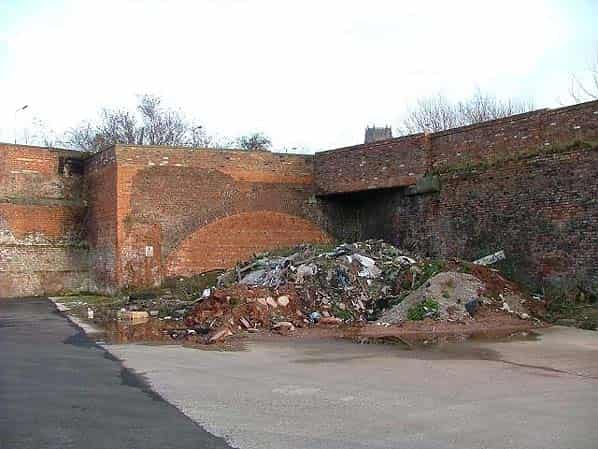
The Wapping tunnel entrance is 5.60 metres high and 7.05 metres wide and considering its length it was a very ambitious project for 1830. Like the Crown Street tunnel the Wapping tunnel is also cut through solid rock with brick arching. For much of its length it is dry but close to the western portal there is standing water which eventually becomes deep. The southernmost tunnel is the largest and although entering the cutting about 1 metre higher than the others, it is 6.50 metres high and 7.60 metres wide.
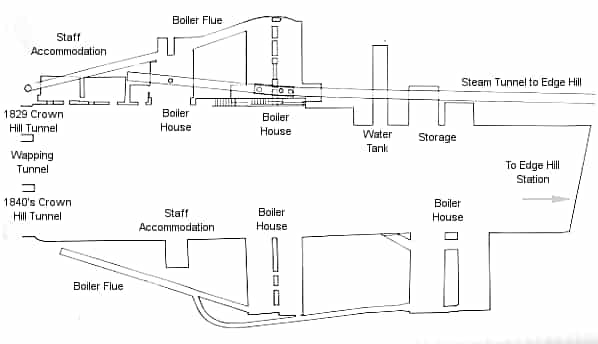
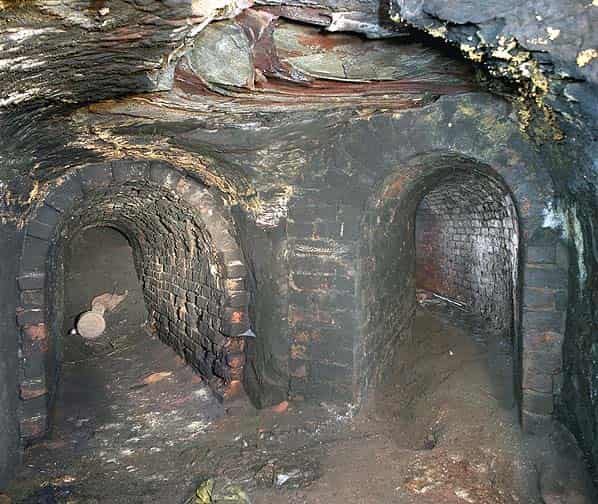
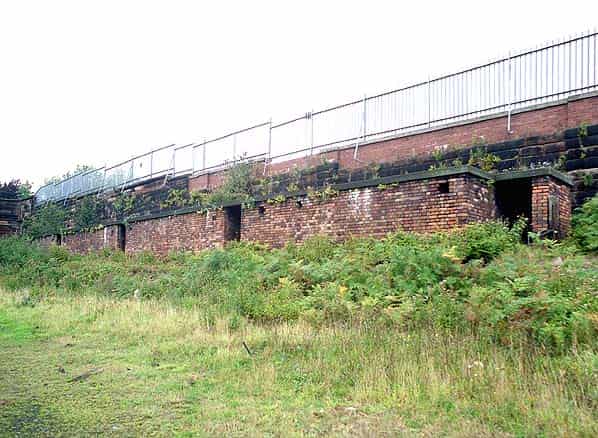
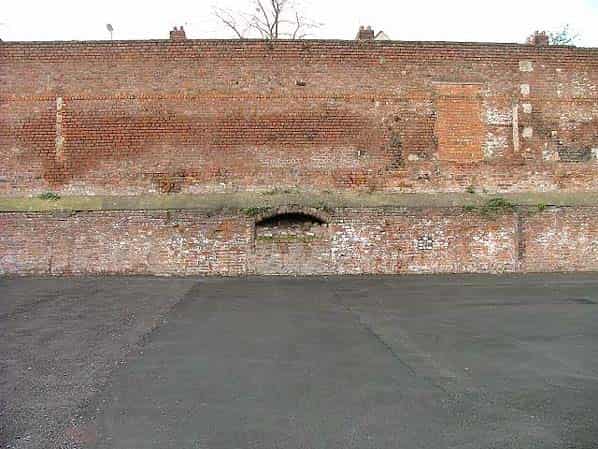
A number of openings cut into the rock face can be seen on each side of the cutting. All those on the south are some three metres shorter than when originally excavated following the widening of the cutting in 1864. On the south side the two easternmost openings (immediately west of the Moorish Arch site) are 12.6 metres deep and although there is no documentary evidence to confirm what they were used for, it seems likely that they housed two of the boilers for the south engine inside the Moorish Arch. The bays are joined together at the rear by a short tunnel and there is also a link to the smoke flue feeding the southern chimney.
Two metres apart, they are 5.10 metres and 6.15 metres wide respectively and 12.6 metres deep by 3.80 metres high. A small tunnel, 1.45 metres high by 1.1 metres wide, at a height of 1.3 metres above the ground joins the two openings about 1 metre in from the entrance at an angle to appear in the cutting wall. Most probably it once led into the south engine house inside the Moorish Arch. From the west side of these two linked chambers a flue leads off westwards towards the south chimney. There is no certain evidence as to the purpose of these rooms although the flue leading to the chimney suggests that boilers were once installed there although ‘folk tradition’ has always called these the locomotive stables.
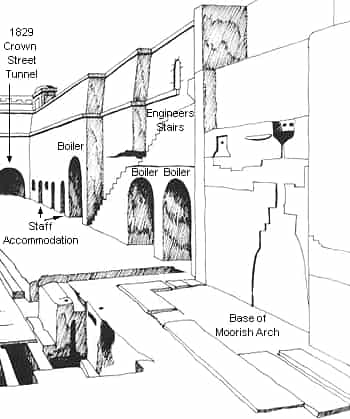
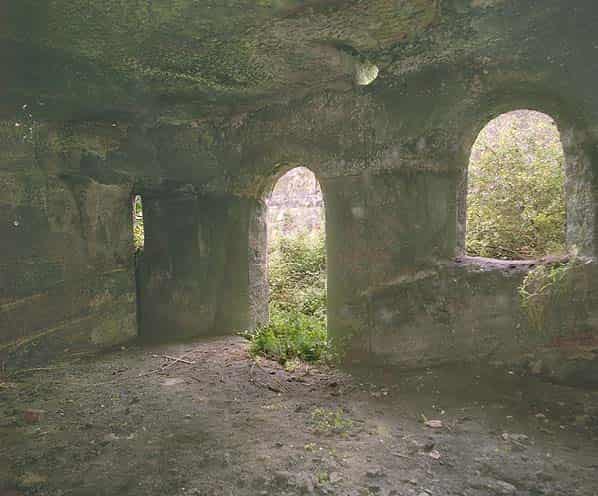
Again foreshortened after 1864, the next pair of openings to the west are certainly the boiler houses for the Moorish Arch engines. They are 12.50 metres deep, 4.30 metres wide and 3.25 metres high. Both are lined with brick for the first four metres or so. The eastern of the two chambers has been altered by the insertion of a brick front wall in order to provide staff accommodation. Two small holes interconnect the rooms and at the back a larger round-headed opening, provides a flue between the two; this then leads off to the base of the south chimney. The flue is about 1.20 metres wide and 1.80 metres high and is round-headed and cut from the solid sandstone. After a few metres there is a junction with the flue from the other pair of chambers.
A fifth chamber to the west does not appear on early illustrations and is presumed to be of later date, perhaps being cut as a refuge when the cutting was widened. Some time later the roof was flattened and a brick fireplace and front wall installed to provide staff accommodation.
On the north side of the cutting the first two openings at the eastern end have no significant features to indicate their original use. The eastern most chamber may have been used as a locomotive coal store and the second chamber may have been used for staff accommodation although latterly it has been used for storing sand.
The third opening from the east is 2.40 metres wide and 13 metres deep; an 1831 lithograph shows the locomotive water feed-pipe at this point. It is quite conceivable that such a supply was available here at the Moorish Arch and this chamber seems the most likely location for the steam-heated water tank in conjunction with the adjacent coal store. The next pair of chambers to the west are the two boiler houses under the steps to the Moorish Arch, as indicated in a contemporary painting published by Ralph Ackermann.
One chamber is 4.25 metres wide, 13.75 metres deep and 3.90 metres high with a low square recess on the east side immediately inside the entrance. The rear wall is curved and from it a flue 1 metre wide by 1.50 metres high curves away westwards to the adjacent chamber. Between the two chambers there are three small holes, a blocked window and a small round-headed tunnel linking the two at the back. The two rooms are mirror images of each other. At the rear of the west wall a flue leads towards the northern chimney. A hole in the ceiling of each chamber gave access into the steam tunnel which runs above.
The steam tunnel carried the pipes from the cutting boilers to operate the Lime Street tunnel steam engines at Edge Hill Station. Installed in 1836, the system was found to be hopelessly inefficient and was abandoned during the 1840s. However, the connecting holes between the tunnel floor and the boiler rooms can still be recognized although they were later blocked. The steam tunnel is about 1.60 metres wide and 1.80 metres high, connecting with each chamber by a 0.7 5 metre hole in its floor. Access to the steam tunnel was made by a doorway opening off the Moorish Arch steps above the boiler rooms, this is now blocked but there is another accessible tunnel from the north face of the cutting. Towards the Edge Hill end, the steam tunnel is now flooded and impassable.
West of the boiler chambers the steam tunnel terminates above another chamber which also has an opening through the brickwork roof into the floor of the steam tunnel. This is the largest room on the north side of the cutting and it doesn’t appear to be original. Its close association with the steam tunnel of 1836 suggests that it is of that date, being cut to provide the additional steam capacity to operate the Edge Hill engines. Another feature in the steam tunnel itself appears to be a coal chute directing supplies of fuel in from the cutting top, though the tunnel, and into this chamber. Access to the cutting top via this coal chute is now completely blocked.
The room is brick lined, 6.50 metres wide, 7 metres deep and 5.40 metres high. The back wall connects with the smoke flue from an opening on its east side and with the chimney base by another flue on its west side. A smaller room to the west may be original, or, as its location and size suggests, may be the mess room for the boiler men working in the adjacent chamber.
The final pair of openings to the west appears to be an enlargement of a smaller chamber that was referred to as a stable for the Crown Street pilot horse.
It was later opened up to provide staff accommodation when the present rooms which include windows and a doorway were excavated.
THE FUTURE
The site was surveyed in March 1976 and a limited programme of excavation including the site of the north engine house, the drainage ducts, and the rope-haulage system was carried out by NW Society for Industrial Archaeology and History. In 1980 British Rail handed over the management of the site to the Edge Hill Railway Trust. To coincide with this, an illustrated pamphlet, describing the history of the site, “Railways Began Here” was published. The trust negotiated a derelict land grant with the City Council and it was proposed to incorporate the site into a rail trail with displays and interpretation boards. The trust also leased part of the building at Edge Hill Station as a visitor centre for the trail.
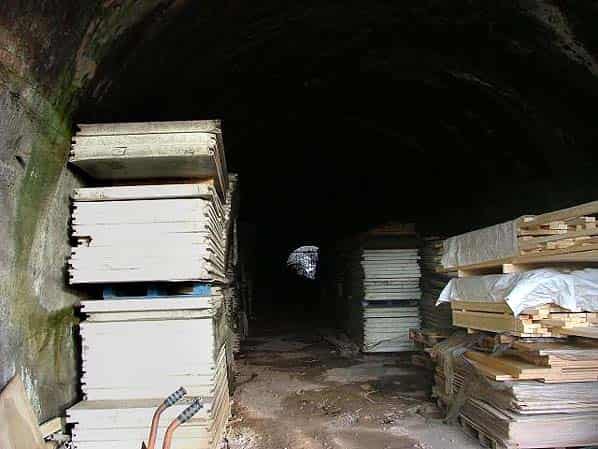
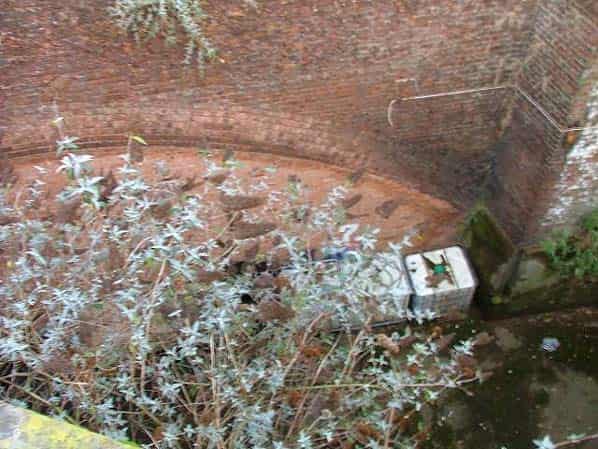
Since that date however, Mersey Rail have found a new use for the existing track as a siding and as a result refused further public access to the cutting. The Edge Hill Railway Trust folded and has now disappeared without trace. The cutting is once again overgrown and derelict and all requests for access to this important heritage site are now refused. When visited in 1996, track was still laid through the later Crown Street tunnel to the site of the L & NW good station and the line is currently used by Mersey Rail as a siding for stabling passenger coaches overnight.
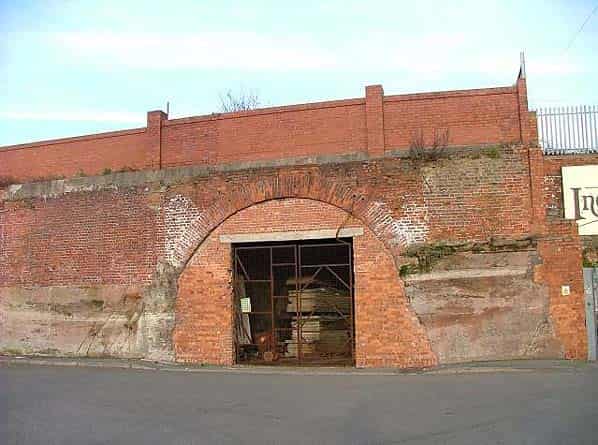
The station at the end of the Wapping Tunnel was removed and slum housing cleared during the 1950’s and 60’s, but plans to carry out large scale redevelopment and construct an urban motorway were never carried out. The zone has since been a centre for light industrial uses and distribution. In 1999 there was a proposal to create a new single carriageway road from the M62 to the port and city centre which includes converting the Waterloo Tunnel into a roadway. Potentially this would allow dock traffic to be directed away from surface routes used at present, accommodate the anticipated growth in dock traffic and facilitate the development of further freight distribution along the dock corridor. A study concluded that the project was technically feasible.
Sources:
- Industrial Archaeology Review Vol 2/1 (November 1977) & Volume 4/1 (Winter 1979/80) ISSN 0309-0728
- Merseyside’s Industrial Past by Paul Rees ISBN 0 907768 01 6
- Andy Dingley
- Colin Parson
- Underground Liverpool by Jim Moore ISBN 1 872 568 43 2
- Various members of Friends of Williamsons Tunnels
- North West Society for Industrial Archaeology & History