When the decision was made by the London County Council to redevelop an unsavoury part of Holborn and to construct Aldwych and Kingsway they considered using the new streets for a tramway to connect the existing northern and southern networks. It was then suggested that instead of running the trams on the streets, a sub-surface line should be constructed as an integral part of the improvement. Similar schemes had been adopted in New York and Boston and a deputation was sent to those cities to see these tramways.
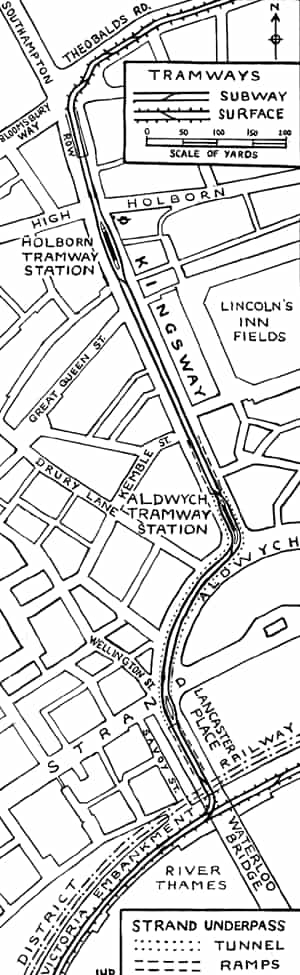
On the strength of their findings an application was made in 1902 for powers to construct a subway for single-deck tramcars running from Theobalds Road to the Embankment at Waterloo Bridge, from which point a surface line would continue over Westminster Bridge. The estimated cost of this proposal was £282,000.
The subway was approved, but the tramway was not authorised beyond the north side of the Strand and it took a further four years for the Council to secure powers.
In hindsight it proved mistake to opt for single deck cars but at the time this was done for three main reasons: (1) To avoid a large sewer under Holborn which would, it was thought, necessitate too steep a descent to be safe for double-deck cars. (2) The position of the District Railway in relation to Waterloo Bridge and the gradient from the Strand presented difficulties constructing a satisfactory southern exit; (3) There was a feeling that it might be found that London traffic could be handled more expeditiously with coupled single-deck cars than with double-deckers.
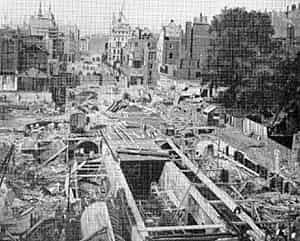
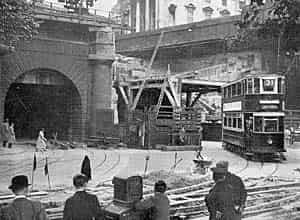
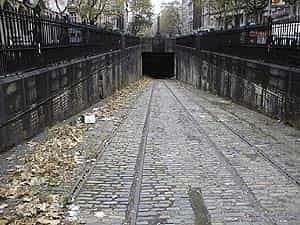
Work on the subway started at the same time as the new streets were laid out. The approach from Theobalds Road was by an open cutting 170 ft. long in the middle of the road. The tracks then passed into two cast iron tubes, 14 ft. 5 in. in diameter and 255 ft. long, which took the them under the Holborn branch of the Fleet Sewer. The rails were 31 ft. below the road surface when passing under Holborn, rising again at 1 in 10 to Holborn Station. Raised sidewalks were provided in the single tunnels.
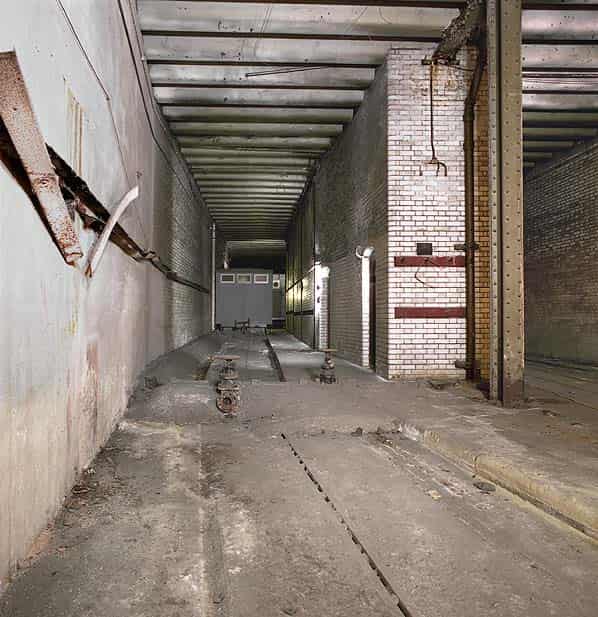
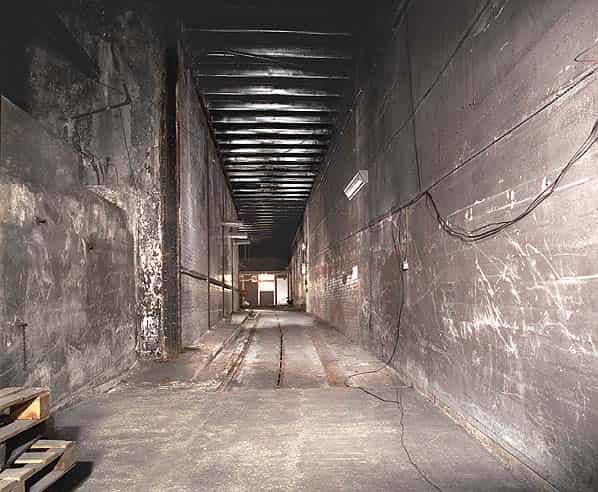
From Holborn to Aldwych the tunnel was 20 ft. wide with a roof of steel troughing just below the street. The running rails were laid on longitudinal wooden sleepers embedded in concrete.
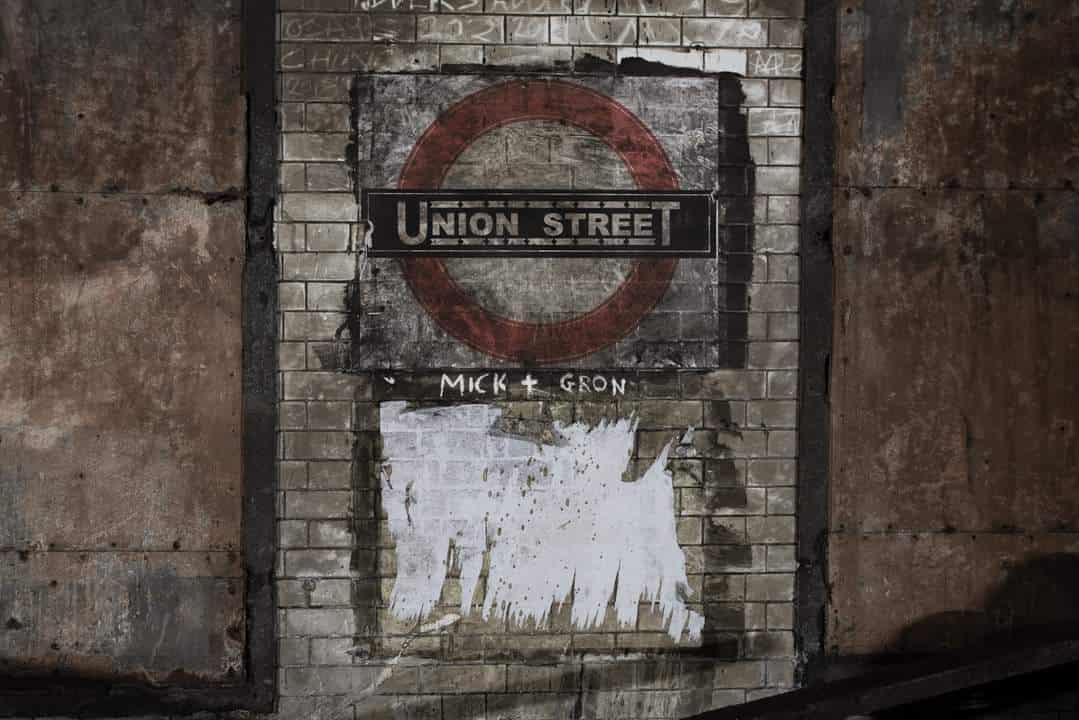
At the time the subway was opened it was not connected with any other electrified route, so it was decided to terminate the public service at Aldwych Station and use the tracks which extended southwards from there towards the Strand as a depot. Inspection pits were constructed under this length and some repair equipment installed. An intermediate station was built at Great Queen Street (later renamed Holborn). Pending the opening of Greenwich power station, current was obtained from the County of London Electric Supply Company.
Sixteen single deck tramcars were ordered from the United Electric Car Company, Limited, of Preston at a cost of £750 each.
Public service from the Angel to Aldwych began on 24th February 1906, with the north bound journey taking 12 minutes and 10 south minutes for the southbound. The new tramway proved an instant success.
In July 1905, the Council’s attention had been drawn to the fact that its compulsory powers for the acquisition of land and easements for the construction of the subway from Aldwych to the Embankment would expire in the following month.
When the Embankment tramway was eventually opened and powers had been obtained for the subway link, work was pushed ahead on the remaining section. This fell on a gradient of 1 in 20 from Kingsway to the Strand, 1 in 108.3 under the Strand, and was then level; it was far more costly to construct than the original length, mainly owing to difficulties in crossing the District Railway. The proposed station at Wellington Street was not built as the Council decided that as the site was only 200 yards from the Embankment it was not needed.
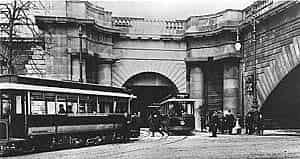
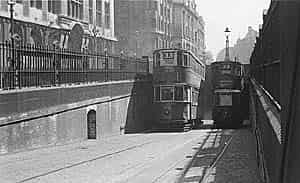
South of Aldwych Station, the tracks curved sharply to the south west in twin tunnels and continued beneath Aldwych as a single tunnel with brick arch roof, separating again at the Strand into twin cast iron tubes which continued to about a third of the way under Lancaster Place. The exit on to the Embankment was through the western wing wall of Waterloo Bridge and here a triangular junction was constructed. The eastern side of the junction, leading towards Blackfriars, was never used and was removed during later reconstruction.
Through services were inaugurated on 10th April 1908, from Highbury Station to Tower Bridge and from Highbury Station to Kennington Gate. The cars were stabled at Holloway and New Cross depots. There were numerous changes to the routes over the following 20 years.
As the years passed, it became increasingly evident that the operation of single-deck cars could not be made profitable and moreover, if the subway could be enlarged to take double-deckers many useful connections could be given and the movement of rolling stock from north of the Thames to Charlton works would be greatly improved.
In 1929 therefore, the LCC decided to increase the headroom to 16 ft. 6 in. by raising the roof at the northern end and by deepening the tunnel at other places.
This announcement brought suggestions that the subway might well be enlarged to take motor traffic as well as trams, but the Metropolitan Police Commissioner pointed out that congestion would arise at each end of the tunnel, that a serious traffic block would quickly develop if a vehicle broke down inside and that there was a danger of exhaust fumes and even fire.
The London Traffic Advisory Committee recommended that the tunnel could serve no useful purpose as a motor way and the L.C.C. would have nothing to do with the idea. The contract was awarded to John Cochrane and Sons, Limited, who started work on the street level on 11th September 1929.
North of Holborn the roadway was opened up and the twin tunnels replaced by one wide passage with a steel girder roof, while elsewhere the additional headroom was obtained by under-pinning the side walls with concrete and lowering the track by approximately 5 ft. The estimated cost was £326,000 including £76,000 for the reconstruction of the 50 single-deck cars.
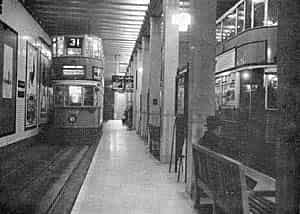
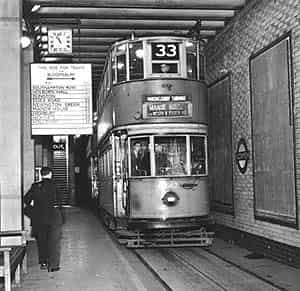
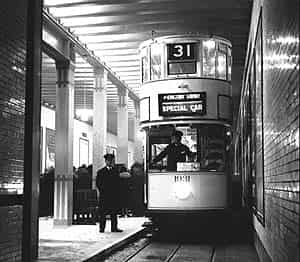
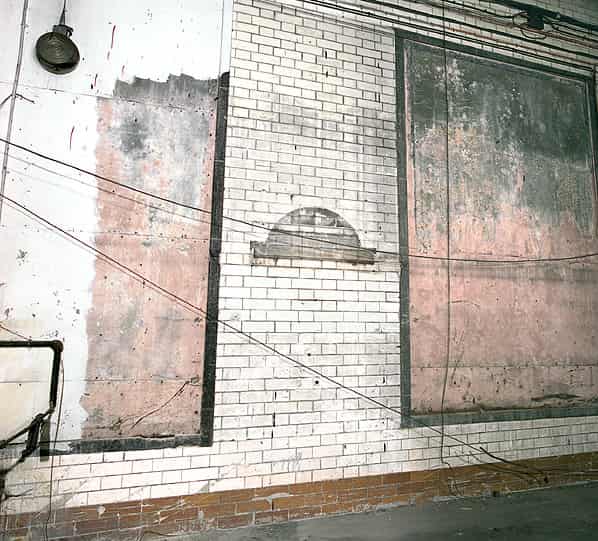
The two tramway stations were rebuilt and modernised, that at Holborn being finished in travertine, a cream marble used in ancient Rome. Standard trackwork with yokes and slot-rails set in concrete was used in place of the special type evolved for the original construction.
The formal reopening was performed on Wednesday, 14th January, 1931, by the Chairman of the Council, Major Tasker. Public service commenced at 5 o’clock next morning, with a one-minute headway and a total of 5,000 cars per week.
In 1937, the rebuilding of Waterloo Bridge necessitated the diversion of the subway exit to a position centrally beneath the new bridge, at a cost of £70,000 including a new crossing of the District Railway; after the changeover took place, on 21st November, 1937, the curved section of tunnel leading to the former exit in the bridge abutment was walled off and still exists.
In anticipation of a general conversion of the London tramways to trolleybus working, an experimental trolleybus placed in service on 12th June, 1939, was so designed as to permit passengers to board and alight from the offside at Aldwych and Holborn Stations.
The war brought a reprieve to the remaining London tramways and was followed by a decision that the routes still working would be replaced by motor buses and the subway closed.
Owing to a need to replace worn out buses, tramway replacement did not commence until 1950. Finally, on Saturday, 5th April 1952, trams ran through the Subway for the last time; tram service 35 (Forest Hill-Highgate) was replaced next day by bus service 172, and tram service 33 (West Norwood-Manor House) was replaced by bus service 171. In the early hours of the following morning the remaining cars from Holloway depot were driven south through the subway to new homes or the scrapyard.
The tracks remained unaltered, though disused, until the final abandonment of London’s tramways on 5th July 1952, after which the street tracks were lifted in stages and those in the subway, cut at the approaches, were left as the longest section remaining in London. A technical committee was set up by the Minister of Transport to report on the possible use of the subway for motor vehicles, and tests with road vehicles were carried out both before and after closure.
In 1953, London Transport used the subway to store 120 withdrawn buses and coaches in case they were needed for the Coronation and in 1955 it was used to represent a railway tunnel in the film Bhowani Junction.
A film company offered to take over the whole subway as a film studio, but this was rejected on account of the fire risk. Repeated questions in Parliament kept the issue alive, but in 1955 London Transport invited applications for the use of the tunnel as a store for non-inflammable goods, and finally leased it in October 1957 to S. G. Young & Co. of Blackfriars as a store for machine parts.
Meanwhile, in June 1958, the London County Council expressed interest in taking over the subway and creating an underpass for light traffic beneath the Strand and Aldwych to deal with the traffic jams which often extend right across Waterloo Bridge. In July the contract for the conversion was awarded John Mowlem & Co. who started work on the 15 month contract. The construction was completed on schedule and the new Strand underpass opened to road traffic on 21st January 1964.
It has been suggested that the remaining part of the subway might have been earmarked for some cold war use and as part of their emergency planning in the 1970’s the GLC established a flood control centre in a portacabin at Holborn Station in 1974 when they relocated from County Hall. The control centre had its own radio room. They also had an annexe at Russell Square House nearby. Each London Borough had their own flood control centres which would have reported to the GLC’s main London Control at Holborn. This remained operational until 1984 when the Thames Barrier was opened.
During the fire brigade strike in 1977 Major General Sir James Eyre was in charge of the deployment of army fire personnel and green goddesses from a temporary underground HQ at Holborn. One night when the Thames rose to within a few inches of top of the embankment he had to make rapid contingency plans to deal with wide spread flooding. It’s not known why this civil matter suddenly became a military responsibility.
In Eyre’s obituary (Daily Telegraph 9.1.2003) it states that this temporary headquarters was located in tunnels under Kingsway suggesting that it might have been co-located with the GLC’s flood control centre. Duncan Campbell states in ‘War Plan UK’ however that “British Museum Station (disused) is occupied by the administrative headquarters of the Scots Guards and other regiments in the Household Division: in the event of peacetime flooding of London, the London district military command will operate from here rather the war time AFHQ 5 at Beaconsfield.”
Eyre was Lt. Col. Commanding the Household Cavalry and Silver Stick In Waiting, a court appointment that goes with his command.
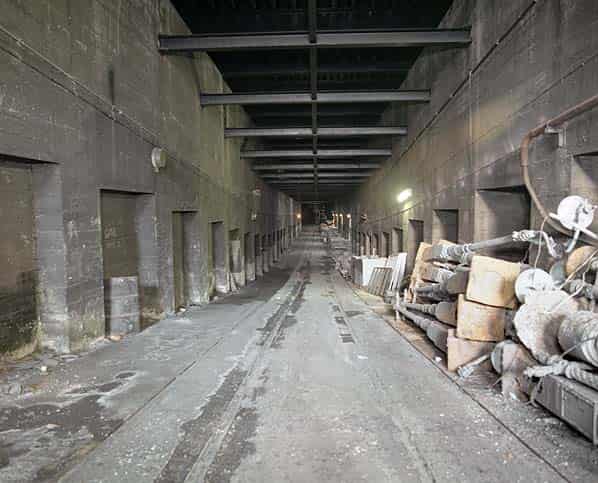
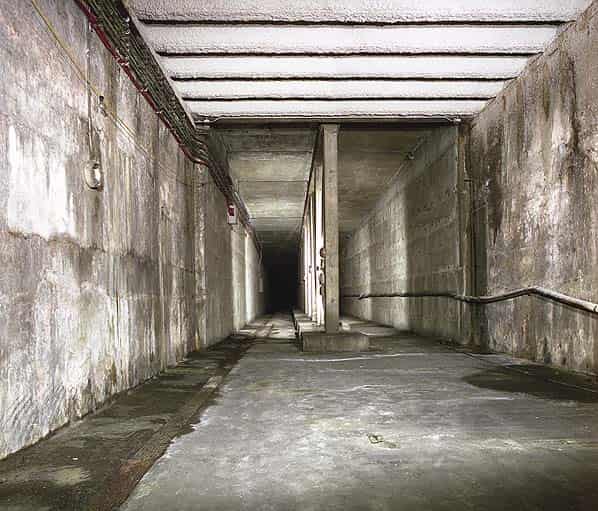
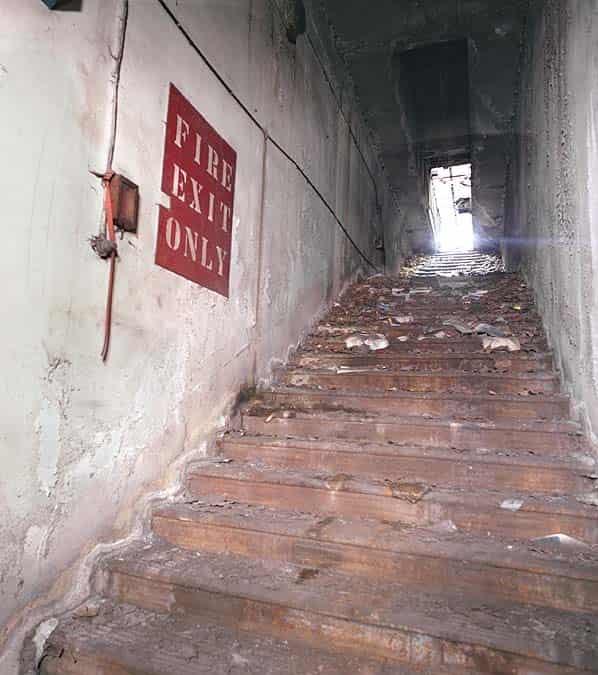
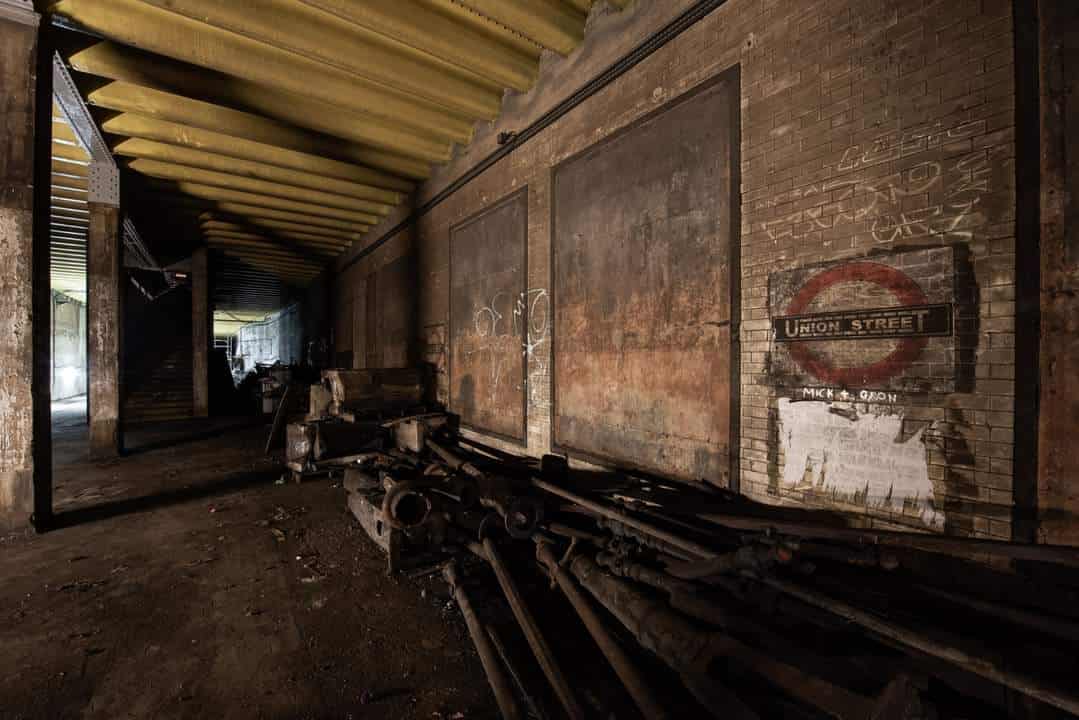
Since 1984 no use has been found for the subway apart from the first few yards which is used for the storage of road materials by the London Borough of Camden. When visited by members of Subterranea Britannica in 1996, the remaining section of the subway including Holborn Station was found to be in good condition with the twin tram tracks intact throughout. Strand Station was demolished during the construction of the Strand Underpass although traces of it are still visible beneath the up ramp. The portacabin for the flood control centre was still in place although stripped of all fixtures and fittings.
Sources:
- Modern Tramways