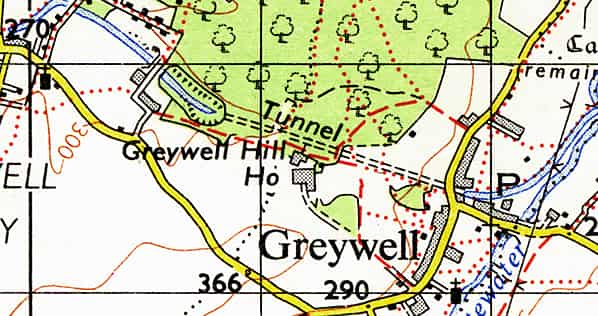
The Basingstoke Canal was built to support local agriculture giving farmers access to London Markets. It was authorised by Act of Parliament in 1778 with work commencing in 1787. The canal took seven years to complete, finally opening in 1794 with 29 locks taking the canal from the River Wey at Byfleet in Surrey, 16 miles to a 245ft high summit level above Ash Lock in Hampshire. From here the canal ran on a level plateau a further 21 miles into Basingstoke. At Greywell the canal was taken through Greywell Hill in a 1230 yard tunnel.
During its early years, coastal traffic was disrupted during the Napoleonic wars and the canal was moderately successful handling cross country traffic that would have normally gone by sea; but with the coming of the railways in 1840 most of the small goods traffic was lost. There was a revival during the late 1850’s during the building of Aldershot Camp with building materials arriving by boat but this dropped off once the camp was completed and within a few years the canal company went into liquidation.
The canal went through a number of new owners, some with ingenious plans to make the navigation pay its way but all to no avail until the First World War when it was integrated into the national canal network. Under the control of the Royal Engineers it was used to transport large quantities of military hardware to the camps at Aldershot, Crookham & Deepcut but traffic declined at the end of the war and the canal went back into private ownership in 1923 with reasonable traffic levels being maintained up to Woking.
There was a further decline during WW2 and the canal was sold to the New Basingstoke Canal Company in 1949; this was to be its last private owner. The new company tried to raise extra income from fishing and houseboat moorings, and unpowered pleasure craft were encouraged to use the navigation. However there wasn’t sufficient income to maintain the waterway and by 1964 it was virtually derelict throughout its length.
By the late 1960’s the canal was considered an eyesore and a group of residents from Brookwood submitted a proposal to the owners that they should form a volunteer working party to clean up the derelict waterway at weekends. The New Basingstoke Canal Company was not impressed with the proposal as it interfered with their own plans to sell off sections of the canal for development.
Despite this set back, The Surrey & Hampshire Canal Society was formed to actively campaign for the Canal to be taken into public ownership and restored for leisure traffic between Byfleet and Greywell Tunnel. Beyond Greywell the canal had been abandoned and in places filled in.
A report was commissioned which recommended that the canal should be restored for through navigation from the River Wey with a rider that navigation should be restricted to preserve the rich natural history along the banks.
Surrey and Hampshire County Councils acquired the canal by compulsory purchase order in 1974 and restoration work began in earnest in a partnership between the two county councils and the Surrey & Hampshire Canal Society. During the week many young people were employed on the canal as part of job creations schemes while at the weekends restoration continued with large numbers of volunteer workers provided by the canal society. The major engineering work was at the Surrey end where 28 locks had to be repaired and in some cases rebuilt.
The canal was officially re-opened by the Duke of Kent on 10th May 1991. Once the canal had been completed the two county councils decided on a scheme of joint management under a new Basingstoke Canal Authority.
GREYWELL TUNNEL
Prior to the construction of the canal a survey was made of the intended route; there were no plans to build a tunnel at Greywell, instead it was proposed that the canal should loop round the north side of Greywell Hill & Butter Wood. A local landowner, Earl Tylney, raised objections to this route however as it would cut off some of his land so a new route was conceived with a tunnel passing through the hill.
Construction followed the standard pattern for canal tunnels. This involved sinking a number of vertical shafts along the line of the canal with a tunnel being driven in both directions from the bottom of each shaft. It is possible to see where each of these tunnels met as there is a slight kink in the line. All this work was done by hand and candle light.
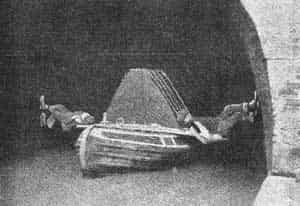
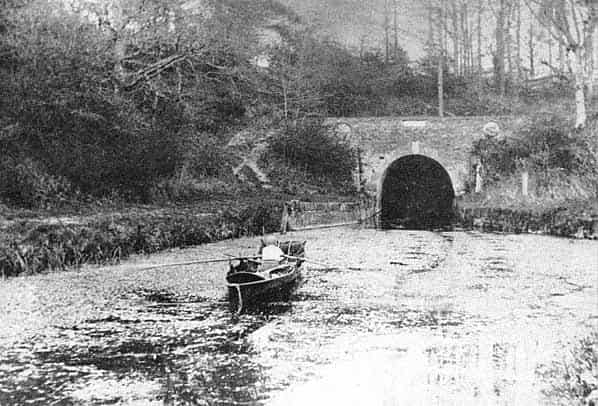
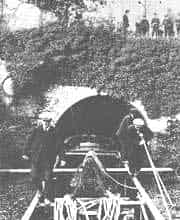
223 yards of the tunnel had been finished by June 1791 and a year later this had been increased to 635 yards. The tunnel finally opened on 4th September 1794 but disaster struck within six weeks when one bank of the canal collapsed near the west portal; a second slip followed forcing the closure of the canal until the following summer. The tunnel has no towpath, boats had to be ‘legged; through while the horses were walked over the top of Greywell Hill. A footpath over Greywell Hill still follows the original horse route.
The tunnel was the second longest canal tunnel in Southern England (longest was Higham on the Thames & Medway Canal) and the 12th longest in Great Britain. At its deepest point the tunnel is 131 feet below Greywell Hill.
Soon after the canal was opened, a 30th lock was built close to the eastern end of the tunnel. The lock had a fall of one foot and it has been suggested that it was built to increase the level of water in the tunnel to aid navigation as the water level in the tunnel was shallower than originally planned.
The last recorded regular commercial traffic through Greywell Tunnel was to and from the Nately Brickworks which opened in 1898 producing 2 million the following year. Traffic must have been considerable but the venture was short lived with the works closing in 1901.
The last boat to navigate through the tunnel was probably the ‘Basingstoke’ owned by Mr. A. J. Harmsworth. Having left Ash Vale with 10 tons of sand on 16 November 1913, it finally arrived at Basingstoke Wharf in February 1914. The time taken indicates the poor state of the canal.
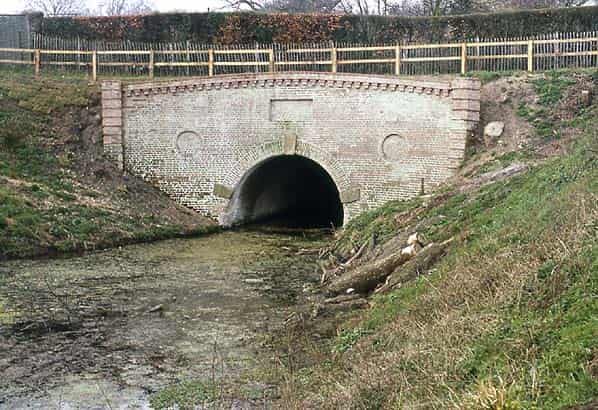
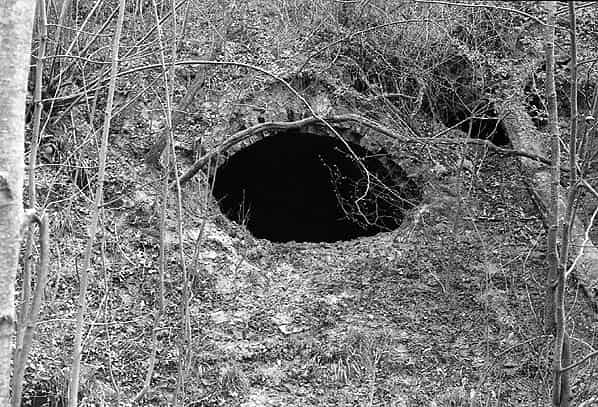
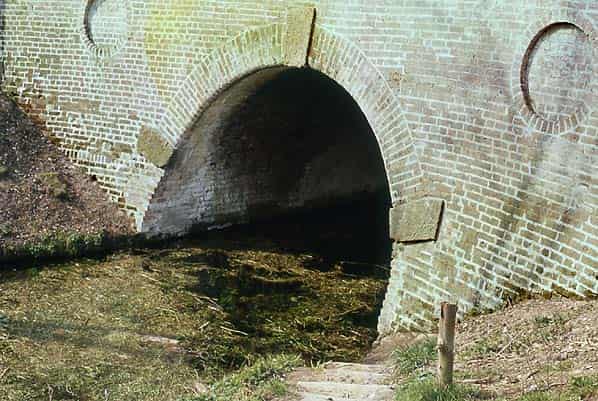
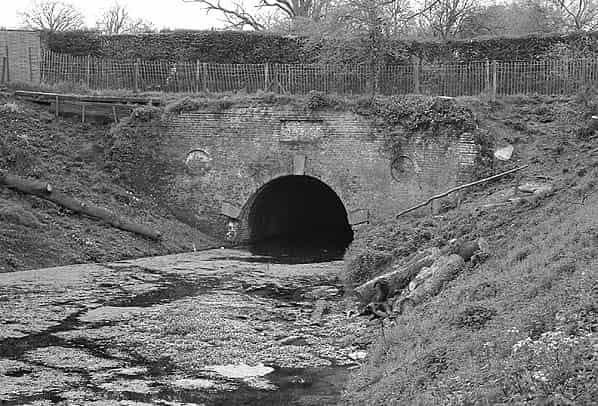
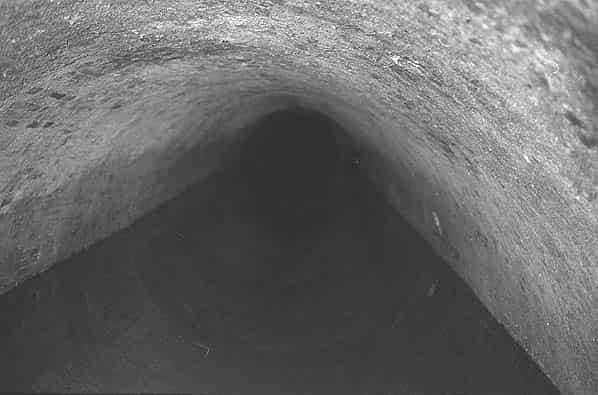
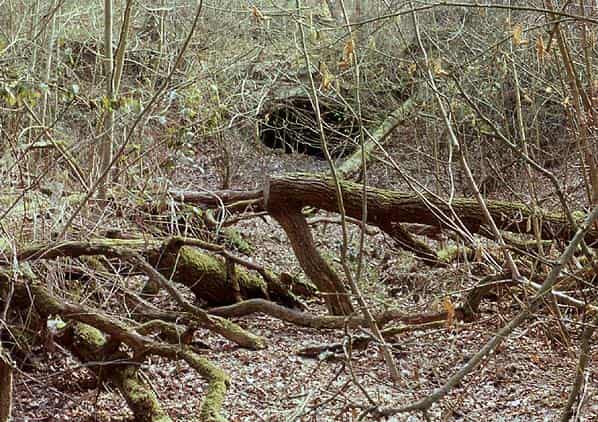
Following a serious roof fall in 1932 when the crown of the roof gave way, the tunnel was closed and the remaining five miles of canal was abandoned. The first 800 yards of the tunnel are in stable chalk, beyond this, the tunnel runs through clay; this is where the collapse occurred. Subsequent subsidence has caused the west portal to collapse and although the tunnel is open at this end all the brickwork has gone and the portal is now securely gated for safety
There are now five ponds above the western end of the tunnel; it is the pressure of water from one of these that caused the collapse; a tree fell through and was left standing upright through the roof of the tunnel. The blockage was initially only partial and the tunnel was still passable for canoeists until the early 1950’s. A further collapse has now left the tunnel blocked with soil up to the roof although the material appears to be soft and could, in time, be cleared and the roof repaired. Despite the collapse the brick lining between the collapse and the western end appears to be in sound condition.
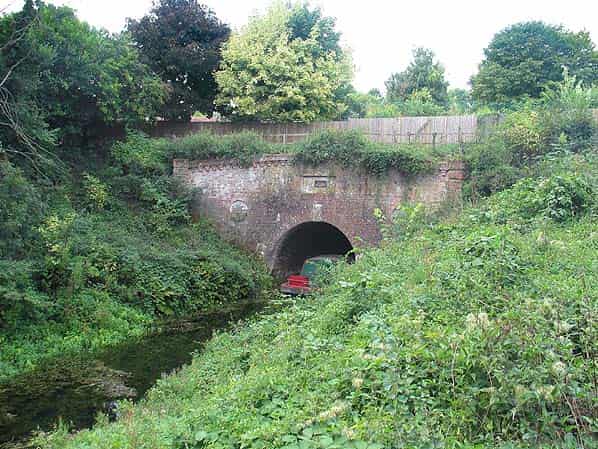
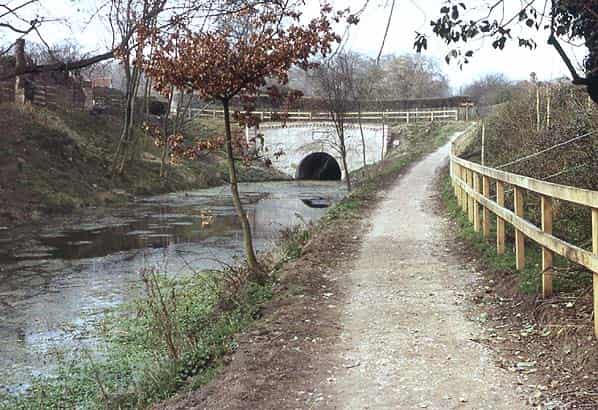
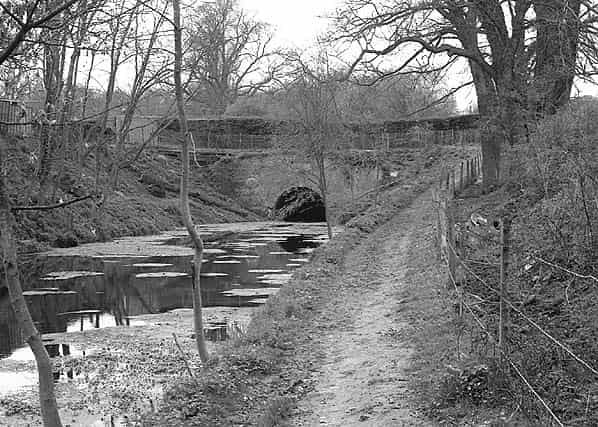
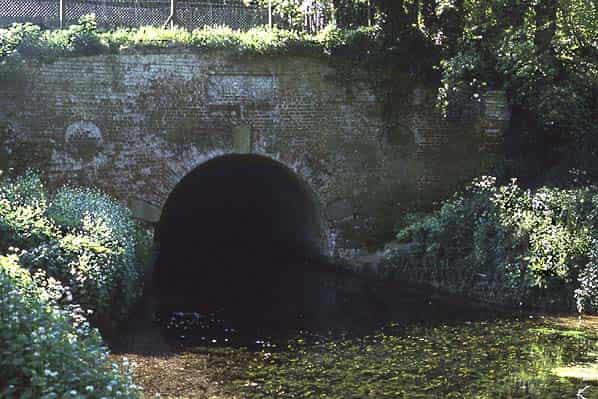
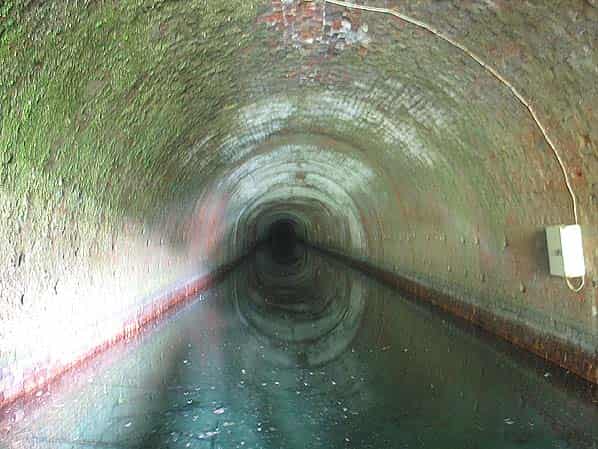
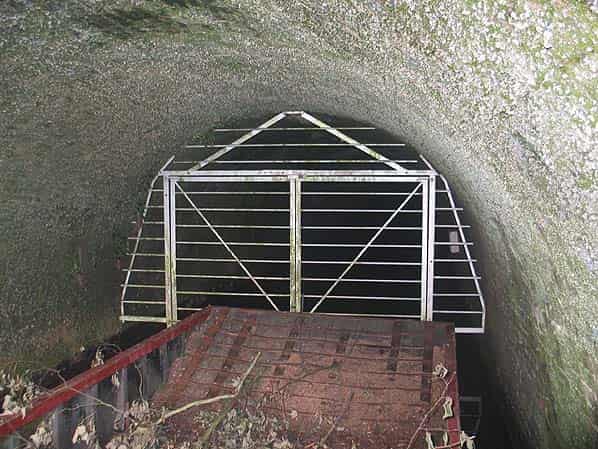
At the eastern end, the tunnel can be navigated for 800 yards up to the collapse and each summer there is a boat trip along the tunnel to check the condition of the brick lining. At other times there is no access following the discovery of bats hibernating in 1995. It has now been declared a Site of Special Scientific Interest (SSSI) and a locked gate has been installed inside the east portal to conserve the tunnel as a winter hibernation and breeding habitat and stop unauthorised access.
The present limit of navigation is the winding hole (a wider piece of canal where boats can perform the equivalent of a three point turn in order to go back the way they came. An indentation in the bank allows the bows of a narrowboat to be held whilst the prevailing wind blows the boat round. Hence the unusual pronunciation - ‘winding hole’.) immediately west of the Whitewater aqueduct although the 600 yards up to the eastern portal was been dredged in 1987 to clear the spring heads and improve the water supply. The portal was renovated by Hampshire County Council in 1975 to mark European Architectural Heritage Year.
Sources:
- London’s lost route to the sea by P A L Vine - David & Charles 1968 ISBN 0715343041
- Surrey & Hampshire Canal Society
- Canals Guide web site
- Basingstoke Canal News No 66 - February 1976