One of Britain’s best-kept secrets of World War II was the Home Guard Auxiliary Units, which used the status of the Home Guard as a cover for their real activities.
In May 1940, Colonel Colin Gubbins formed a tightly structured resistance that was to be supplied with the best weapons available and with modern plastic explosives. He names them the Auxiliary Units, a deliberately nondescript title. Everything about the Auxiliary Units was to be kept highly secret.
Gubbins knew he needed local men to form the small patrols in each area, men who could be trusted and who had a good knowledge of their surroundings. He decided it would be best to obtain his resistance men from the Home Guard. Contrary to popular belief (mainly due to the BBC series ‘Dad’s Army’), the Home Guard was not totally made up of bungling old men. Many younger men who were in reserved occupations joined their ranks. This is not to say that every member of the Auxiliary Units was originally in the regular Home Guard. Potential members were always vetted by the local police before they were allowed to join. All the men had to sign the Official Secrets Act, and, on joining the Auxiliary Units, were issued with Home Guard uniforms bearing the number of their battalion. These battalions were: 201st in Scotland; 202nd in Northern England; and 203rd in Southern England. None of these battalions ever had official recognition, which meant they were not covered by the Geneva Convention. If the men were captured, they would have been shot.
When a patrol was formed, it had to have its own underground hideout. This was known as an Operational Base or OB The hideouts were to be used in the event of an invasion. They were well-hidden and purpose-built to house the patrol along with the necessary food, water, ammunition and explosives. In Sussex there were 23 patrols with 139 men, the smallest consisted of four men and the largest eight.
Each patrol had an underground hideout, the operational base (OB) and in many cases an underground observation (OP) post or lookout was also sited close by. Both the OB and OP were extremely well hidden, usually in woodland or thick undergrowth.
The Goodwood Patrol had seven members. The Patrol Leader was Lesley Drewett, a farmer at Colworth Farm, Colworth, between Chichester and Bognor Regis. The other members were Charley Longlands, a farmhand on Lesley Drewett’s farm, Bunny Bailey, a farmer at Elbridge Farm, Colworth, Jack Code, a farmer at Courthill Farm, Slindon, Reginald Heaver, a farmer from Oving, his brother Alan who lived at Fishbourne and whose occupation involved extracting, processing and marketing sand and gravel and a Mr. Bingham, a coalman from Bognor.
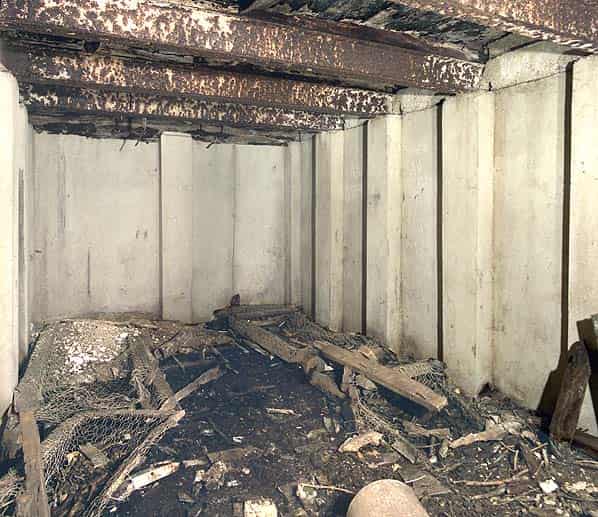
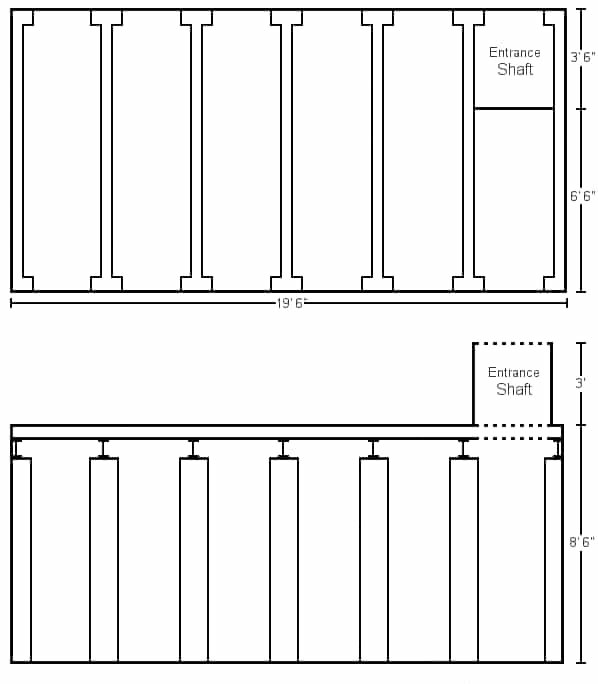
The hideout was a single underground chamber measuring 19 feet 6 inches and 8 feet 6 inches high, situated in a woodland area called ‘The Thicket’, a mile to the west of Eartham.
It was built by the Royal Engineers, its walls and floor are constructed of solid concrete with a 6" thick reinforced concrete ceiling supported by five evenly-spaced 8" by 4" RSJ beams.
This overly-solid construction, coupled with the absence of an emergency exit is an unusual design for an Auxiliary Unit hideout in Sussex
Entrance into the hideout was gained by lifting an old tree stump which was attached to a hinged trapdoor; this revealed a wooden ladder going down into the hideout. Inside were four bunk beds, ammunition, explosives, a large food store, and water stored in two galvanised tanks. Two hundred yards to the north east of the hideout was the patrol’s OP. This was basically a 6 feet by 4 feet trench with a camouflaged top over it. One man would have stood inside, relaying any information back to the hideout via a direct telephone line.
Because of its concrete construction the Goodwood hideout is still in excellent condition although corrugated sheeting and timber that originally lined the shaft now makes access a little difficult.
Former patrol member Alan Heaver remembered doing a great deal of training with the neighbouring West Ashling patrol of which his other brother, Jack, was a member. On one such night-time training exercise, the two patrols had to simulate laying an explosive charge on a guarded anti-aircraft gun at a place called Temple Bar about one mile north of Tangmere airfield. The guards around the ‘Ack-Ack’ gun had been warned that an attack might be attempted some time that night, and not to fire live ammunition at the attackers.
The two patrols met up at Shopwyke, about two miles away from the target site. Alan Heaver was teamed up with Stanley Mason, the West Ashling patrol leader. As they made their way towards Temple Bar Alan Heaver, being the younger man, started to pull away from Stanley Mason and reached the target site first. He entered the perimeter of the site, got right up to the gun, chalked a swastika on it and escaped the same way without detection. He had completed the exercise long before the other men arrived. Unsure what to do with the remaining time; he decided to have another go and chalk a second swastika on the gun. This was a bad move; he was caught, as were all the others eventually.
All the men were taken to see an army officer at Halnaker Windmill. The officer consoled the men on their failed attack, at which Alan Heaver said he had managed to mark the gun and was only caught on his second attempt. The officer, most put out, demanded to be shown the swastika and drove Alan Heaver back to the site to see for himself.
Sources:
- The Secret Sussex Resistance, Stewart Angell. Published by Middleton Press ISBN 1 873793 820