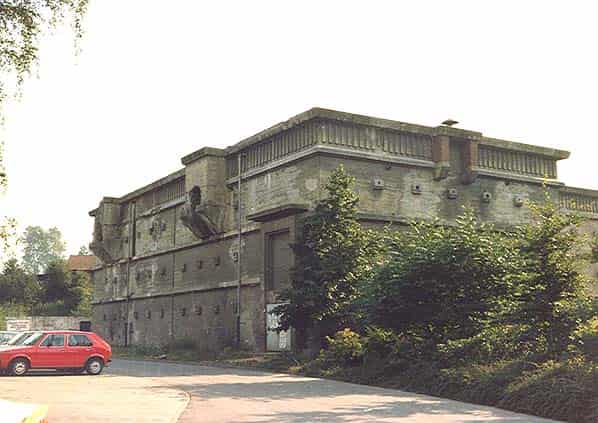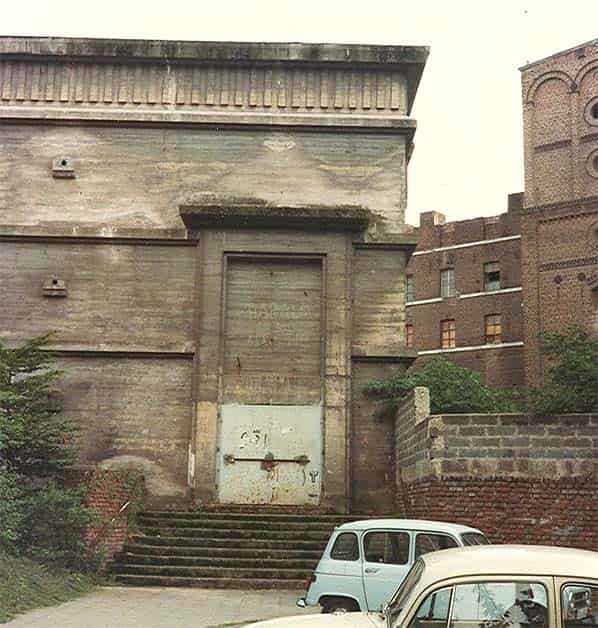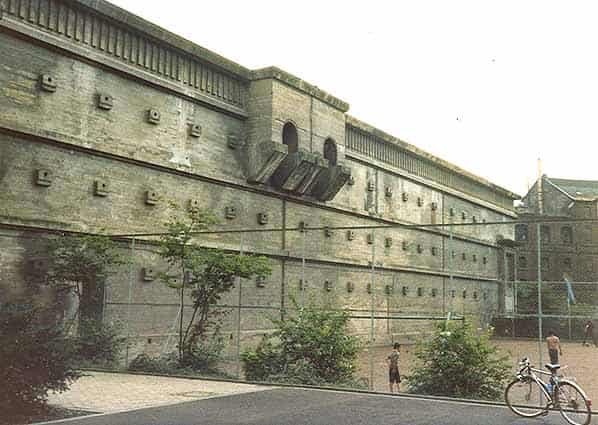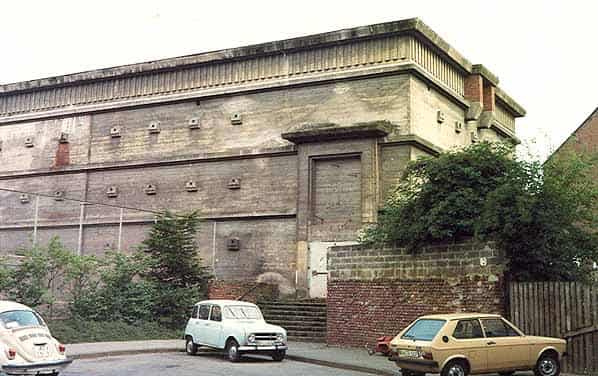
Except when we are talking about coal bunkers-or indeed oil bunkers-we British always assume bunkers to be underground structures. Why this is I am not quite sure, but the Germans did not feel any obligation to build all their Luftschutzbunker (aerial protection bunkers) below ground. In fact they have two words for the notion, Tiefbunker (underground bunker) and Hochbunker (surface bunker).
Many of the bunkers constructed for air raid protection from the mid-1930s onwards were constructed above ground, particularly those constructed under the Führer-Sofortprogramm (Hitler’s Immediate Programme) of 10th October 1940. These were sub-classified into Luftschutzhäuser (air raid protection buildings) and Luftschutztürme (air raid protection towers). Both patterns were very substantial structures of similar construction, the chief distinction being that the ‘towers’ were circular in ground plan.
Underground shelters give a possibly false sense of security. For protection they rely on earth cover and any structures overhead, although if this collapses, caves in or blocks means of escape, the shelter provided is of no real value. The German way of thinking was that above-ground construction was a lot simpler and faster, and if carried out on a sufficiently massive scale, would provide equally good protection. The number of surface bunkers that survived intact (or largely intact) bears out this notion.
Anyone familiar with the fairly paltry scale of organised civilian air raid protection provided during the last war in Britain will only marvel at what the Germans achieved. Whereas London’s underground air raid shelters aimed to protect just 1 per cent of people at risk, in Germany a far more elaborate construction programme set out to provide shelter for 5 per cent of the population in 70 cities, using elaborate above-ground structures of massive proportions. Measured against London’s provision, they were both luxurious internally and elegant externally
After the war these structures proved to be very difficult to demolish and for many new uses were found. Some were turned into residence blocks for students, while in Hamburg a huge bunker became the city’s first television studio centre.