One of Britain’s best-kept secrets of World War II was the Home Guard Auxiliary Units, which used the status of the Home Guard as a cover for their real activities.
In May 1940, Colonel Colin Gubbins formed a tightly structured resistance that was to be supplied with the best weapons available and with modern plastic explosives. He names them the Auxiliary Units, a deliberately nondescript title. Everything about the Auxiliary Units was to be kept highly secret.
Gubbins knew he needed local men to form the small patrols in each area, men who could be trusted and who had a good knowledge of their surroundings. He decided it would be best to obtain his resistance men from the Home Guard. Contrary to popular belief (mainly due to the BBC series ‘Dad’s Army’), the Home Guard was not totally made up of bungling old men. Many younger men who were in reserved occupations joined their ranks. This is not to say that every member of the Auxiliary Units was originally in the regular Home Guard. Potential members were always vetted by the local police before they were allowed to join. All the men had to sign the Official Secrets Act, and, on joining the Auxiliary Units, were issued with Home Guard uniforms bearing the number of their battalion. These battalions were: 201st in Scotland; 202nd in Northern England; and 203rd in Southern England. None of these battalions ever had official recognition, which meant they were not covered by the Geneva Convention. If the men were captured, they would have been shot.
When a patrol was formed, it had to have its own underground hideout. This was known as an Operational Base or OB The hideouts were to be used in the event of an invasion. They were well-hidden and purpose-built to house the patrol along with the necessary food, water, ammunition and explosives. In Sussex there were 23 patrols with 139 men, the smallest consisted of four men and the largest eight.
Each patrol had an underground hideout, the operational base (OB) and in many cases an underground observation (OP) post or lookout was also sited close by. Both the OB and OP were extremely well hidden, usually in woodland or thick undergrowth.
The Firle Patrol was the smallest patrol in Sussex, having only four members. The Patrol Leader was Bill Webber, a market gardener from Firle. The other patrol members were Tom Smith, another market gardener, Jack Cornwall, a painter and John Pilbeam, a farmhand. The latter two men both worked on the Firle Estate.
All the men were originally in the Home Guard until Bill Webber was approached by Captain Gwynn with a view to his joining the Auxiliary Units and forming the Firle Patrol. They all did their basic training at Coleshill and trained locally in association with the neighbouring Bishopstone Patrol.
The patrol’s hideout was sited south of the village of Firle, on the Downs, within a wood called the Firle Plantation. It was built by the Royal Engineers.
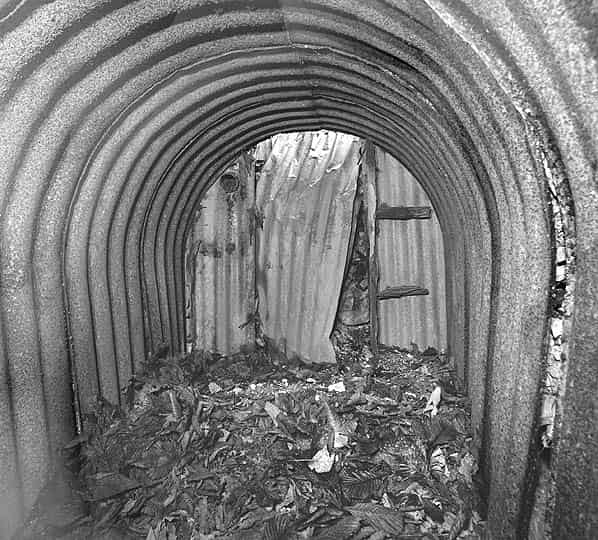
The construction was of wood and galvanised steel sheeting. The whole of the inside surface was lined with cork to try and combat any condensation.
The entrance hatch was opened by lifting a small tree trunk which was attached to it. The earth on top of the hatch was kept in place by netting which had moss and leaves intertwined in it to disguise its existence.
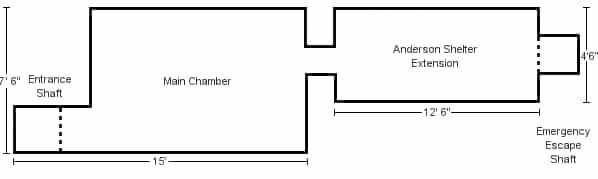
The hideout contained three bunks at one end with a stove. Food, ammunition and explosives took up most of the remaining area. Water was stored in a galvanised tank. An extension was later added to the hideout in the form of an Anderson shelter, along with an emergency exit.
The chalk spoil created from this excavation was spread under the trees in the lower part of the plantation.
Twenty yards north of the hideout the patrol had a small underground store which contained extra food and ammunition. To the south there was an underground lookout, connected to the hideout via a direct telephone line. It only had enough room for one man inside it, and overlooked the main trackway through the upper part of the plantation.
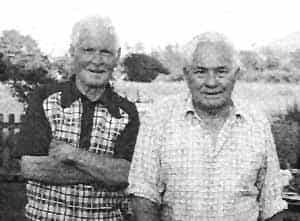
Patrol Leader Bill Webber and Tom Smith are the only surviving members of the patrol. They both recalled using the hideout as part of their training and many nights they walked from Firle to Bishopstone to join their neighbouring patrol in training exercises.
Due to the discovery and ransacking of the hideout by Canadian soldiers, on several occasions, in 1942, this OB was abandoned. The patrol then shared the Bishopstone OB from August, 1942.
Bill Webber recalled the time the patrol followed the River Cuckmere from its haven at Exceat all the way to Heathfield. They had to cross the river at various points during the journey. On another occasion he took a high-ranking officer, based at Coleshill, from their hideout at Firle over the Downs to Bishopstone, using only a prismatic compass and the stars to guide them
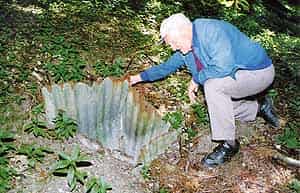
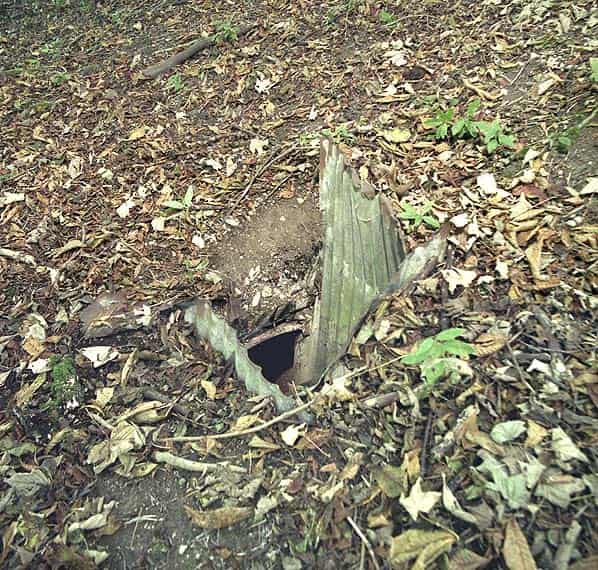
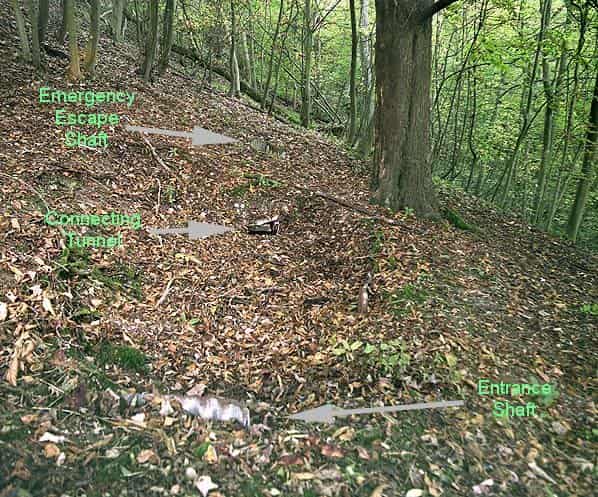
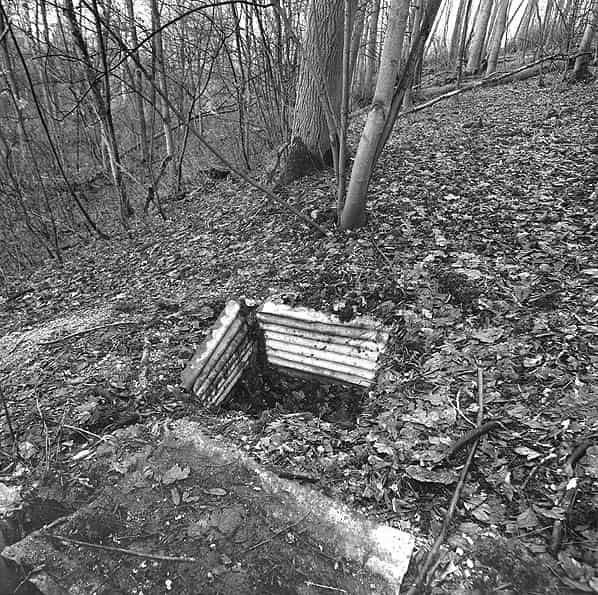
The main chamber of the Firle hideout has collapsed and the only evidence is a depression in the ground and some corrugated sheeting marking the site of the entrance shaft. The Anderson Shelter extension is accessible either by crawling in through the connecting tunnel between the extension and the main chamber or by decending the emergency escape shaft which is tight. The underground store 20 yards to the north is also still extant.
Bill Webber’s Diary
Bill Webber, the Firle Patrol Leader, kept a diary of his patrol’s movements during their operational years. Although the entries are brief it gives a detailed account of their training, visits to Coleshill House and Tottington Manor, inter-patrol competitions and interactions with neighbouring patrols.
The diary contains 124 entries and is about 1200 words. Not every entry that appears in the diary is noted here as it would become repetitive. Only the most informative entries have been summarised, with additional details supplied by Bill Webber, who discussed the diary with the author.
The first entry was made on 5 October, 1941 and mentions a rally at Northease Manor. At this event Captain John Gwynn mapped out the autumn and winter programme for the patrols. He also gave his farewell speech on this day and introduced his successor Captain C G F Bond.
The evening of 22 October, 1941 saw the patrol practicing in the FirIe area. An attack was also made on the patrol’s OB (Operational Base) by Badger I. Badger I was the code name for the neighbouring Bishopstone Patrol (FirIe Patrol was Badger II). This exercise lasted five hours between 1800 and 2300 hours.
A combined patrol operation was held on 29 October, 1941, with both Firle and Bishopstone Patrols at full strength. This involved an attack on a Canadian guard hut at Bishopstone. It lasted six hours between 1900 and 0130 hours. At this point it is worth remembering that all the patrol members had to do their daytime jobs as well as these night training sessions which lasted for many hours at a time.
The weekend of 8/9 November, 1941 was spent training at Tottington Manor. Lectures were given by Colonel Bill Beyts who came down from Coleshill House specifically for that weekend. Colonel Beyts was in charge of training at Coleshill.
On 29 November, 1941, an inter-patrol competition was held at Bishopstone. Competing were members of the Bishopstone, Cooksbridge, Ringmer and Abbot’s Wood Patrols. The events included Mills bomb throwing, pistol, rifle and Thompson sub-machine gun target shooting; and a night patrol efficiency test. Cooksbridge patrol came first, with 84 points, Bishopstone second, with 81 points; Abbot’s Wood third, with 55 points; and Ringmer last with 43 points.
On 10 December, 1941 FirIe and Bishopstone Patrols started practising map reading.
The Sussex final of the inter-patrol competitions was held at Tottington Manor, on the weekend of the 20/21 December, 1941. This was won by Icklesham patrol, who then went on to represent Sussex in the second Home Guard patrol competition final at Coleshill House.
6 January, 1942 saw the FirIe patrol engaged in an attack on tanks in Stanmer Park, just outside Brighton. This took place between 1900 and 0030 hours, the Firle Patrol being successful in their task.
On 18 January, 1942, Bill Webber visited the Patrol’s OB and found that the Canadian soldiers based at FirIe Place had been digging slit trenches within the FirIe Plantation. They had found the OB’s entrance and forced their way in. It was not until 8 February that he found the patrol’s gallon bottle of rum was missing. On 5 March a Court of Inquiry was held on this matter. No blame was attached to Bill Webber and a verdict was made that a person or persons unknown had taken it.
Saturday 14 March, 1942, saw the patrol practice their drill for action, in the event of an invasion by the Germans. They had to get to their OB with all their kit. This started at 0700 hours Saturday morning and finished 1130 hours on Sunday.
On 26 March, 1942, a Patrol Leaders' meeting was held at Allington Farm, East Chiltington. This was where the Cooksbridge Patrol Leader, Frank Martin lived. After the meeting they all visited the Cooks bridge Patrol’s OB.
Captain Bond gave a lecture at Bishopstone on 15 April, 1942, about using and concealing knives. By 23 April this was being put into practice. The patrol attacked a sentry with the object of killing him silently with a knife. This operation lasted from 2000 to 2200 hours.
30 April, 1942 saw another Patrol Leaders' meeting at Allington Farm. The men were issued with the silenced .22 rifles, with telescopic sights, for the first time at this meeting. They were also given a new pass-word. Bill Webber could not remember what this was but recalls that such phrases as ‘Rule Britannia’, ‘South Down’ or ‘Sussex Weald’ were used at any given time.
It was discovered on 20 May, 1942 that the entrance to the Patrol’s OB had been forced open again, and the operational rations ransacked. A Court of Inquiry was held at Bishopstone on 12 June about the loss of the ration packs. The outcome was again that a person or persons unknown had taken them
On 25 June, 1942 a Patrol Leaders' meeting was held at Offham. They learnt that Captain Bond was leaving to take up a new appointment. They also heard details of another inter-patrol competition that was to be held on 12 July
On the days 28 June, 2 July and 5 July, 1942, the patrol trained for the forthcoming competition. The competition was held on the 12 July, as planned, at Mary’s Farm, Falmer. The Cooksbridge patrol won. Bishopstone and FirIe finished third after leading. They lost valuable points on the last event called a ‘relay’. This involved each man running at a target, while firing a sten gun at the same time. Out of a possible 40 points they only gained 10. This put them into third place. After the competition they were introduced to Captain Bond’s replacement Captain Benson. On 31 July, 1942, there was a Patrol Leaders' meeting at Offham. This was the first to be chaired by Captain Benson.
31 August, 1942 saw the FirIe Patrol moving their stores from their OB to the Bishopstone patrol’s OB. This was because the Canadian soldiers had broken into it yet again. Thereafter FirIe shared Bishopstone’s OB and their own hideout was abandoned.
On 20 September, 1942, a patrol meeting was held to work out the coming winter programme. Map reading and patrol work took place in Firle Park.
A Patrol Leaders' meeting was held at Offham on 25 September, 1942, and the next month’s programme arranged.
On 30 September, 1942 Captain Benson visited the Bishopstone Patrol. He was very impressed with the OP (lookout) and OB. While Lionel Willett showed the Captain around, the rest of the Patrol, led by Bill Webber, stalked and waylaid them.
12 October, 1942 saw both the Bishopstone and Firle patrols completing an explosives practical. Both used a standard charge (80z of gelignite) and both charges went off successfully.
Bishopstone Patrol was visited on 29 October, 1942 by the Commander, Colonel F W R Douglas from Coleshill House. The Commander later gave an address to Patrol Leaders at Hailsham.
On 22 November, 1942, a meeting of Patrol Leaders from all over Sussex was held at Tottington Manor. Captain Benson laid down a training programme for greater efficiency and to forestall any staleness that might be affecting the patrols.
On 1 December, 1942 the Firle Patrol had a lecture on the prismatic compass at Bishopstone. After this lecture much more map and compass work was undertaken.
The Patrol were map reading around the Chailey and Burgess Hill area on 13 December. These were strange surroundings which made the exercise much more difficult.
The patrol practised more compass work with the Scout Patrol on 17 December, 1942, during a night time operation in Hailsham.
On 29 December, 1942 Bill Webber and John Willett (Lionel Willet’s son) attempted to cross the River Ouse in a rubber dinghy. Both men were thrown into the water when the craft suddenly turned over. They were both in full kit and the water was very cold! The exercise took place between 1830 and 2100 hours.
A weekend training course took place at Coleshill House from 8 January to 10 January, 1943. This was the second time Bill Webber had been to Coleshill. The first time was in 1940. He was accompanied by Tom Smith, Jack Clark and Charlie Woolmer. Tom Smith and Bill Webber took part in a night operation around Coleshill House. Bill Webber attained full marks for Mills bomb throwing, one of his favourite events.
The weekend 16/17 January, 1943 saw a Patrol Leaders' course at Tottington Manor. This was a very intensive course which included such items as the right and wrong way to stalk, behavior in the OB, firing of the Sten gun, revolver and rifle, lectures on the course of the War, first-aid, care of arms, and giving orders.
On 31 January, 1943, the Firle Patrol visited the Rodmell Patrol to see their OB and OP. 11 February, 1943 saw the patrol crossing the River Ouse at Durham Farm, near Tarring Neville, and walking down to Brookside Farm just outside of Piddinghoe. They returned the same way. The patrol used a rubber dinghy, and both river crossings were successful. This exercise took place between 1900 and 2300 hours.
On 16 February, 1943 there was a Patrol Leaders' meeting at Allington Farm with Captain Benson as chairman. They all heard that Lieutenant Ashby and the Scouts were leaving the Auxiliary Units to return to their regiments. The reason given for this was that they had to prepare and be available for the Normandy landings. Soon after this the Auxiliary Units were asked for volunteers to be parachuted into France as a pre-invasion plan. This would entail two weeks of intensive parachute training which the Auxiliary Units lacked. Both Bill Webber and Tom Smith volunteered from the Firle Patrol. Entries in the diary are few and far between after this date. This was due to the threat of German invasion passing and training becoming more relaxed. Even so the Firle Patrol continued to train as a patrol until the stand down was ordered on 18 November, 1944. The last entry in the diary is 9 January, 1944 and mentions a patrol course at Tottington Manor.