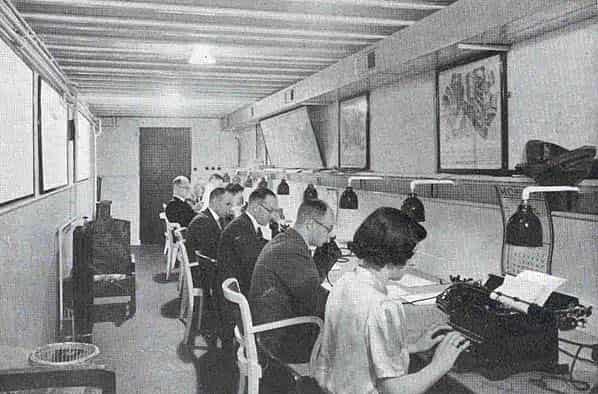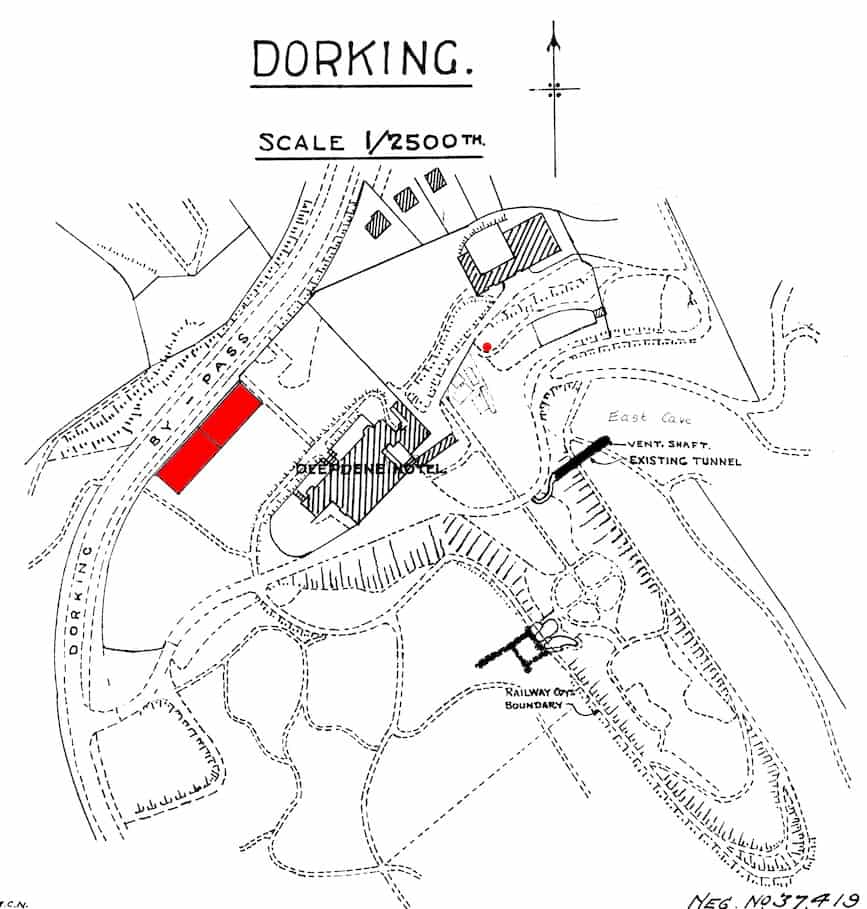
During World War 2, the Southern Railway took over the Deepdene Hotel near Dorking in Surrey for its wartime emergency headquarters. In the grounds they excavated an underground control centre taking advantage of a network of existing natural caves that had been acknowledged 300 years before in the diaries of John Evelyn. Because of the natural protection afforded by the location of the caves they were eminently suitable for the development of a bunker to house both the headquarters' telephone exchange and Traffic Control who also had their underground control centre there with underground divisional controls at Woking (South West Division), Southampton (Western Division), Orpington (South Eastern Division) and Redhill (Central Division).
The Southern Railway’s Traffic Accountant (Passenger, Parcels, Goods and ticket print shop) had taken up residence adjacent to nearby Dorking North station on land that had been acquired before WW2 for a never implemented junction between Dorking North and the Deepdene to Redhill line. Other than the usual air raid shelters, there were no subterranean features associated with that office.
When the Southern Railway purchased the hotel, they retained the name deliberately so as not to alert any change to its former use by those unaware that the hotel was closed. In fact, during the time it was in railway ownership under the hotel name, requests for accommodation were received from time to time and a suitably worded response was given to maintain the subterfuge.
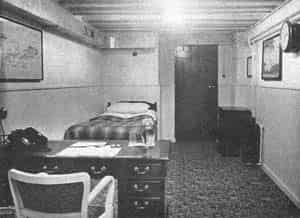
The lawn between the caves and the house was used as a site for the 99 foot mast supporting aerials for the emergency radio. The bunker was constructed within the caves which were enlarged to house the 30 staff and once complete their emergency headquarters with office staff was moved there from Waterloo. The network of tunnels included a Control Room, meeting room, switchboard, battery room, main distribution frame (MDF)/maintainers room, a bedroom for the night officer and an air plant and toilet facilities. The switchboard was a three-positioned installation with Post Office lines and extensions serving the headquarters staff with direct lines to the various divisional traffic and engineering officers; it was in use 24 hours a day.
The night staff of the Operating, Motive Power, Chief Mechanical Engineer, and Chief Electrical Engineer’s Departments also worked in the tunnels, which accommodated a total of 30 clerks. Among the accommodation was a meeting room suitable for any conferences which might have to be held under emergency conditions.
The tunnels were well ventilated and the temperature was regulated by radiators in each room.
The Southern Railway General Manager, Eustace Missenden, lived nearby and had a switchboard extension in his house. During the air raids he spent many nights there with his wife and it is reputed that the Prime Minister, Winston Churchill was a visitor.
Among the features of the control centre were diagrams of all important junctions on the Southern Railway, giving staff immediate access to all information necessary to enable them to make emergency or alternative arrangements for any diversion of traffic necessitated by damage caused by enemy action. Each of the rooms was fitted with a radio receiver for the reception, under emergency conditions, of any important Government announcements which might have been broadcast. The underground control centre remained operational until the mid 1960’s when British Railways moved out of the Deepdene Hotel, which had been renamed Deepdene House from 1st May 1947. One visitor in the 1960’s remembers three operators and he noticed one of the side tunnels still contained bunk beds.
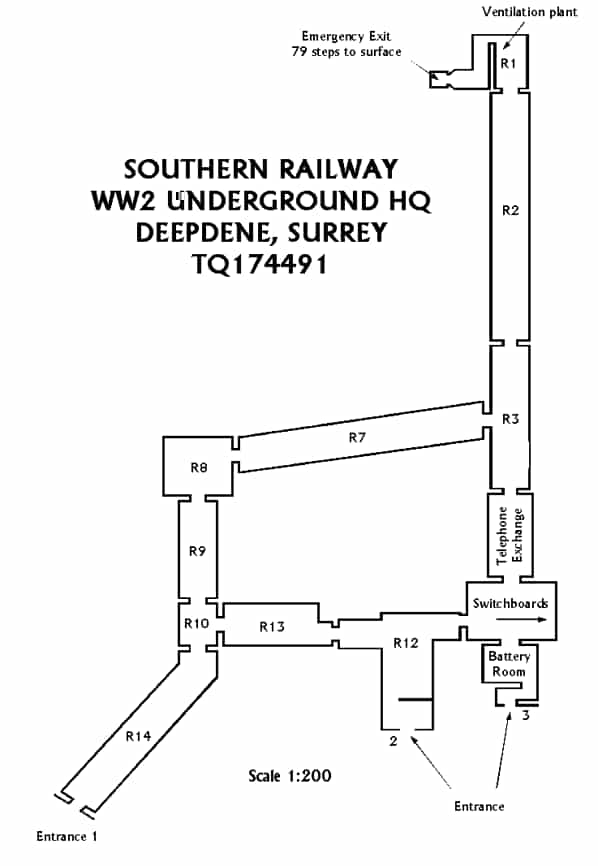
The underground control centre consisted of a series of tunnels driven into the steep hillside to the rear of the house. There were three entrances plus a fourth emergency exit. A 60-foot vertical shaft at the rear of the complex provided an air inlet and the emergency exit. A 4 foot thick concrete slab covered the complex but no protection was provided against a ‘near miss’
British Railways left Deepdene in the mid-1960’s and the house was demolished in 1969 with a modern office block being built on the site; this is now the Headquarters of Kuoni Travel. For many years the tunnels lay forgotten in the bushes to the rear of the office block but in 1997 local children started a small fire just inside one of the entrance tunnels and when the fire brigade came to extinguish the it they found the whole network was heavily contaminated with asbestos, so much so that they had to dispose of all their clothes after the incident.
As a result of this information, Kuoni commissioned a survey of the tunnels by Redhill Analysts who confirmed that most of the complex and two of the small surface buildings were heavily contaminated with both white asbestos (Chrysotile) and blue asbestos (Crocidolite). Shortly afterwards all four entrances, and the contaminated surface buildings were sealed.
In June 1999 Subterranea Britannica approached Kuoni for permission to break into the tunnels to carry out a photographic survey and although English Heritage had previously been turned down permission was granted on the understanding that the entrance was repaired the same day and those people entering the tunnels signed a relevant disclaimer.
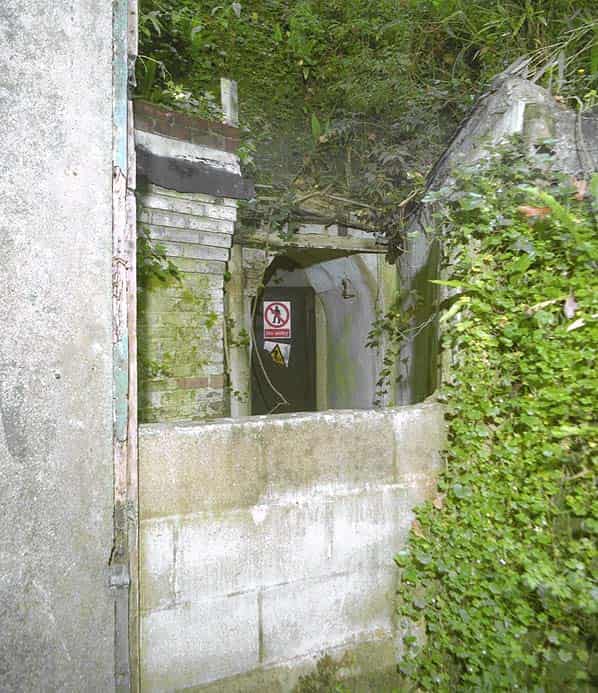
It was decided to force an access into the small blockhouse above the emergency exit that is located 50 feet up the steep wooded hillside behind a grassed recreational area to the south east of the office block.
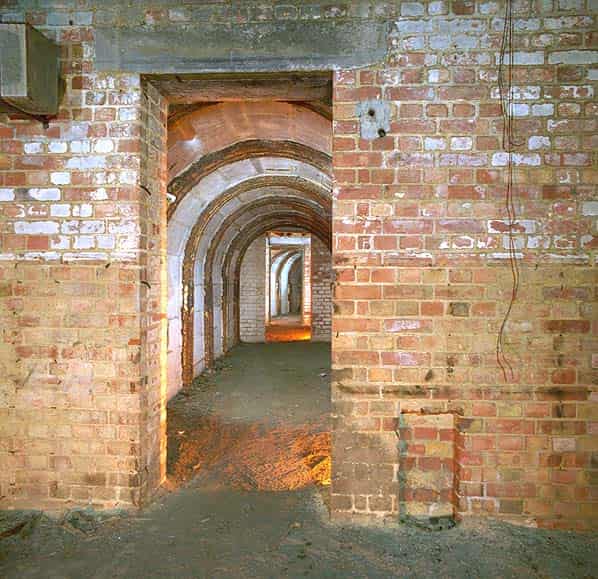
The entrance consists of a small square brick building with a sloping roof. The doorway had been sealed with concrete blocks, we removed several course of these to gain access to the 79 step spiral staircase. At the bottom of the staircase the tunnel turns through a 270 degree dogleg for blast protection before entering the main north - south tunnel that is divided into 6 ‘rooms’. All internal wooden doors have been removed but the doorways remain intact. The first room contains the remains of the ventilation plant with ducting leading through into the rest of the network.
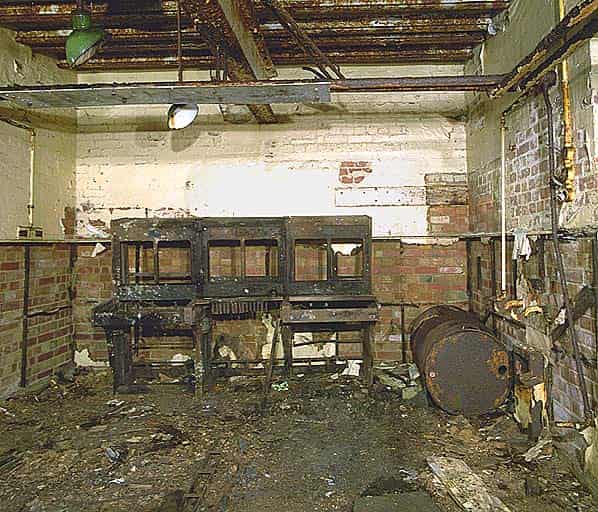
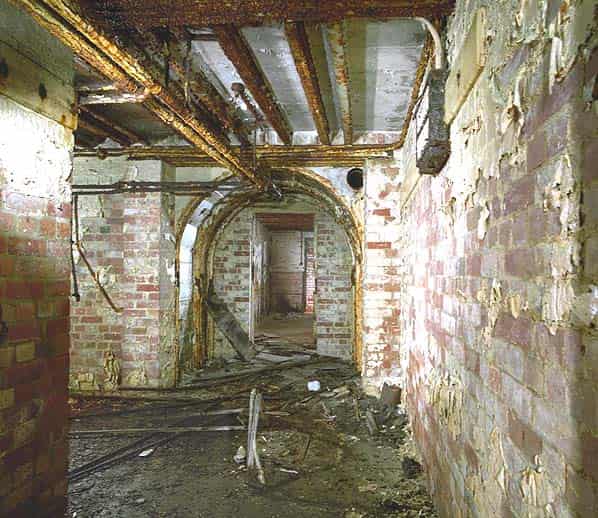
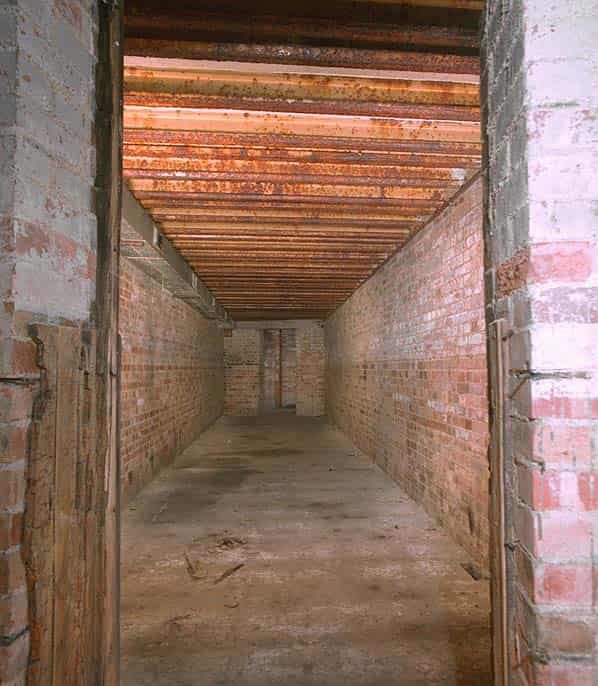
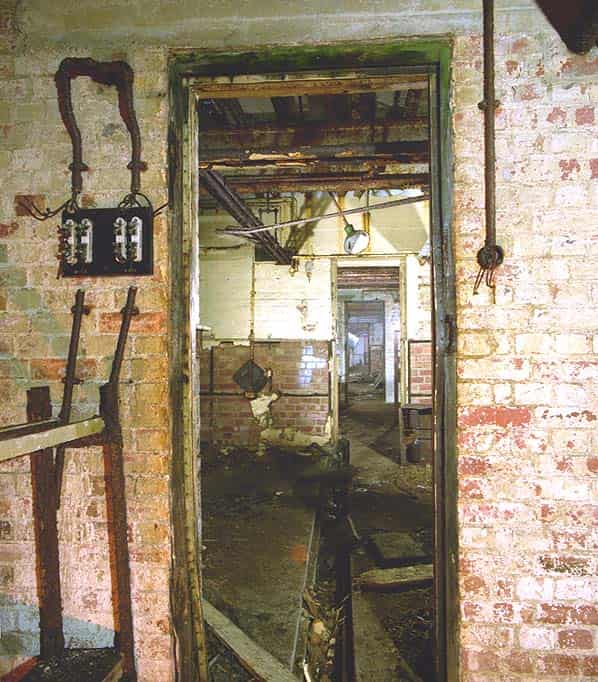
The next room south (R2) is about 30' long with an arched concrete roof supported on steel hoops. Apart from the ventilation ducting high on one wall and an old telecommunications box on the floor this room is empty. R3 to the south is square in section with a concrete roof supported on steel girders. There is a junction with R7 half way along the west wall that also carries the ventilation ducting. R7 was the control room but it has now be stripped of any original fittings (Compare with the picture on the previous page). There are heating pipes along the east side with a pile of fire damaged asbestos panels leaning against the wall.
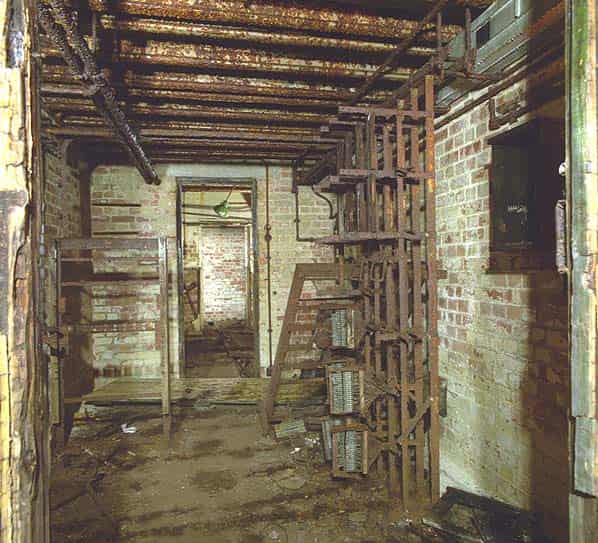
R4 contains rusting main distribution frame with some of the panels still in place. This leads into R5 that is the hub of the control centre with tunnels leading off in three directions. Against one wall are the remains of three floor standing switchboards.
The final room south (R6) has battery terminals on the walls and would probably have contained the back up power supply for the telecommunications equipment. There is a dogleg to the south leading to entrance No. 3 and the external boiler house. The external door is still in place and locked but there is now a concrete block wall in front of it.
Returning to R5 an east - west passage runs through three rooms. The first (R12) is ‘T’ shaped with an electrical switch box on the north wall. To the south there is a blast wall and entrance No. 2. To the west R13 has an arched roof, this room was the site of the fire. This leads into a small square room (R10) where it joins the second north - south passage. R14, which has an arched concrete roof curves round to the west and entrance No. 1. North from R10, R9 also has an arched roof and apart from some pipe brackets on the wall is completely empty and free from debris. R8 is another square room leading at right angles into R7. This long room is also completely empty and links back to the main north - south passage.
As well as the ventilation ducting throughout the network, much of the wiring is still in place together with switches and light fittings. The tunnels are all of concrete construction with the walls lined in brick. Unless stated, all roofs are flat concrete supported on steel girders.
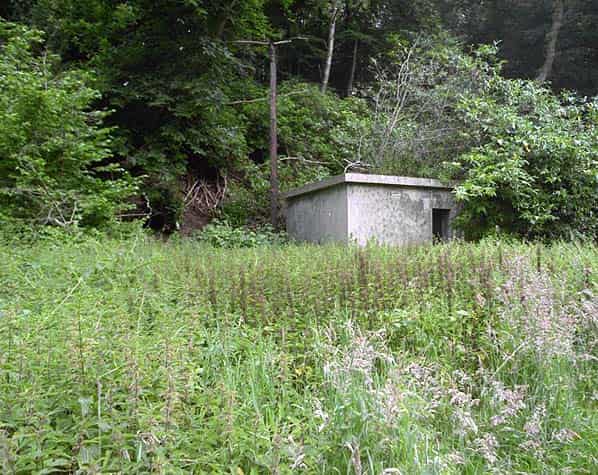
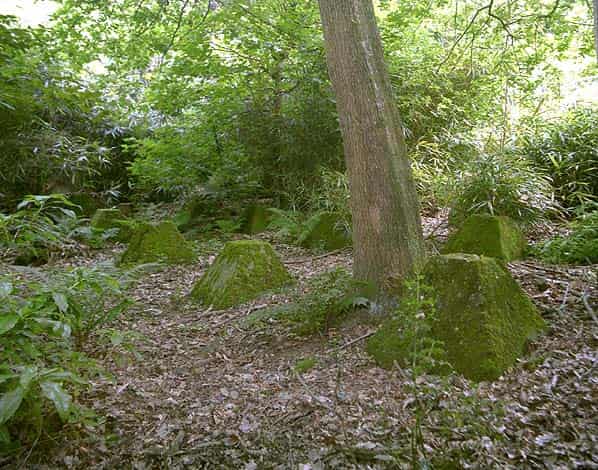
There are three external buildings. To the south of entrance 3 is the boiler room which was not entered. This building is heavily contaminated with asbestos and has been sealed. Close to entrance two is a rectangular building. This was the external toilet block. Like the boiler room this is also contaminated and has been completely sealed. A third rectangular concrete building lies on the other side of the recreation area. This building is still open and its purpose is unknown. There is a disused telegraph pole beside it. In the woods to the south of the site are three parallel lines of anti-tank pimples (dragons teeth).
After concluding our photographic survey the concrete block wall across the emergency exit was repaired and the site is now secure. Kuoni have made it clear they would not welcome any further requests for access.
Sources:
- Norman Langridge