A denehole is an underground structure consisting of a number of small chalk caves entered by a vertical shaft. The chalk uplands of Kent once contained many hundreds, if not thousands, of deneholes of various types. The origins and purpose of these man-made excavations was the subject of intense interest and debate in the latter 19th century.
At this time, many theories were put forward to explain why these structures were excavated, varying from Druids' temples, flint mines and ancient hiding places to elaborate animal traps. By the end of the 19th century, however, opinion had polarised between ancient grain storage pits and chalk mines. Subsequent investigation and research by the Kent Archaeological Society and Kent Underground Research Group confirms that deneholes are no more than small chalk mines. The vast majority were sunk to obtain an unpolluted supply of chalk to spread on the surrounding fields as a fertiliser. The method had much to recommend it as a small shaft at the edge of a field would not interfere with farming operations and could easily be blocked when mining ceased.
Opencast extraction would, on the other hand, have meant the removal of a thick overburden and the loss of precious arable land. This method of winning chalk was in use in Kent before the Roman conquest and continued in varying forms, with a brief break in the 15-16th centuries, until the turn of the 20th century. In fact, whilst the archaeologists were arguing as to the age and use of these mysterious holes in the 1880s, similar excavations were still being dug, often in the same areas as their older counterparts!
Although there are many variations of the basic denehole ground plan, there are two distinct types.
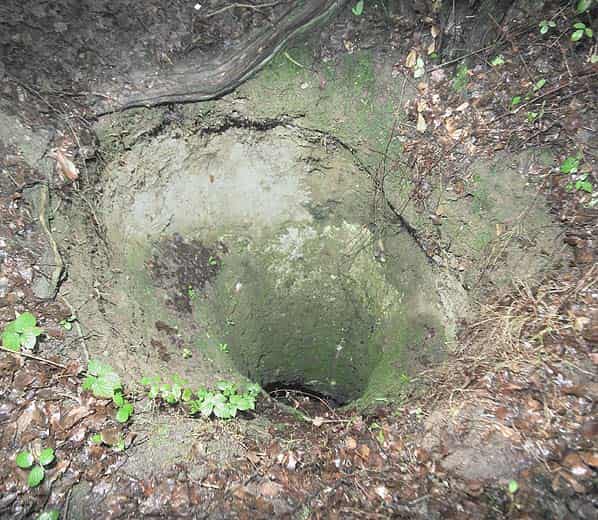
Within the two main types there exist variations in shape depending on the mining techniques employed and there are also regional differences as separate mining teams developed their own particular style. The first (and regarded as earlier) type consists of a narrow shaft, about 3ft in diameter, sunk through the overlying strata (usually Thanet Sand) until the chalk was reached. Footholds were cut on opposite sides of the shaft so that miners could climb in and out without a ladder. After reaching the chalk, a number of chambers were excavated and these were often in two sets of three to give a double cloverleaf or trefoil pattern. This type was being dug up until the late 14th century and is usually referred to as the true denehole.
The second type is generally known as a chalkwell (or draw well) and was sunk in areas where the chalk was overlain by a heavy soil such as clay. The shaft of these types is wider, from 4-6ft in diameter, and the chambers consist of between 2-4 roughly cut caves radiating from the base of the shaft. This type was being dug from the 17th century right up to the beginning of this century.
The shaft was sunk as close as possible to the field boundary so that any future subsidence would not interfere with ploughing operations.
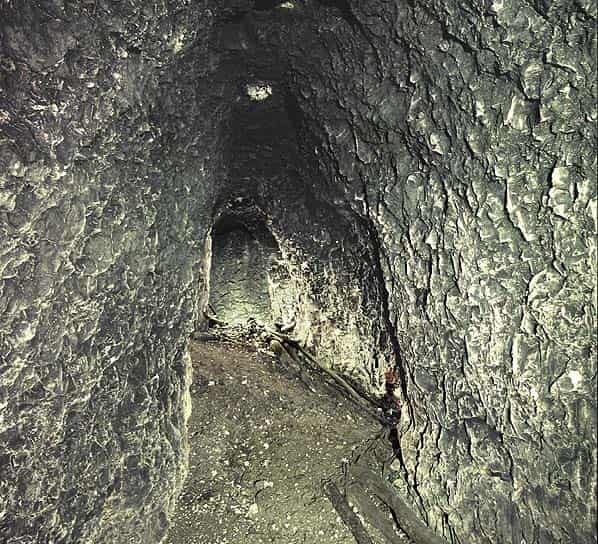
Once the spot for the shaft had been chosen and cleared as necessary, it would be sunk vertically through the Thanet Sand, using the hauling rope and basket as a plumb line, until the chalk was reached. After leaving about 3ft for roof thickness, two opposing headings were commenced as the start of the usual double trefoil plan. The excavators had developed the most efficient shape for extracting the maximum amount of chalk with the minimum of effort. They were constructed with care to ensure stability and reduce the risk of roof fails. The excellent finish and obvious knowledge of mining techniques indicates that most deneholes were dug by groups of professionals hiring out their services to the local farmers.
A mining team would have consisted of three men. One would work below ground cutting out the chalk using a short-headed iron pick, working forward in a series of steps or ‘benches’. The chalk was hauled to the surface in a basket by the miner’s two companions, using a small windlass mounted over the shaft. The length of the underground chamber was determined by the friction generated by the hauling rope on the chalk at the base of the shaft. The miner thus filled the basket at the working face and, when the friction became too great for the surface workers to haul it up that part of the mine considered finished. Most deneholes have deep grooves visible at the base of the shaft where the hauling ropes have cut into the soft chalk.
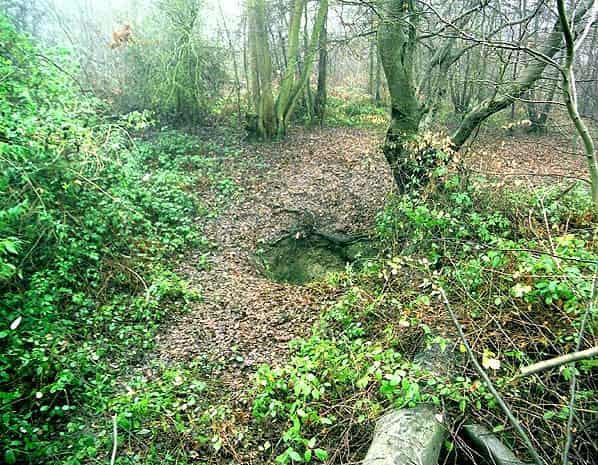
When excavations had ceased in the denehole, a bush or tree stumps were thrown down the shaft. These would invariably jam part way down and the shaft was then backfilled to surface. Many denehole sites are now in woods or long narrow copses where farmers have planted trees in the past to isolate the area.
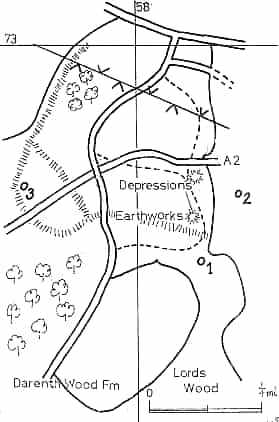
Very few deneholes are still accessible but one at Darenth Wood (3), it is unusually shallow with an uncapped 20' vertical shaft leading to six chambers. The roof of one chamber has collapsed and the hole so formed provides an easy entrance with an easy scramble down. The walls are disfigured with dates, mainly from the 1950’s and are blackened with soot from a fire; an old wheelbarrow lies under the shaft.
No. 1 is on the eastern edge of the wood at TQ583724. The shaft is 45' deep and 3' wide and has been grilled by the Kent Underground Research Group. Six chambers open out at the bottom. No 2 is filled with rubbish so descent into it isn’t possible.
Although most deneholes are found singly and in distinct association with ancient field boundaries, some are found in groups of up to 70+ separate shafts. Great care was taken by the miners in these groups that individual deneholes did not communicate underground. Sometimes less than 3ft of chalk would separate two deneholes and this was to ensure the overall stability of the area and reduce the risk of subsidence. Two of the largest groups are near Bexley, Kent, with 35+ at Cavey Springs (TQ500727) and 50+ at Stankey Wood (TQ596728). With a large output from such sites it is probable that the chalk was used for other purposes and the deneholes at Bexley almost certainly provided chalk blocks for building.
Sources:
- Chelsea Speleological Society Records Vol. 4 - January 1966