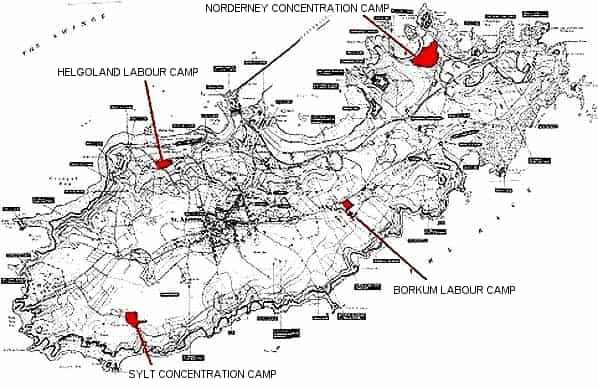
By June 1940 most of the inhabitants of Alderney had been evacuated with labour brought in from Europe to construct the islands defences. In January 1942 four camps were built with a volunteer labour force of French workmen to house these workers. Each camp was named after a German North Sea island, Helgoland, Norderney, Borkum and Sylt.
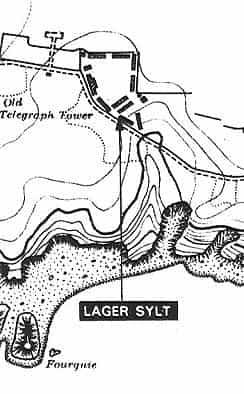
Of the four labour camps ‘Lager Sylt’ was in reality a concentration camp; it was handed over to the SS Construction Brigade in March 1943 and used by Organisation Todt (OT) to house Russian and other forced labourers. Sylt and Nordeney were the only concentration camps ever to exist on British soil. Sylt remained in operation until June 1944 acting as a satellite camp of Neuengamme near Hamburg but the inmates came from Sachsenhausen, a camp near Berlin.
Islanders who were caught breaking the law or who were seen as being undesirables could find themselves drawn into the continental prison system and for some the journey ended in the concentration camp.
Life in the camp was very rough with regular atrocities meted out by the SS. One former inmate, Wilhelm Wernegau recalled “It is difficult to conceive how it was possible to survive this camp life and the extremely hard work of building bunkers and fortifications. At one stage our camp was half empty, as around five hundred men had died from being murdered, from hard work, from starvation and from the climate. Some were beaten to death and many more were strangled. Occasionally men were hanged. The most popular form of killing by the SS in Sylt was strangulation. Many were also shot.
There were three extremely sick Russians who were left to lie in the camp for several days during which time they were given nothing at all to eat. And then an SS officer gave an order to carry them out of the camp to the gate where he shot them there. He explained to us that he did it because these men were very sick and they would infect the whole camp with their illness. I pointed this man out after the war, but he walks around today a free man. He was the one who did this. When people could no longer work there was only one thing that happened to them. The SS would kill them.”
Another former inmate Font Francisco recalled, “While doing jobs in Alderney we were near Sylt one day where we saw a Russian strung up on the main gate. On his chest he had a sign on which was written ‘for stealing bread’. His body was left hanging like this for four days”
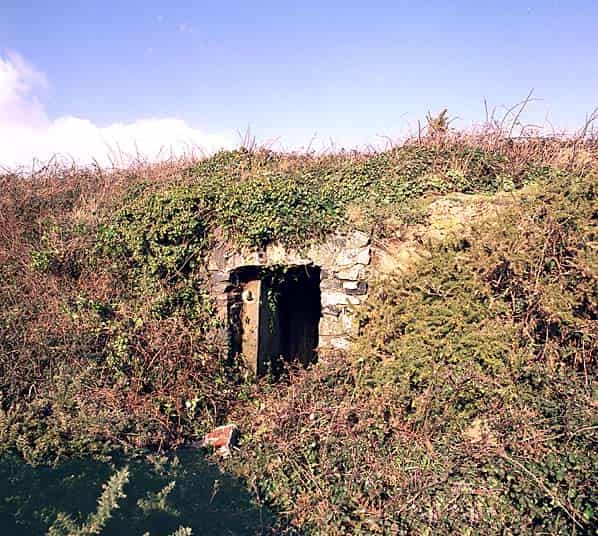
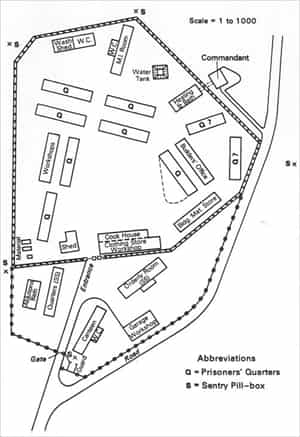
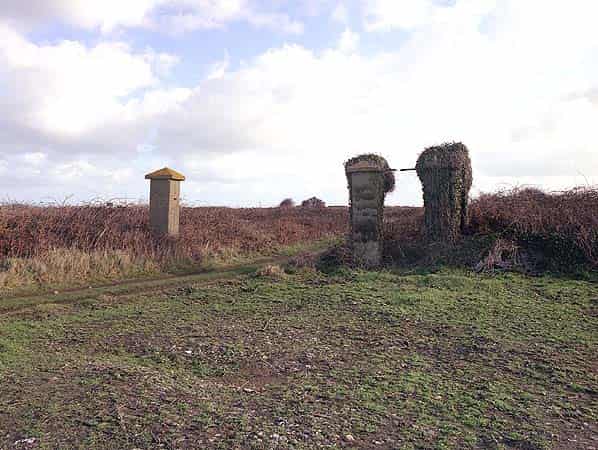
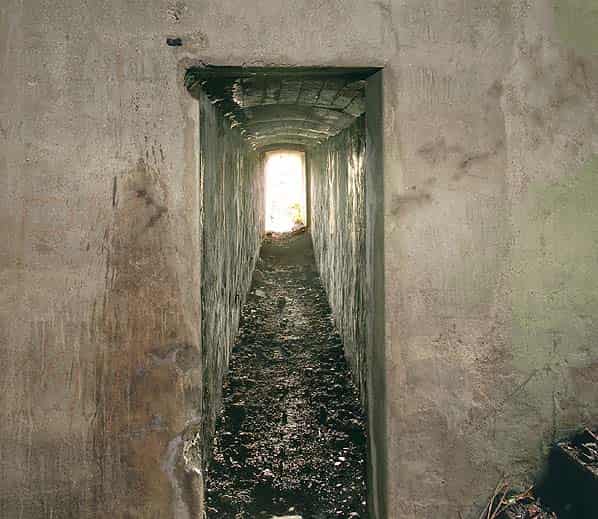
Today little evidence remains of ‘Lager Sylt’ as the camp was completely cleared by the Germans before the end of the war, presumably to cover their tracks. The entrance to the camp is clearly identified by two concrete gate posts alongside an unmade road close to the southern perimeter of the airport. There is also a short concrete lined tunnel that connected the camp commandant’s house outside the perimeter fence to the camp, entering the camp below the ablutions block in a 3 metre square room with stairs up to the surface; this is the only remaining building on the site. This concrete lined tunnel is 2 metres high and about 10 metres in length. The commandant’s house was demolished in 1989 and moved to another site on the island. Around the perimeter were five conical concrete sentry posts, at least two of these still exist.
The States [Alderney’s governing body] decline to commemorate the sites of the four labour camps, local historian Colin Partridge feels this may be due to the locals' desire to dissociate themselves from the accusations of collaboration. A faded memorial plate, tucked away behind the island’s parish church, vaguely mentions 45 Soviet citizens who died on Alderney in 1940-45, without saying how they died and why. Colin Partridge is convinced that a decent memorial must be built on Alderney. He and a group of enthusiasts have managed to establish the names of all 460 people who perished in the island’s four camps. To begin with, they are now planning to unveil a memorial plate with 460 names on it.
Sources:
- Fortifications of Alderney by Colin Partridge & Trevor Davenport
- Forced workers by Jersey Heritage Trust