This Group HQ is built into the side of a hill. Administration was housed in the former 1941 prefabricated ROC Centre although the WW2 control room was demolished when the new bunker was built.
After stand down, Yeovil Group HQ was retained by the Home Office, acting as a nodal point for the emergency communications network which was established there in July 1993 under the guise of G-CAT Computer Centre. This included the installation of a new SX2000 ECN unit, two computer terminals and a second standby generator. Some time in the mid 1990’s the site was offered for sale and the PSA ‘For Sale’ sign is still leaning against a wall. As the council refused planning permission for four houses on the plot the sale was abandoned and the centre remained in use until the spring of 2001 with an upgrade to the ECN equipment in 1999. During that period the grass was regularly cut and the bushes around the perimeter trimmed.
Since closure in 2001 both the bunker and the administration block have been broken into on several occasions and the bunker has become a regular haunt for tramps, drug users and drug dealers. The police have been called by local residents on numerous occasions and the Home Office have been informed of the deteriorating state of the buildings. According to local residents, the site is once again to be offered for sale. Representations were made to the Home Office and the Council after this visit and the site should now be secure.
The 9 Group Control lies at the end of a quiet suburban cul-de-sac and is surrounded on two sides by a steep wooded hillside. Southwoods ends just past the main gate to the compound and a public footpath continues along one side of the compound through the woods to the west.
The original 1941 administration block stands in the centre of the site with the new 1963 bunker at the western end. It is of the semi-sunken variety consisting of three floors. The small upper floor is contained within a small concrete blockhouse, often referred to as an ‘Aztec Temple’. The middle floor is at ground level but mounded over and grassed with a concrete retaining wall on the east side to prevent slippage. The bottom floor is completely below ground.
The main entrance to the bunker is at the top of a covered stairway from the administration block. Unusually at the top of the stairs is a wooden door into the bunker which opens onto a short corridor. The first room on the right houses a small fan for cooling the generator and plant in the room below; alongside is a filter room with the racks of filters still in place. The two rooms on the left were originally for decontamination with sinks and water heaters but the first room now contains a small diesel generator to provide back up power for the ECN equipment and the second room houses a fuel tank. Beyond these rooms are the stairs down to the lower levels on the left and straight ahead a room that originally contained a winch for dropping heavy equipment down to the lower levels. The winch has gone but the gaping hole in the floor could present a danger for casual visitors. To the right of the winch room is a large tank room.
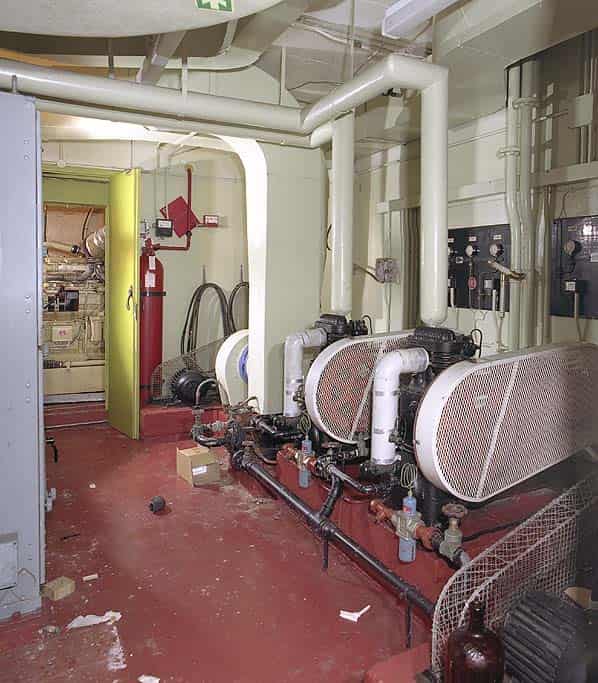
At the bottom of the stairs is a dog leg with a steel blast door opening on to the north - south spine corridor. The first room on the right is the ventilation and filtration plant room with all the original ROC plant remaining in good condition. This includes the main intake fan which draws air through the filters into the trunking system running through the bunker. There are also two smaller fans, two compressors, a large floor standing control cabinet and a metal cupboard for spares. In one corner of the room are the filters contained within their own room with a gas tight door. At the back of the plant room double wooden doors open onto the standby generator which is housed in its own room. There is a second floor standing control cabinet. All the plant and the generator appears in good order and is undamaged by recent vandalism.
The next room on the right is the canteen which is accessed along a short corridor. A door on the right hand side of the corridor opens into the kitchen. Most of the original ROC fittings have been removed at some time and there are now a large number of floor and wall mounted wooden cupboards, a food preparation surface and a stainless steel sink and draining board lying on the floor. There is a serving hatch into the canteen with its glass window broken. The canteen is empty apart from electrical switch gear in cupboards along one wall.
The next room on the right is the BT equipment room. The SX2000 would have been installed here but this has been removed. There is however a large floor standing cabinet containing an optical/electrical line interface. This appears to have been fitted recently, perhaps during the 1999 refit. Behind it there is a wall mounted cabinet marked ‘E.P.D. control interfaces’. There are numerous cables in trunking around the room including a bunch of optical fibres.
Beyond the BT room are stairs down to the bottom level and then the first of two doors on to the balcony. The frames for the revolving post display boards are still in place along one side of the balcony as is the frame for the tote slats. The triangulation table is in its alcove although its Perspex top has gone. There is a slot for the fixed survey meter in the alcove with the bottom of the probe pipe in the ceiling above. The far side of the balcony opens back onto the spine corridor. Beyond this is another steel blast door to the emergency exit. Beyond this door is a ladder up to a short landing then a second ladder up to an ROC post hatch. This was the original emergency exit but a second stairway was added in the 1970’s with a wooden door at one side of the mound.
Back in the spine corridor the first room on the left is the sewage ejection room which has two compressors and a compressed air receiver on the upper level and two pumps in the sump below. The next room on the left is the female toilet with a shower, hot water tank, two WC cubicles and two hand basins. The male toilet next door is identical but with one urinal replacing one of the cubicles. The next room is the male dormitory which has lost all its bunks and now has a long table and plastic chairs. The larger female dormitory next door is empty. The final room on the left hand side of the corridor is the officers' room which is empty.
There are three rooms on the bottom level, one of these is a tank room. The radio room appears to have housed the two computer terminals for the ECN network. The switchgear for is still on the wall and there are two heavy stabalised power supplies on the floor. There is also an older valve unit that appears to have a telephone connection.
The control room still retains most of its original furnishings including the control table, the frames for the A & B display screens and a second large floor standing display board. There is a large two level rack of wooden shelves and a floor standing sloping wooden rack with clips numbered 10, 15, 20, 25, 30, 35, 40, 45, 50, 55, 60, 99. This board held the Log Charts. Each cluster had a chart on graph paper of the fallout received at each post. This enabled the scientific officer to see the actual fallout of any post and also the trend, increasing or decreasing. Once fallout maximum had been reached the rate of decay could be drawn (a curved line drawn by pencil). They were not called log charts because it was a log of the progress of fallout but because ‘log paper’ was used. This used a ‘logarithmic’ scale to compress very high readings onto a manageable size sheet of paper.
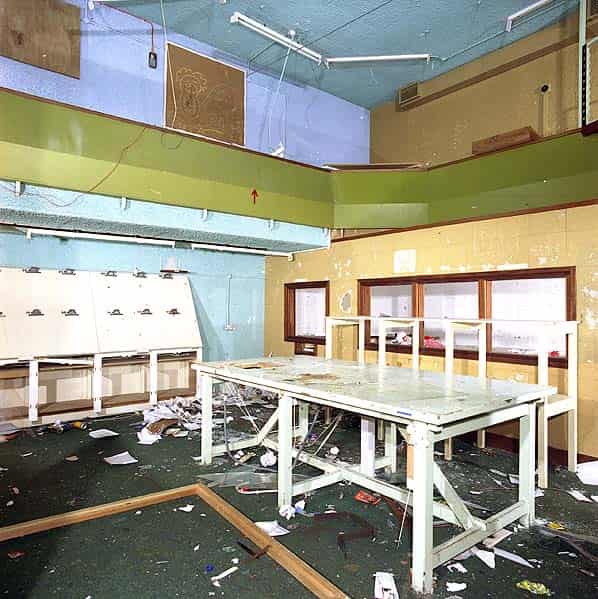
There is a large post cluster map of Yeovil Group and parts of surrounding groups set behind Perspex. There are a number of windows into the adjacent communications centre, one of them has a small message hatch beneath it. The communications centre has acoustic tiles on the walls and tables along one wall.
Throughout 9 Group Control is badly vandalised with many of the rooms strewn with papers, some relating to the ROC but many from the post cold war ECN operation. There are also a lot of telephones lying on the floor in several rooms; some of these are TX14 extensions from the SX2000. There are some damp patches, mainly on the access stairs into the bunker but generally all the rooms are dry. The administration block is completely empty apart from a key cabinet which originally housed keys to all the ROC posts in the Group.
Externally the bunker is still in good condition with its pump up aerial still in place to one side of the surface blockhouse. FSM and BPI pipes and the original emergency exit hatch are still visible on top of the grass covered mound. There is an original dark blue plastic sign, about seven feet long just inside the emergency exit. It says ‘Royal Observer Corps No. 9 Group Headquarters’.
After a number of failed planning applications from several different property developers a family from Sidcup, Kent finally moved into their new luxury house in the converted bunker in 2017.
Those taking part in the visit were Nick Catford, Keith Ward and Nick McCamley.