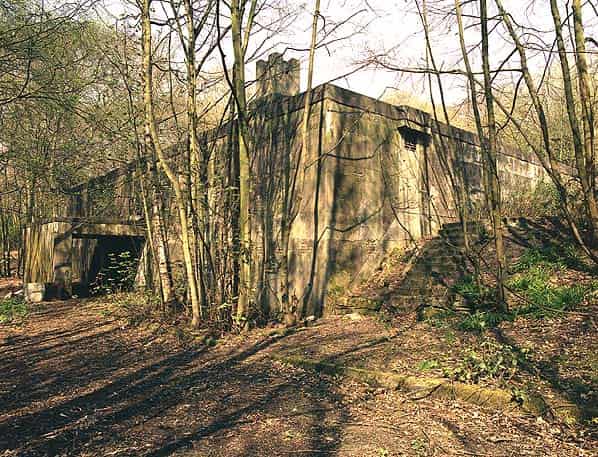
The Worsley post war anti aircraft operations room was opened in 1952 on the site of Worsley New Hall which had been pulled down after the first world war. The AAOR served the Manchester Gun Defended Area (GDA) and was of the standard two level design built into the edge of the hillside in Middle Wood, 50 yards south of the A572 Leigh Road. Unusually one entrance is on the upper level and the other on the lower level; only one other AAOR, at Frodsham in Cheshire, has this entrance layout.
By the mid 1950’s the network of AAOR’s had become redundant and in 1958 the building was used as a Royal Navy food stores deport attached to RNAS Riseley, various papers found in the building verify this use. In 1961 it was bought by Salford Corporation and used as a Joint Area Control with Lancashire County Council and in 1966 it was redesignated as a Sub County Control for the Stretford and Turton areas, one of numerous sub controls reporting to County Main at Lea Road Preston. Following the disbanding of the Civil Defence Corps in 1968 the building was put into care and maintenance until 1974 when it was handed over to Greater Manchester County Fire Service. They in turn sold it on to a local gun club in the early 1990’s. In 1998 it was sold to a Manchester property investment and development company who are hoping to develop the estate as a golf course, if possible retaining and restoring the AAOR and incorporating it into the new complex.
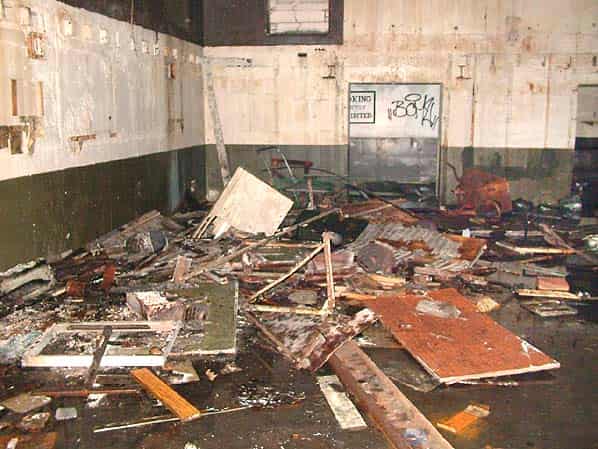
Although no documentary evidence of any other use has come to light the building appears to have been used in connection with the rotor radar network some time after the demise of the AAOR and before it was handed over to the Royal Navy in 1958. On the back wall of the former plotting room, stretching the full height of the two floors, (the spectators gallery has been removed) there is a large map of the entire UK made up on hardboard panels. It shows most of the early Rotor Stations and Chain Home radar stations including SOC’s and what appears to be communications routes linking them. Not all the panels are in place, some are leaning against a wall and a few are missing. This map must date from the mid 1950’s as Trimley Heath is still shown as a GCI station.
There are still various signs on doors, some appear to date from the AAOR period like ‘WRAC Rest Room’ while others indicate a later use. ‘Sector Operations Room’ is on the door to the former Plotting Room and ‘Control Centre’ is on the door of the room behind what was the open gun commanders gallery (now removed). which, in AAOR days, was the ‘Multiphone and switchboard room’. There is also a ‘Blue Dormitory’ and a ‘Yellow Dormitory’. There would have been no dormitories in an AAOR so these must also from a later period.
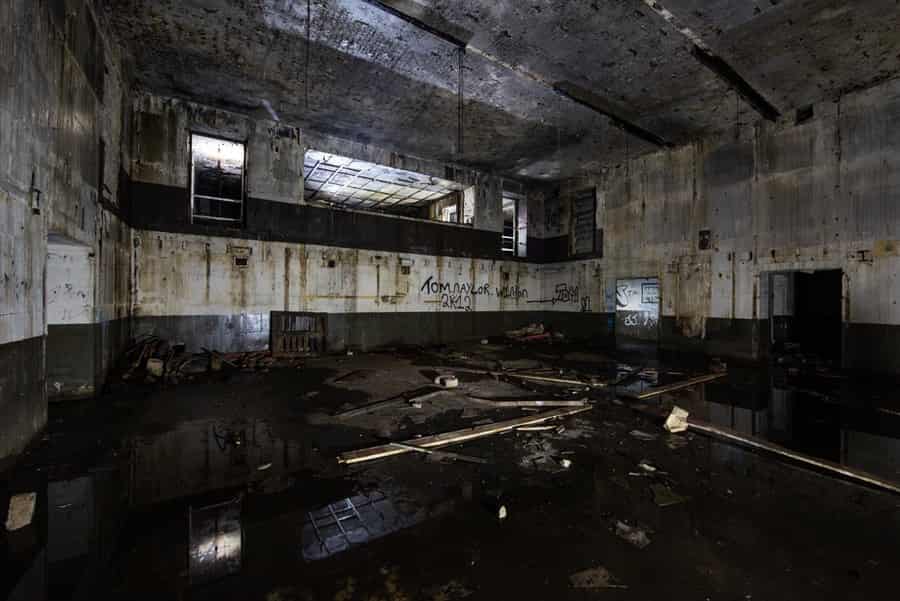
As it was necessary to remove the spectator’s gallery to accommodate the rotor map it can be assumed that the two side galleries and the gun commanders dais were also removed at the same time in the mid 1950’s. At some time the room layout on the upper floor has also been completely changed with the removal of partition walls and corridors along three sides creating three long rooms. These were used as shooting ranges by the gun club in the 1980’s and still retain targets and other shooting paraphernalia. Two of the five stairways have also been blocked off, the west inner stairways and the back stairs.
The main entrance is on the upper level on the north side of the building and incorporates the standard covered porch. The entrance doors have been strengthened by the gun club with the addition of several extra locks and other devices to improve security. Inside the door the corridor to the left has been blocked with access to the building through a new door to the right which joins the former upper ring corridor. The only section of the ring corridor that remains is along the north side of the building. The former WRAC lavatories have been ripped out and the room now houses a kitchen and canteen, this alteration probably dates from the 1960’s when the building was used as a control centre. On the opposite side the officers male and female toilets remain intact and presumably in use until the building was abandoned. The former switchboard room has been used as an office by the gun club and still has windows which originally looked over the gun commanders dais but now look directly into the well below.
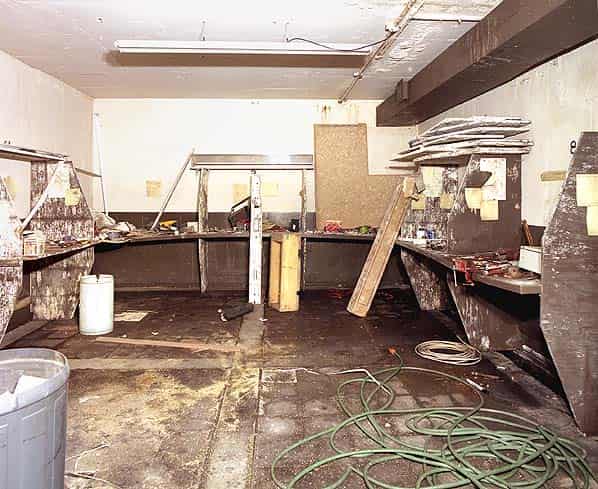
The lower floor is generally unaltered and still retains its original room and corridor layout. Most of the rooms are empty or filled with rubbish, much of it from the gun club. One of the former rest rooms has been converted into a gun safe with a large safe door installed at the entrance and two smaller safes inside.
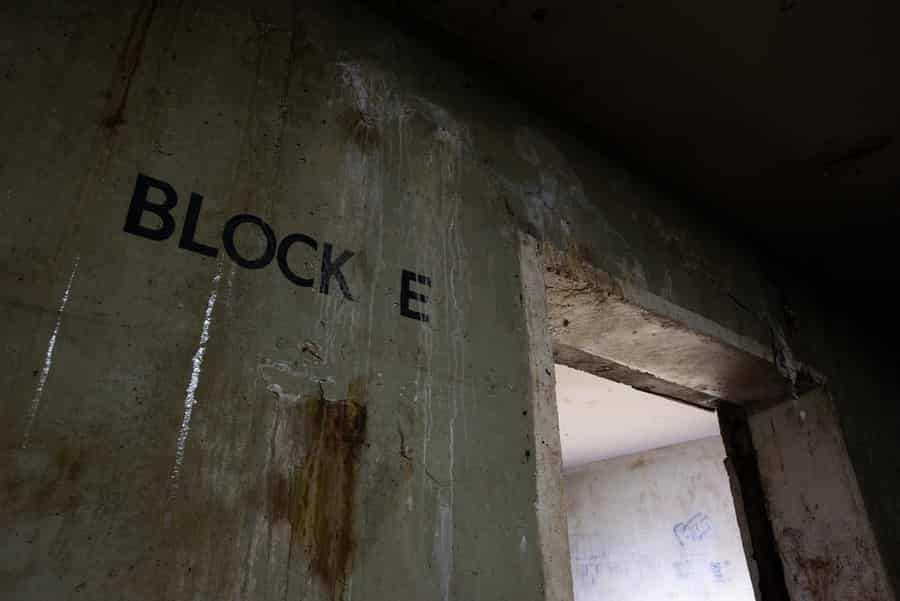
The former ‘Ops Staff Room’ on the east side of the plotting room now has acoustic booths along three walls and was probably used as the signals room during the 1960’s although the brown and cream paint which matches the rest of the building might indicate an earlier use. Its counterpart on the west side, the former ‘Plot Liaison Room’ has also had a later role, being used as a set for the Granada TV drama series ‘Cracker’ in the 1980’s. A prison cell has been built within the room with a steel bar door and a recessed barred window, it looks very realistic. ‘Block E’ and ‘Block F’ have been painted on the walls. There is a large sign on the ring corridor wall which reads ‘Smoking Strictly Prohibited’ and next to it a sign that has been painted over that read ‘Decontamination showers’.
The secondary entrance is on this level on the south side of the building; this has been bolted and welded shut by the gun club. The adjacent standby generator room has been stripped of all its plant but still retains the mains input switchgear and fuse boxes. The power is still connected and most of the lights in the building were found to be working despite the fact that many of the electrical fittings were damp with some dripping water. The ventilation plant room is opposite the generator room, this still contains all its original plant and when tested this was found to be in good working order with all the ventilation trunking throughout the building intact. Behind this plant room is the boiler room which still retains its original boiler.
Some other rooms on the lower level still have names on the doors including ‘Decontamination Equipment Stores’. It is unclear if the two level plotting room was used in the 1960’s as the wall maps predate this period. There is a large room allocations board with room numbering that appears to date from the late 1950’s use of the building. There is also a door, partly hanging off its hinges high up on the wall (originally accessed from the side gallery) and it is possible to read the words ‘Radio Monitoring Equipment’ on it.
The building is very damp in places with some rotting of the timber and is strewn with rubbish dating from all periods and all users. It is not however beyond repair and as the current owners recognise its historical importance it is hoped that its future is secure. It is also hoped that the large wall panels are removed for preservation before any restoration or renovation is done inside the building.
Those taking part in the visit were Nick Catford, Keith Ward, John Fogg, Paul Smith, Mike Shaw and Nick Garside
Historical research by Keith Ward.
UPDATE
Unfortunately since the visit in 2002 the building has been forced open and then left open for many years. Internally it is now in very poor condition, covered in graffiti and badly vandalised. The large wall panels have now been wrecked. (2009). The owners Peel Holdings have been informed on several occasions but don’t respond to e-mails.