RAF Watnall is not an airfield; it was home to the control and administration centre for Fighter Command’s 12 Group covering the Midlands, Norfolk, Lincolnshire and North Wales. As well as numerous surface buildings including the domestic site, the hub of RAF Watnall consisted of 3 ‘bunkers’, the control centre, the filter block and the communications centre. The filter block was a collecting point for information, duplicate and irrelevant information being filtered out here before passing on to the control centre. The layout of these bunkers is similar to Fighter Command’s Group HQ’s at Preston (‘Langley Lane’ or ‘Goosnargh’), Inverness and Newcastle (Kenton/Blakelaw). At Watnall the control centre is completely underground and now flooded while the filter block was built in a railway cutting and covered over. The construction of the communications centre is unclear.
Although construction started in 1938, the control centre was not completed by the outbreak of war and it wasn’t until late 1940 that 12 Group’s new headquarters became fully operational having moved in from nearby Hucknall. The second operations block, the filter block was not finished until 1943.
RAF Watnall was sited on both sides of the B600; the timber barrack blocks were on the west side of the road. A block of four airmen’s barrack huts, nearest Watnall Hall, was of temporary brick construction. A group of six buildings, a large timber building, used as a unit stores, four Laing Hutting buildings and an ablution of temporary brick construction were erected in the grounds of Watnall Hall. The junior officers' quarters was also Laing Hutting in the grounds of Watnall Hall, but to the north of the main site. On the east side was the Officers' Mess, HQ offices and the underground Operations Block, which was some 60 ft below ground. From this underground base there was a direct link into the main defence telephone and teleprinter network with direct lines to all operational HQs. In 1941 work started on a second Operations Block, just to the south of the main site, in a railway cutting close to Watnall Wharf railway siding. This was the Filter Block, which housed top secret equipment. It became operational in 1943 and through the Filter Block passed all information received from all the Radar and Ground Control Interception Stations. Included on this second site was an Air Traffic Control building, Guard Room and two Ejector Chamber buildings, all of permanent brick construction.
After the war, No 12 Group HQ moved to RAF Newton in December 1946 and the operations Block closed. The Filter Block, of solid concrete construction, remained in use. In early 1950 the buildings were updated by 5002 Airfield Construction Squadron and the site was used during the ROTOR programme throughout the 1950s.
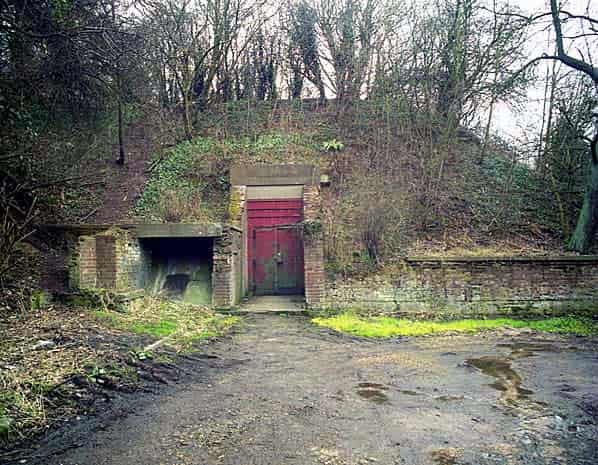
RAF Watnall closed in 1961. The Filter Block was left in a ‘State of Readiness’, the two metal entrance doors being welded shut. But, it was not long before thieves broke in via the ventilation duct and removed the brass and copper nuts and cables. Over the years of neglect many fires were started and various classified documents were either burned or removed. In the building, open for all to see, was a telephone directory (then current), listing all the secret sites in the UK and even the wartime Q sites. It was a security shambles. In the early 1980’s the Filter Block was taken over by the Kimberly Rifle Club and by the mid 1980s it’s Guard Room and the Air Traffic Control building had been demolished. By 1990 most of the site to the west of the main road has become housing and no RAF buildings remain, only the bases of the Laing hutting, which are in woodland. The east side containing the Operations Block is now an HGV Testing Centre and to the south lies Watnall Weather Centre on what was once the Nissen hut site of the Royal Observer Corps offices. The wartime Officers' Mess, later the Sergeants Mess, and the area to the north has been acquired by a haulage firm, and this area has now been landscaped. The area close to the road that once housed the Stand-by-Set House No 3 and the Transformer Kiosk No 3 for the Filter Block now houses a garage and a small industrial estate.
In recent years, the cutting, which is an SSSI, has been leased from the owners, Hardy and Hanson’s Brewery of Kimberley (the land had been donated to them by British Railways in the 1950’s) by English Nature and has become a nature reserve. In January 2001 however, English Nature were three days late in renewing their lease and the Brewery took the opportunity to revoke it and they now plan to use the cutting as a landfill site. The Filter Block itself, which is on a separate short term lease to the Kimberley Rifle Club, was to have been demolished at the same time and that part of the infilled cutting used for an extension of the nearby industrial estate. Planning permission has however recently been turned down in a revision to the local development plan but the bunker is still on borrowed time as the brewery is not conservation minded. Following a joint visit by the Kimberley Local History Society and members of Subterranea Britannica in March 2001, there is now a campaign to list the structure which is one of only three such blocks still in anything like its original state albeit vandalised, partially altered by the rifle club on the upper level and smoke damaged. A spot listing application has been made at the D of CMS in London and the Borough Council are now opposing the infilling of the site following objections from local residents, a nearby bakery and the environmental issue. English Nature have now had their SSSI listing extended until May 2001 during this time a spot listing application is being processed.
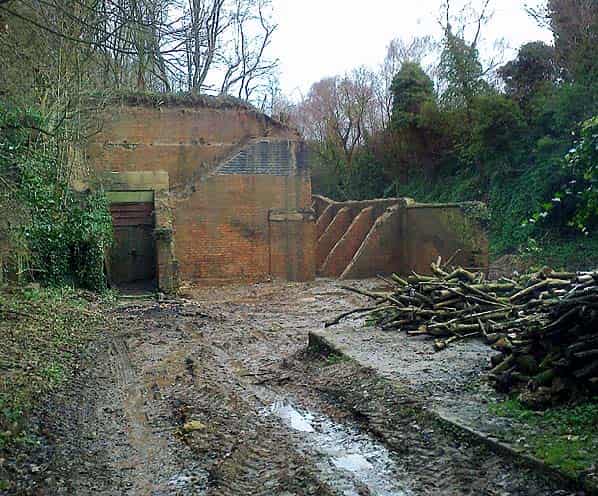
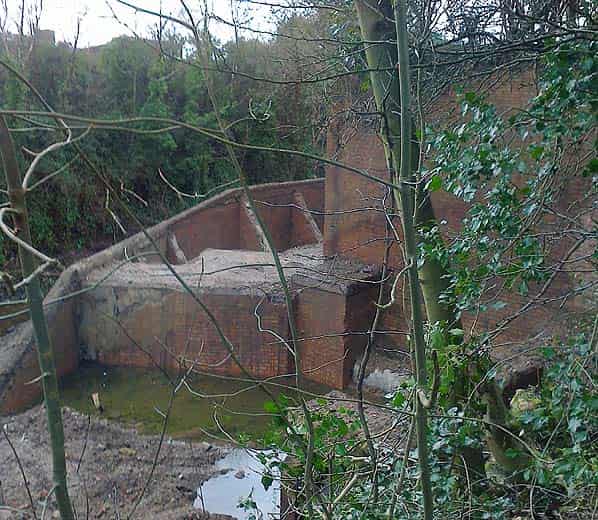
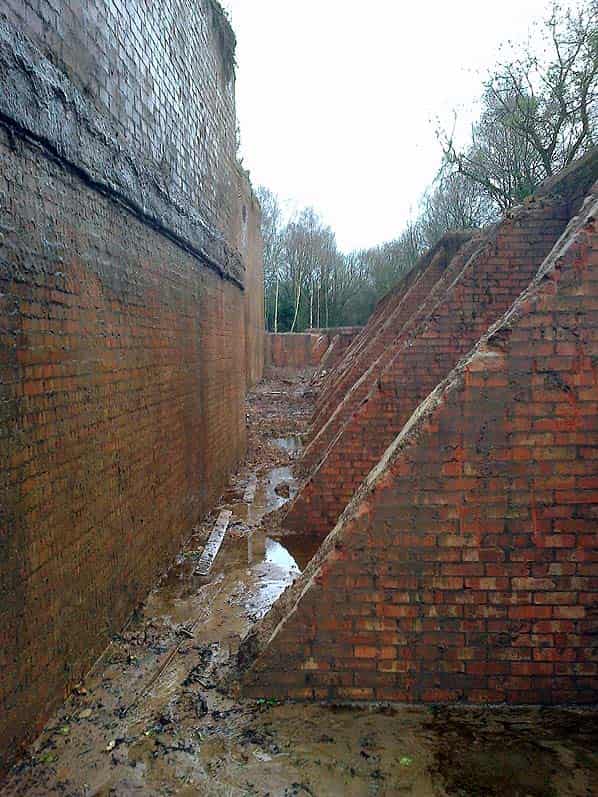
The entrance to the Filter Block (SK506454) is along a sunken road leading from the B600 into the disused railway cutting. The bunker was built at a point where the cutting widened out at the site of the Midland Railway’s Watnall Station (Closed 1917 - the line continued to carry a freight service until 1954). The original disused station buildings were demolished to accommodate the bunker although a narrow platform was retained for military traffic. At the end of the access road there is a large, square, pillbox on the right with views along the cutting where the grass and tree covered Filter Block is located on the north side. It has a brick retaining wall along one side and a second smaller pillbox overlooking the site. The upper floor is actually well above the floor of the cutting, with the top of the mound level with the top of the cutting. The main entrance is at the lower level and is securely locked. Beyond the heavy steel entrance doors the passage turns to the right and up a flight of stairs where it swings round to the left into the upper floor.
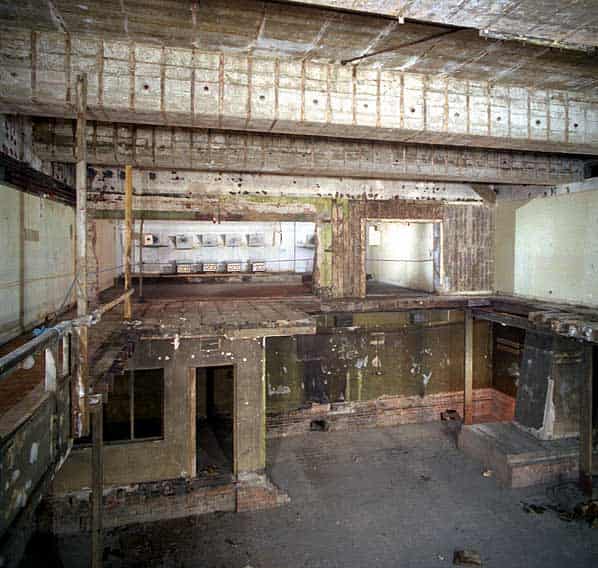
There have been various alterations to room layout on this level to accommodate the needs of the rifle club creating two ranges. Originally, a corridor ran round three sides of the bunker opening up onto a balcony overlooking the central well. At the western end there were six rooms on the inside of the corridor, three accessed from each of the two east-west corridors This room layout has now been altered. The eastern pair of rooms and the end corridor having been converted into one room, which is now the control room for the rifle club. There are two small rooms accessed from the east side of this room, formerly the east side of the corridor. Access to the main stairs down to the lower level is now made from the southern corridor alongside the former two cubicle ladies toilet. The original twin Lamson Tube message handling system terminates high in one wall. (The Lamson tube was a simple pneumatic, mechanical device often seen in department stores in the first half of the 20th century. A tube [approx. 4 inches in diameter] extended around the store and at each sales desk, a capsule could be inserted into the tube. A sales ticket and the customer’s payment placed in the capsule could be sent by pneumatic pressure down the tube to a central cashier. Similar systems, used for passing messages are seen at a number of WW2 military sites including the Eisenhower Centre, a former deep level shelter in London. The inner four rooms have been converted into one large room and this is now the firing end of the rifle range, firing across the well with targets in the room beyond.
The southern east-west corridor carries the twin Lamson Tubes and opens out onto the balcony. The well area has been severely fire damaged and all the wooden rails along the front of the balcony have gone. A doorway has been knocked through into the room to the west of the well and a further room beyond that has now been sealed. The northern east-west corridor has been converted into a second range and is now blocked at the western end along with the top of the second stairway. The upper level is lit throughout with much of the original lighting conduit and fittings still in use.
The lower floor is unlit and all the walls are blackened with soot although two original signs pointing to the exit are visible. A corridor runs around three sides with two male toilet blocks in the shorter north-south section. The urinals and WC’s have been smashed but it is still possible to make out the words ‘Airmen’s Toilet’ on one of the doors. To the east of the well there are four rooms, two accessed from each of the two east-west corridors. Two of these, (on the north side), were probably the kitchen and canteen. On the south side there is a smaller internal room linking the two rooms and the corridor; its purpose is unknown. The northern corridor has two doors into the well while the southern corridor, like its upper counterpart opens directly into it. The wooden floor was destroyed by fire in the 1950’s and has been removed leaving a step down from the corridor. At the western end of the northern corridor there are three steps down to the plant room. This area is wet with an inch or so of water on the floor. At the bottom of the stairs is a rack of electrical boxes and switches on one wall, the blocked second stairway also enters at this point. There are two rooms one of which still contains all the ventilation and heating plant as well as the pumps for the Lamson Tube system. A short passage also with its flooring removed bends round to the right to the emergency exit through the retaining wall and into the railway cutting.
The lower floor is in a derelict state strewn with rubbish and fallen ventilation ducting. It’s not used by the rifle club other than for mounting a small working fan for their own ventilation system.
The entrance to the control centre 400 yards to the north in the HGV testing centre. There is a prominent grass covered mound and to one side a small concrete blockhouse housing the stairway down. It is known that the control centre is now completely flooded although it was pumped out in the early 1990’s to allow a survey to be made.
Historical information was kindly provided by Barry Halpenny with additional information from Roger Grimes of the Kimberley Local History Society.
UPDATE: In September 2012 work started on conversion of 12 Group filter room into a guest house.