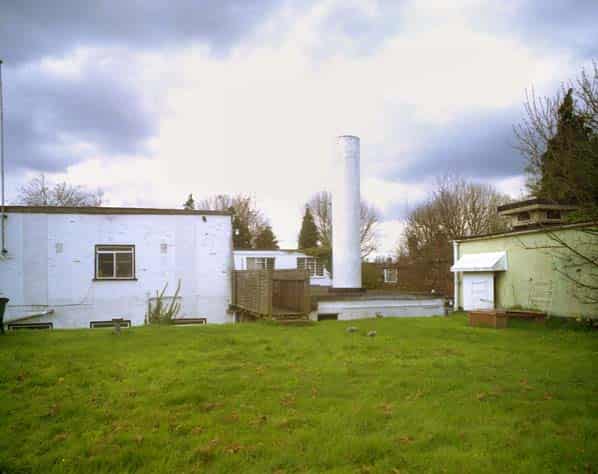
17 Group as it was designated during the war moved into their new purpose built headquarters in 1943 having vacated their former HQ in the GPO buildings in Market Street Watford. The new centre consisted of a central brick built two storey control room with single storey prefabricated blocks around it, similar to WW2 centres at Winchester and Bedford (now demolished). Unlike Winchester and Bedford a brick second storey has also been added to one of these blocks. In 1953 Watford was redesignated 5 Group with protected accommodation being opened at the rear on the 18th November 1961.
The Group was disbanded following the 1968 reorganisation with its posts being dispersed to Bedford, Horsham and Oxford Groups. The buildings were retained as a secondary training centre, attached to Metropolitan Headquarters Uxbridge until 1973 and were sold in 1974.
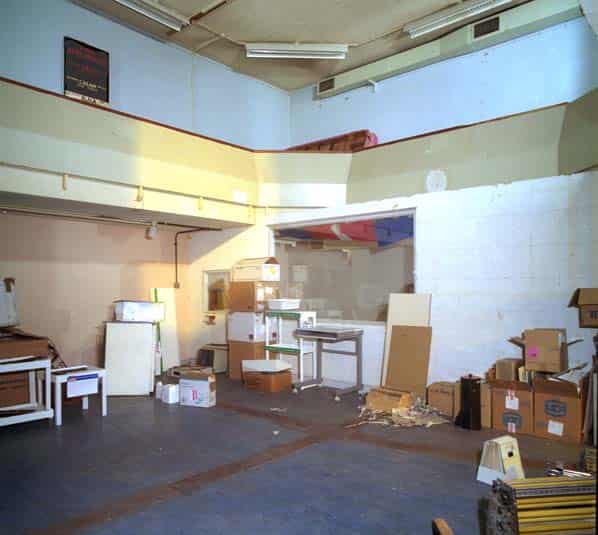
For at least the past 15 years the former Group Control has been used by the Park Veterinary Centre who have the WW2 buildings as their surgery, offices and public reception area. The bunker is used for storage, mainly old records, discarded furniture and medical apparatus and empty cardboard boxes. They have also fortified the radio room on the lower floor for use as their store.
Watford is a semi-sunken bunker with the main entrance into a small blockhouse on top of the mounded middle floor, the surface blockhouse giving access to the bunker is light green while the rest of the buildings are white. There are only a few rooms on this top level, a filter room and two small decontamination rooms. Beyond these stairs lead down to the middle level with a dog leg into the main spine corridor. On this dog leg is the sewage pump room with the pumps still in place and in good condition in a small sump. The corridor is clear of clutter and much as it was left in operational days with some small hanging pointers indicating the rooms still in place. One says ‘GPO Equipment Room’ while another points downwards to the ‘Ops Room, Ground Floor and Wireless Room’. Moving along the spine corridor the rooms on the left are male and female toilets which are both intact with all their fixtures and fittings. Beyond these are the officers room and the male and female dormitories. These have been completely stripped and are now used for storage.
On the right hand side of the spine corridor the first room is the plant room with ventilation and filtration plant, bank of filters and compressors still intact and in good order. At the far side of the room a door leads into the generator room. The generator has been removed although some of the control equipment is still in place. The next doorway give access to a short corridor with the kitchen on the right and the canteen straight ahead. The kitchen has been stripped of all appliances and the serving hatch into the canteen has been replaced by a window. The canteen has a number of electrical fuse boxes on one wall. Both rooms are used for storage. The next room on the right is the ‘GPO equipment room’ which still retains one floor mounted equipment rack. Beyond this is the stairway down to the bottom level and then a doorway onto the balcony. The balcony with its well below are intact and relatively clear of clutter. Beyond the balcony there is a door across the spine corridor, a second door onto the other end of the balcony and a dog leg round the emergency exit. Most centres were modified and a new door installed for the emergency exit, but as this was an early closure the emergency exit consists of a ladder up to a standard ROC hatch. Beyond the hatch is a short stairway and a blast door out onto the top end of the mound.
On the bottom level there are three rooms, the control room with a window into the adjacent communications centre and the radio room which, as mentioned, has now been fortified and is used by Park Vets as their store.
There are several large original black and red signs in the corridors, and in the Ops Room which read ‘Fire Appliances - coloured red for all solid fires, coloured cream for all acid fires, coloured black for all electrical fires.’