Staffordshire County Main Emergency Centre is located in the basement of the County Buildings in Martin Street Stafford. The County Buildings date from 1895 and the basement was first converted into a control centre at the start of WW2 when it was strengthened with metal pillars and beams. It is still fully operational today although it is only used during major emergencies (most recently the foot and mouth outbreak and the fuel strike) and for regional and national exercises. When fully manned it is designed to hold forty people.
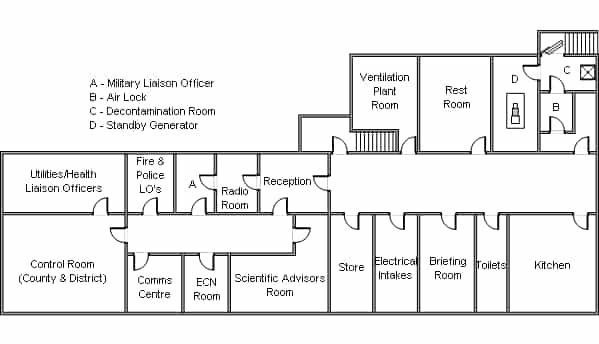
Access is down a stairway from the lobby of the County Buildings; at the bottom of the stairs a steel gas door opens into the middle of a long dog-legged corridor. The domestic areas and plant is to the left and the operations rooms to the right. Turning left into the corridor the first room on the left is the ventilation plant room with 3 Andair CH8450 fans feeding into the ventilation trunking; there is also one cylindrical filter drum. The plant is still fully operational and was in use at the time of the visit. The next room on the left is the rest room which is now used for storage.
The final door on the left leads into a small lobby on the far side of the room is an airlock consisting of two gas tight doors into a decontamination room. On the right of the room is a shower, on the left a door into the generator room and straight ahead a heavy steel and concrete blast door and behind it a flight of steps up to the outside of the building. This is now designated as an emergency exit but in times of war it might have been used as the main entrance into the bunker as it offered blast protection and decontamination. There are overpressure blast valves between the lobby and the air lock and the air lock and the decontamination room. The spacious standby generator contains a Dorman Generator and its associated control equipment and a large diesel tank. The generator is still regularly tested and is in good order. On the opposite side of the corridor is a conference and briefing room, kitchen and toilets. These rooms have now been stripped and put to other uses. There are a number of fibreglass water tanks in the corridor.
Back at the entrance gas door the section of corridor to the right was partitioned during a 1980’s refit to form four rooms and a dog leg to the left opens into a new, narrower corridor. The first room on the left is the scientific advisors room. This has a large 1:50,000 map of Staffordshire on the wall and next to it there was a large map showing ROC posts and clusters but this has now been removed.
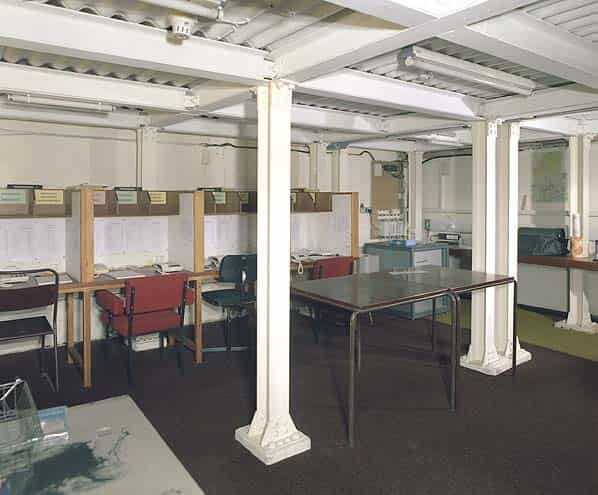
The next room on the left contains the SX2000 County ECN unit and its associated control equipment, this is still in use. The next room on the left is the ‘Communications Centre’ which has four acoustic booths, each with a telephone. During a crisis these phones are manned by a team of operators running a public help line. There are a number of computers at the back of the room including one that came from RGHQ91 at Swynnerton. There is a ‘communications state’ board on the wall showing links to 91 RGHQ, 16 Group ROC HQ (Shrewsbury), County Military HQ, Staffordshire Police, Staffordshire Standby Emergency Centre (in the basement of Hanley Library) and the 9 District Emergency Centres in the County. These are Stoke on Trent City Council, Cannock Chase District Council, East Staffordshire Borough Council, Litchfield District Council, Newcastle-under-Lyme Borough Council, South Staffordshire District Council, Stafford Borough Council, Staffordshire Moorlands District Council and Tamworth Borough Council. All of these had protected emergency centres except Stafford and Tamworth which used offices.
On the right of the corridor there are three rooms. The first room, which is entered through the second room is the Raynet Radio Room. This contains two radio transceivers which are owned by the county but operated on their behalf by Raynet. Both sets operate on the 144 MHz band, one is a Trio TR715E and the other a Trio TR9130. The second room on the right is the ‘Military Liaison Officers’ Room and the third room is the ‘Fire and Police Liaison Officers’ Room, both these rooms contain redundant computer equipment.
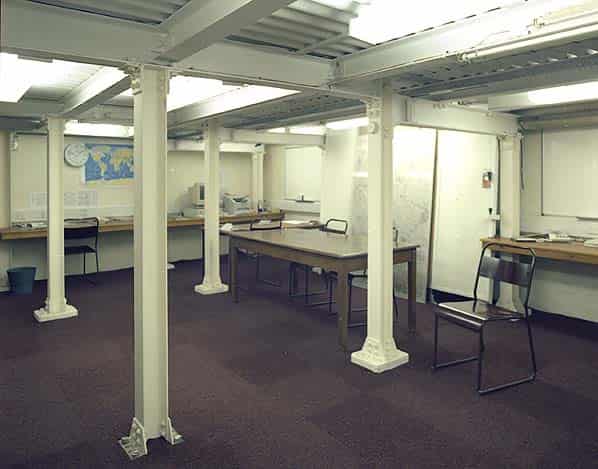
At the end of the corridor a door leads into the largest room in the bunker, this is the ‘Control Room’. There is another 1:50,000 Ordnance Survey map with as Perspex overlay. There are tables around the walls and in the centre of the room, a number of computer terminals, telephones and a large map cabinet. A door on the right opens into the ‘Utilities and Health Liaison Officers’ room and on the far wall is the second emergency exit behind a wooden door. Behind the door is a shaft with a ladder up to a trap door in the street.
Those taking part in the visit were Nick Catford, Keith Ward and Andrew Smith.