The Solihull District Control (Solihull Metropolitan Borough Emergency Centre after 1986) was located in the basement of ‘The Council House’, the Solihull Civic Offices in Homer Road. It was opened in 1967, refitted and altered in 1989, remaining operational until the end of the cold war. Emergency Planning has now moved out of the basement into offices elsewhere in the building and the former emergency centre has now been stripped of most of its original fittings.
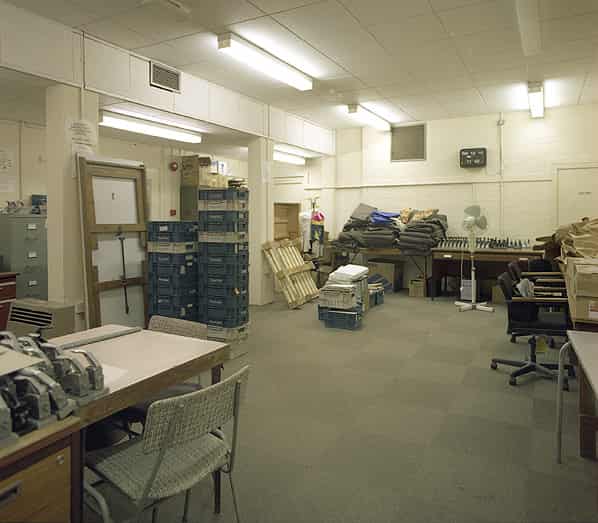
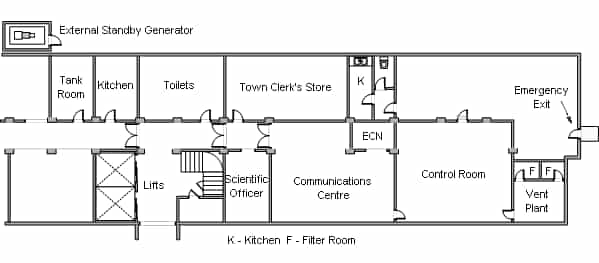
The former control is unusually large taking up approximately two thirds of the basement of the northern of the two buildings that form the Council House. Access to the basement is down a flight of stairs or lift from the entrance lobby; this opens onto a spine corridor. To the left was a tank room, kitchen and toilets, these were all taken out of commission during the 1989 refit and were put to other uses. To the right there is a small room on the right that was originally the Scientific Officers Room and opposite a long room that is shown on the 1989 plan as the Town Clerk’s Store but may have originally been the dormitory. At the end of the corridor double wooden doors lead into the large communications room which is now used for the storage of election paraphernalia. The only evidence of its former use are a number of notices still fixed to the wall and redundant phone and radio sockets on the back wall.
One corner of the room is partitioned off, this still contains the SX50 ECN unit and its associated control equipment. There is currently no line from here to the new emergency centre so if the ECN needs to be used, the only extensions are still in the basement. There is a door from the communications room into the adjacent control room and a second door, now blocked, from the ECN room into the control room. The control room has also been stripped of any original fittings.
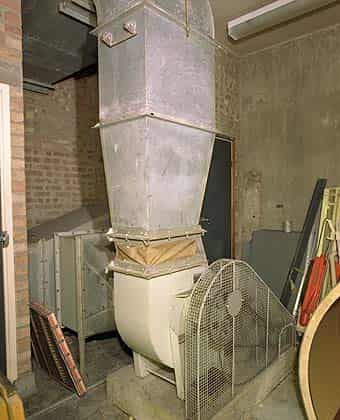
Once again the only evidence of its former use are notices fixed to the walls. At the far side of the control room a wood gas tight door leads into the small ventilation plant room. None of the plant was modernised during the 1989 refit and the original 1967 fan and ventilation trunking is still in place although now redundant; the trunking runs through all the rooms in the bunker. In two corners of the room are two further gas doors leading to the filter rooms with shafts up to the surface; the filter banks are still in place.
Back in the control room another door leads into a large ‘L’ shaped room, it’s original use is unknown. On the left hand side of this room a door leads into a small lobby with a single flushing toilet to the right and a small kitchen straight ahead. The kitchen still retains a stainless steel draining board and sink, water heater and a food preparation bench.
There is a cooker socket but the cooker has been removed. On the opposite side of the ‘L’ shaped room is the emergency escape shaft behind two wooden doors. A ladder leads up to a trap door in the pavement above very close to the wall of the three storey building. There would be little chance of the emergency exit being usable if the building collapsed. The emergency Petter generator and it’s associated control equipment is located in a small external building at ground level, a fuel tank is located in another external building alongside; the generator is now redundant. Apart from the gas doors into the plant room, there are no blast doors anywhere in the basement.
Those taking part in the visit were Nick Catford, Keith Ward and Andrew Smith.