RAF Skendleby was a Chain Home Low radar station which became operational in 1941. This installation improved the coverage on low-flying aircraft in the area, and also passed information on shipping movements up and down the Lincolnshire coast. A Type 54 centimetric radar became operational in 1943. This was mounted on top of a 200 ft. wooden tower and greatly improved the low-level coverage in the area north of The Wash. The CHL station closed down during 1945, although the Type 54 was still listed as operational in October of that year.
In the early 1950s Skendleby was developed as a Ground Controlled Intercept station within the ROTOR scheme, similar to that at Anstruther. This entailed building a 2-storey underground operations room connected to a guard house ‘bungalow’ by a tunnel. The bunker was later developed as SRHQ3.1 covering Lincolnshire, Nottinghamshire and Derbyshire. In the 1980s the bunker was completely modernised as RGHQ 3.1. The false floor of the lower level was removed to allow an additional floor to be squeezed in. New plant and tank rooms were added on the top of the bunker and mounded over. The aerial mast was an unusually high wire-supported type. The 6.75-acre, rather windswept site, situated 1 mile north-east of Skendleby near the village of Spilsby was sold in January 1995. Oddly, in the selling agent’s details it was inaccurately described as an “ROC Regional Group Headquarters”.
SITE VISIT REPORT
On the 18th November, five members of Subterranea Britannica were able to visit the former ROTOR station and RGHQ at Skendleby in Lincolnshire. It has recently been announced that the bunker is up for sale but our visit was arranged thanks to a chance meeting in a shop between the owner and Sub Brit member Paul Charlton. Those present were Nick Catford, Dan McKenzie, Andrew Smith, Paul Charlton and Richard McLachlan. It was arranged that we should meet at the owners house a few miles away, Richard & Paul arriving there by helicopter (! - ed). Having met the owner, a local businessman, we travelled in convoy the ten miles to the site.
RAF Skendleby first became operational in 1943 as a Chain Home Low (CHL) radar station but only remained in use for two years. In the 1950’s the site was chosen for one of the R3 GCI (Ground Control Intercept) Stations as part of the ROTOR Project, coming on line in July 1953. With the demise of the ROTOR project the bunker saw a new lease of life as SRHQ in the mid 1960’s and following a major rebuild in 1985 when two extra floors were added it was re-designated RGHQ 3.1 for the East Midlands region.
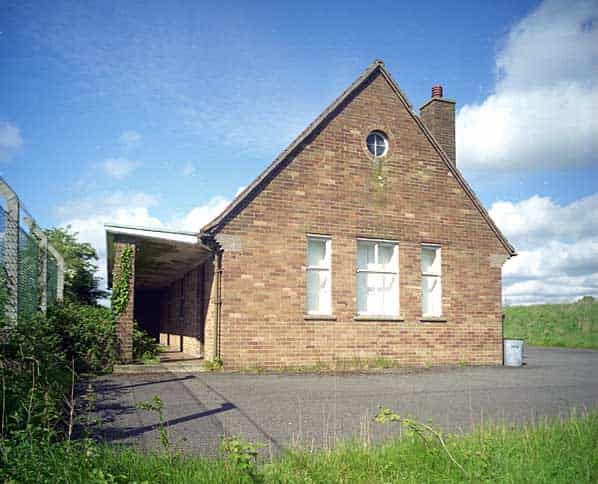
As a standard ROTOR R3 it was a two level underground bunker with a surface bungalow style guardhouse. During the 1985 rebuild a third floor was added between the original two floors. This was possible because there was considerable space under the two floors for cables, ventilation ducting etc, in fact there was a man-sized walkway below the upper corridor (a very little man! - ). By removing this space which was not required for its new role it was possible to squeeze in a third level, albeit with a lower ceiling. A small fourth level, in reality at ground level, was added on top of the bunker and mounded over with soil. The bunker is within a securely fenced compound recently planted with new trees in places. The original lattice aerial mast still stands in its own locked compound behind the guardhouse. There is an emergency exit to the rear of the bunker on the north side and a third entrance into the generator room in the centre of the north side of the mound. Outside the main compound one building remains from the 1940’s.
For our visit, we entered through the Guard Room bungalow which is located alongside the road. The bungalow is of the standard design with its veranda fronting onto the road and an extension at the back that housed the stairwell and goods entrance fitted with heavy blast doors (not original). There is one small room on the south side of the bungalow with boarded up windows but this room gives no access to the rest of the guardhouse or the bunker. All the other windows are painted on and the only access is through the heavy steel front door or the rear goods doors. The owner explained that somebody tried to break in through the roof on one occasion but was thwarted by the real flat concrete roof below.
Inside the bungalow there is a small office with a window on the left and the decontamination room now stripped out on the right. The fuel pumps (one manual and one electric) are also located here. From the short corridor a doorway leads through to the extension and the stairwell where there is a 5 tonne electric hoist fixed to the ceiling above the well; this is still in good working order.
We descended the stairs and down the sloping passage into the bunker. After 20 yards the passage turnes sharply to the left and continues downhill for a further 50 yards to a heavy blast door. Just before this door on the left is a large 11Kv mains transformer and its associated control cabinet mounted behind a metal grille. At the end of the slope a section of original teak flooring remains in place with trap doors down to the cable tunnels below. Having passed through the blast doors there is a dog leg in the passage which leads into the upper corridor of the third floor (the original top or second floor; this corridor is still in its original position. On the right is the main stairwell down to the two lower floors with another hoist in good working order. All the rooms in the bunker still have their most recent function printed on a metal plate on each door. Most of the rooms on the right hand side of this corridor are still in the same positions as they were in rotor days although, like most of the rooms in the bunker, they have all been completely stripped of fittings and furniture. It is still possible to make out the position of the small kitchen on this side although the internal walls have been removed and the doorway has been bricked up. The layout of the rooms on the left hand side of the corridor has completely changed. There are now a number of short corridors on the left hand side, the first leads to the communications room which still contains some wiring and part of a mounting frame on the ceiling. Beyond this is the BBC office with a window through into the BBC studio with its walls covered with acoustic tiles. Both these rooms are completely empty.
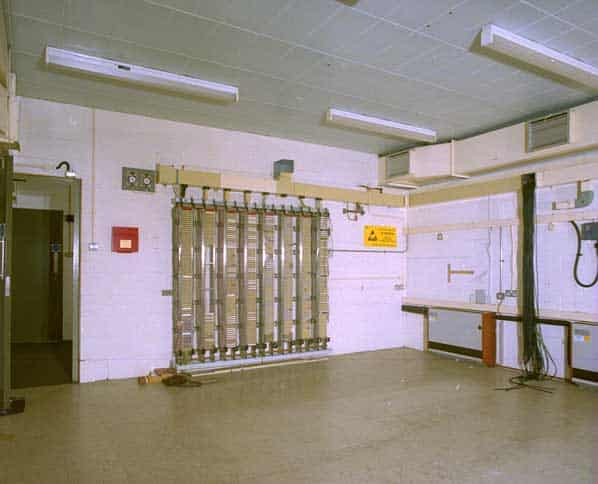
Amongst the rooms accessed from the next corridor on the left is the BT room. It is obvious from the marks on the floor that this was a fairly large telephone exchange and some of the wiring and the main distribution frame with its panels is still in place on one wall. The only telephone in the building is on the floor here and it is still working, “It’s just in case somebody gets locked in” explained the owner. The next room on the left down the main corridor is described as the ‘Counter Room’ and sure enough behind the door there is a counter with a glassless window into the room beyond which, judging by the remaining wires and plugs is the telex or teleprinter room. Within that room is a small cabin with glass windows. This is described as the MSX room with a patch panel on the wall linking to various towns and cities, Nottingham and Derby were included together with various AFHQ’s. The final room on the left hand side of the main corridor is a large open plan office. At the end of the corridor there is a wooden doorway to the right which leads to the emergency exit stairway, the second stairway down to the lower levels and through a door, to the stairway up to the top or fourth level.
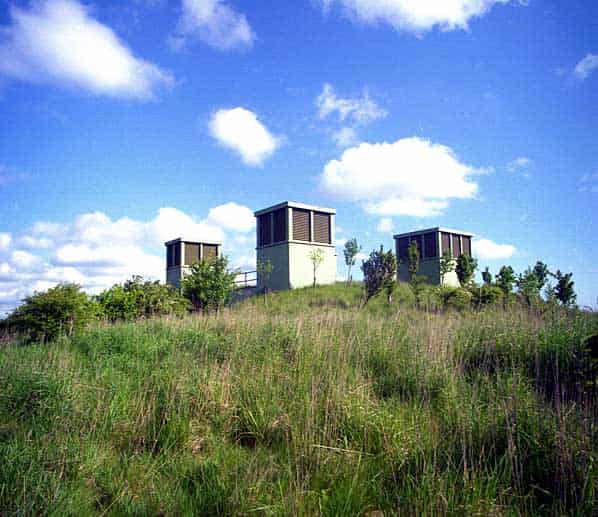
The top level is not underground but built on the surface and mounded over with soil and grassed. There are four ventilation towers (two intake and two exhaust) on top of the mound with access to the underside of these towers from the level below. They contain banks charcoal filters for filtering the air before circulating it round the bunker. At the top of the stairs there is also a small decontamination room with a shower and a disposal chute for contaminated clothes, beyond this is a heavy steel door that to the left that leads to the ventilation towers, and to the right leads into the generator room with two large diesel generators and their associated control units. Although the bunker is still connected to the mains, the generators are in perfect working order and one of them was started easily. At the rear of the generator room there is a room that contains a number of horizontal fans, part of the bunkers ventilation system. On the far side of this room is an external steel door leading through the side of the surface mound, hence the decontamination room on this level. This appears to be a weak point as the steel is not thick and the blast protection not great. The locked door between this area and the decontamination room is however more substantial. At this level there is also a fuel tank room and the tanks are almost full.
Returning to the third level we descended the rear stairway to the new middle or second level. At this point we noticed that the paintwork on each level is a different colour (3rd floor cream, 2nd floor green, 1st floor red) and there is a sign on the wall by the stairway indicating which floor it is. The middle floor has the longest corridor running the full length of the bunker. There are only a few rooms on this level, mainly on the north side. The first room is the kitchen and an adjacent store room. Everything in the kitchen and serving area is stainless steel including counter, cookers, sinks, hot plates, hot water dispensers and heated containers for the pre cooked food and all appears in good working order. On the other side of the serving counter is the spacious canteen with pillars supporting the roof. The rest of this side of the corridor consists of a very large ‘L’ shaped open plan office, again with a number of supporting pillars. This would have housed the various government agencies. On the other side of the corridor is a small engineers room, the only room in the bunker that appears to be much as it was when the bunker was vacated. It contains tables and chairs and a large set of map draws still containing plans of all the plant throughout the bunker. There are also floor plans of the bunker, plant logs and other papers lying about. It seems likely that this room was left intact as the bunker was sold with its plant in working order and any future purchaser might require these papers. I remember at Hope Cove the equivalent room remained intact with plans still in place.
We descended the stairs to the first or ground floor. Again rooms on the left (north) side of the corridor have changed out of all recognition from the original rotor bunker. The radar office, main two level control room and intercept cabins were originally on this side of the corridor at this level but now it is the dormitories, all empty rooms. On the right hand side of the corridor is the main air conditioning plant and switchgear room. All the ventilation and filtration equipment and large bank of control cabinets date from 1985 when the bunker was rebuilt and although not kept running are in good working order and started up when we pressed the appropriate buttons.
A small room beyond the plant room is called the ‘Ejector Room’ and contains the sewage pumps and compressors. Again this is in good working order and sprung into life when we were in the room. There are male and female toilets on this level and the third level, these are still functioning with the water supply connected.
My thanks to Paul Charlton for arranging the visit and to the owner for allowing the visit and the photography which took almost three hours.
Sources:
- Ian Brown of Historical Radar Archive
- Steve Fox