The bunker is located beneath Hambrough Primary School in South Road, Southall. There were originally four entrances, the only one now accessible is an unobtrusive wooden door on the north side of the main school entrance. The bunker runs west under the school with the operations room and plant rooms under a raised section of the playground behind the school buildings. Two other entrances, now bricked up, are clearly visible from the staff car park at the end of Beatrice Road while a fourth entrance, also blocked, is in the playground. The bunker was built during the 2nd world war and was enlarged and modernised in the 1960’s when the network of four regional war rooms in London (Mill Hill, Wanstead, Cheam & Chislehurst) was expanded. Chislehurst closed and was replaced by the bunker under Pear Tree House (a block of council flats in Lunham Road, S.E.19), Wanstead and Cheam were retained. Mill Hill was also retained as the new North Group HQ while Southall was modernised to take on the role of the now reduced North West Group ‘Group War HQ’ (Control 51E). It also housed Ealing Council’s emergency control centre.
It is unclear when the bunker was abandoned. From the evidence below ground it certainly took a part in the ‘Square Leg’ home defence exercise in 1980 but there is no evidence that it took place in ‘Hard Rock’ two years later. By the time the school was built in 1983 it had definitely closed. It seems likely that the erection of the school damaged the fabric of the building and may be responsible for the current water ingress although it was known to have a water problem while still operational.
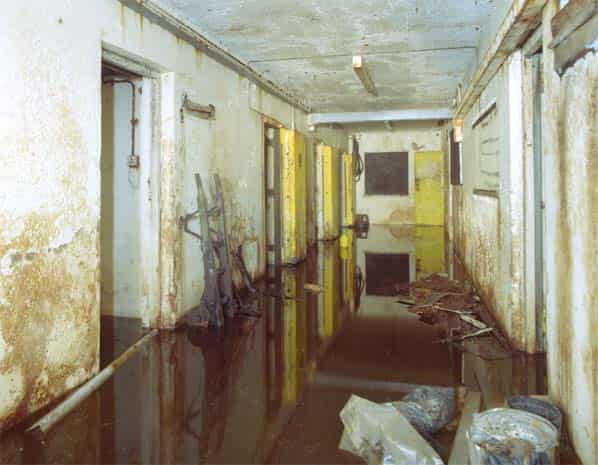
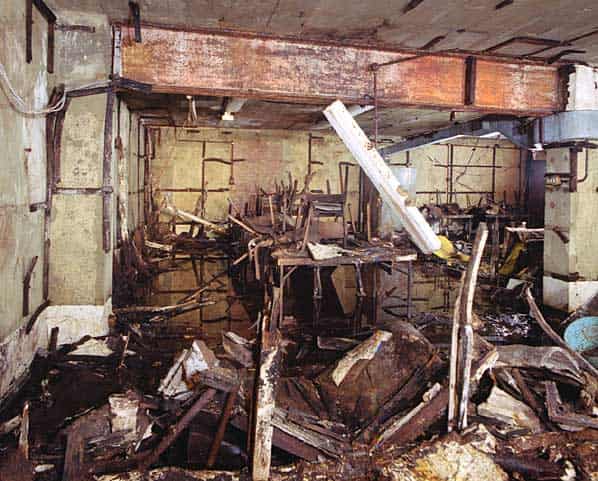
Today, it is difficult to put a definite use to all the rooms as the bunker is in appalling and dangerous internal condition. Everything is wet and most internal doors and partition walls have rotted away. The little paperwork that survives is sodden and virtually impossible to read. Much however still remains giving evidence of its former use. Rotting timber under water can give off Hydrogen Sulphide gas when disturbed with its characteristic bad eggs smell. Hydrogen Sulphide is highly toxic and can be lethal and nobody should enter the bunker without being aware of the implications. Gas was detected in a number of the rooms during this inspection.
Going through the wooden entrance door a short flight of steps leads to a corridor at right angles which opens into the first room. From this point onwards, the bunker is always flooded at least to a depth of six inches. The first room leads into a further three rooms in line. All of them are filled with rubbish, most of it demolished partition walls and it’s impossible to ascertain their former function. After the fourth room, there is a cable entry on the right and a flight of steps up to one of the sealed entrances, there is also a power distribution panel on the left. Beyond this is the kitchen with only a domestic sink and draining board remaining. Three further rooms follow in line with a corridor along the left hand side.
The partition wall between the corridor and the rooms has fallen away. Beyond the kitchen is the communications room but again the partition wall between the two has gone. All that remains in the communications room are some electrical racks. There is a solid wall between the comms. room and a second communications room which still contains a number of co-axial cables and two telex tables. There was a partition wall still in place between this and the fourth room but when I touched the wall, half of it gently collapsed.
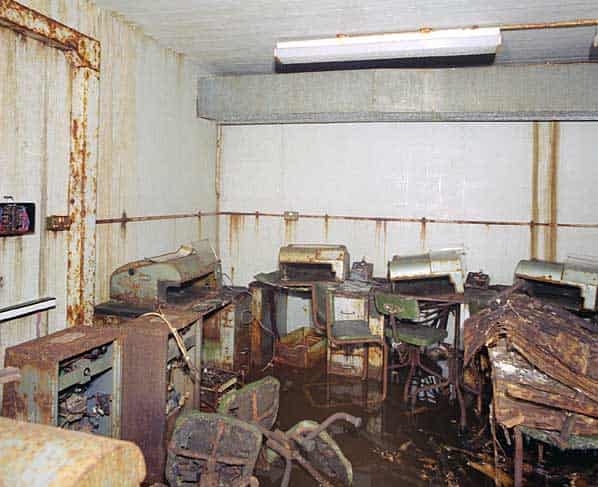
The next room is probably the most interesting in the bunker. Its door still stands though the walls around it have gone. There is a sign on the door that reads ‘Tape Relay Room’. It still contains teleprinter tables along two sides with the teleprinter cases still in place, each sporting a GPO badge. Every teleprinter machine is labeled according to its designated area: Hounslow, Hammersmith & Fulham, Harrow, Brent, Kensington & Chelsea, Hillingdon, (being the sub-regions of North West Group), Q Met and two labeled UKWMO. There are also a number of chairs and a floor standing test jack and patching frame which includes a number of valve amplifiers with their valves still in place. Passing out of this room there is a double dog leg in the corridor which gives access to male and female toilets. Although most of the taps have seized solid, a few still turn and it would appear that the water supply is still connected.
The dog leg opens into a wide north-south corridor approximately 60 feet long. To the right a doorway leads to a flight of steps to one of the sealed entrances and diagonally opposite are the plant rooms. The first room contains the ventilation and filtration plant which is all intact apart from the vertical filters which have been removed. Their mountings on the floor and ceiling are still in place. There are two doorways out of this room, one leads to the boiler room which has a small oil fired boiler in one corner with a number of dials on the wall indicating litres. A doorway out of this room has been bricked up but one brick has been removed to reveal earth infill behind. This was probably the position of the fuel tanks for the boiler. The other doorway out of the ventilation plant room leads into two small rooms, one of which gives access to the generator room with the generator is still in place.
Returning to the wide corridor on the opposite wall there is another toilet followed by three doorways which still retain three heavy man sized ‘safe’ style doors. Two of these probably led into secure storage rooms which still contain filing cabinets (with their keys rusted in place) and cupboards. There are stocks of leaflets relating to flooding, a packet of GLC headed notepaper, some papers relating to exercise ‘Square Leg’, a number of empty GLC War Emergency Plan files, some furniture and a duplicator. The third room with a safe door has another doorway at the far end that leads into the large ‘L’ shaped operations room. Much of the furniture (desks and chairs) still survives although again the partition walls along one of the sides has largely fallen away. From the end of the wide corridor one doorway leads to a flight of stairs up to one of the blocked entrances and another leads to another block of male and female toilets. In an alcove on the left hand side of the corridor to the toilets there is a large floor standing metal map cabinet but alas no maps in it.