Fighter Command was established on 14 July 1936 under the leadership of Air Marshal Sir Hugh Dowding. In 1940 it divided fighter coverage over Britain into four groups: 10 Group, 11 Group, 12 Group, and 13 Group, each being responsible for the defence of a geographical area. 10 Group protected Western England and was led by Air Vice Marshal Sir Christopher Quentin Brand. The four groups were sub-divided into sectors, where various squadrons were based. 10 Group was based at RAF Rudloe Manor (No 1 site) at Box in Wiltshire. It controlled four Sector stations, RAF Filton, RAF Middle Wallop, RAF St. Eval & RAF Pembrey.
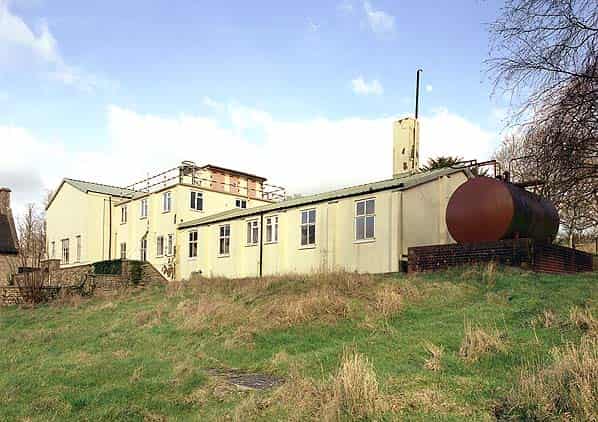
As well as utilising the old Manor House itself, a new Operations Block was built alongside based around a standard design operations room consisting of a balcony overlooking the map table in the ‘well’ below. The ‘ops’ room remained operational until 15th January 1951 when its function was transferred to the underground operations room in Browns Quarry, nearby.
Rudloe Manor had also acted as Royal Observer Corps Western Area HQ from 1937 and was renamed Southern Area in 1953. The UKWMO continued to occupy the Operations Block until 1990 when their Sector HQ were co-located with the ROC 12 Group Headquarters at Lansdown, near Bath.
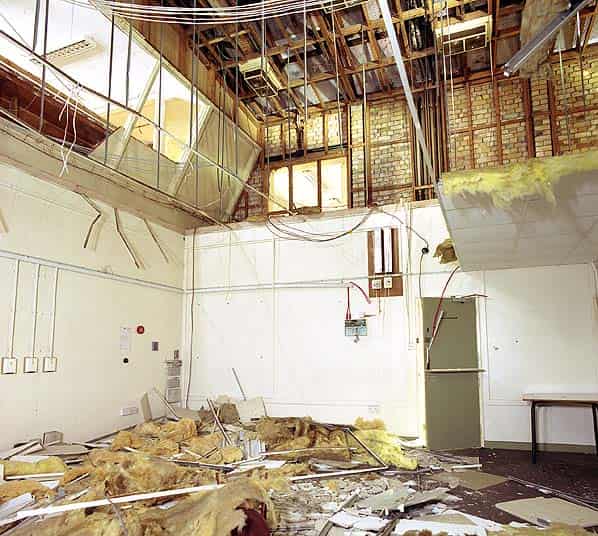
During this period, the two story operations room was given two false ceilings at different periods, one a foot lower than the other and the building has been further added to and altered over the years and is now an absolute rabbit warren of corridors and stairways.
In its last years it was the peacetime Ops Room for the whole of Rudloe Manor (the wartime standby was in the Quarry Operations Centre underground) and it also contained, amongst other things, the RAF Provost & Security unit’s photo studios and dark rooms. No 1 site was closed in late 2000 or early 2001 and is to be redeveloped as industrial units. In early 2002 most of the site remained derelict and unused with only a couple of huts taken over by the ASTAC College in September 2001 for training air traffic controllers.
The Grade 2 listed Manor House remains empty and unused, the operations block alongside has only recently been permanently locked and has suffered some vandalism.
Much of the false ceiling has now been removed revealing the original two level ‘ops’ room with a sloping glazed window looking down into the well from the room above. On the opposite side there is evidence of another viewing balcony that has subsequently been completely removed. There’s little other evidence of what might have been other than numerous safes and steel cupboards with combination locks (all wrecked) and a number of telephones, the handsets marked with a red lightning flash and ‘6 SU’, while the bodies are marked unclassified only. The photographic area is clearly visible with walls painted black in the dark rooms and a number of sinks still in situ.
A run of six Lamson tubes are still in place running down the walls on both floors, they run into underground ducts and head of to other buildings. Externally the later extensions to the building are obvious with several prefabricated additions and a number of signs on the external wall indicating ‘Ops Room this way’ with an arrow. There are a number of WW2 pillboxes around the site both inside and outside the perimeter fence. There is definitely no entrance to any underground workings. The only underground structure is either an air raid shelter or, as it is filled with ammunition boxes, it may have been built as a magazine.
Those taking part in the visit were Nick Catford and Nick McCamley.
Sources:
- Nick McCamley