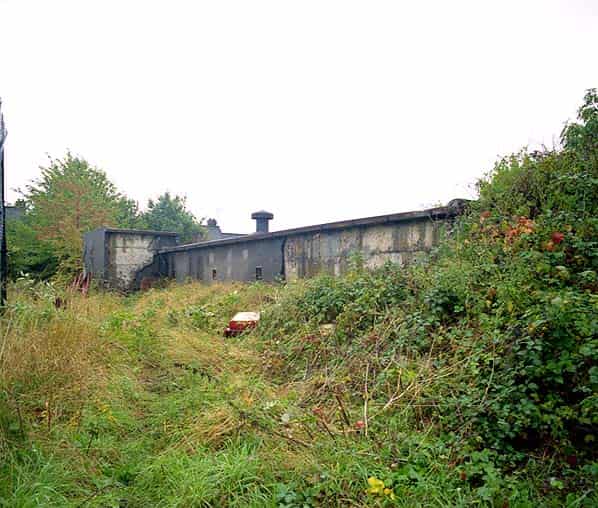
The Rotherham County Borough Control (SK452941) consists of a rectangular concrete surface blockhouse; partially overgrown and hidden away at the rear of a council yard south east of the junction between the A630 and A6123. The entrance is in the middle of one side with steps leading down through a gas tight door into a short lobby.
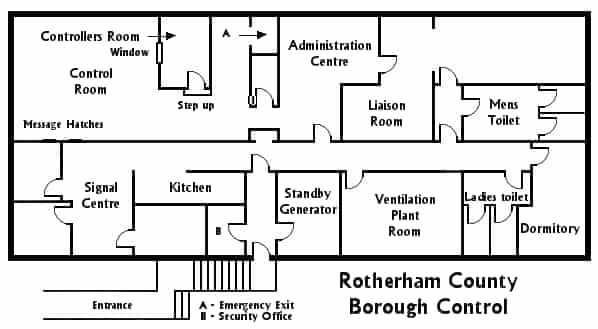
Two rooms can be entered from the lobby, the first a small security office and on the opposite side, the standby generator room, a narrow room that only just has room for the Lister generator with its Magnicon alternator. There are also some electrical control boxes and switchgear in here. The unit is still live and there is a distinct smell of ozone. Beyond these two rooms a second gas tight door leads into the main north - south spine corridor. Apart from the two wooden doors, which still have their rubber gas seals intact, there is no additional blast protection.
Turning right into the corridor, the first room on the right is the ventilation plant room, which is intact with two fans, ventilation trunking and electrical switchgear. Some of the trunking appears to have been replaced at some time. The next room on the right is the female toilet with two porcelain basins, two cubicles and a mirror. At the end of the corridor is a room of unknown use (possibly the dormitory). On the opposite side is a short section of corridor at right angles to the spine corridor. On the right hand side of this is the male toilet with three cubicles, three porcelain basins, four ornate porcelain urinals and a mirror.
At the end of this short corridor is a room that has latterly been used for storage with a large quantity of folding chairs stacked along one wall with other wooden chairs in a pile. There are boxes of civil defence forms and other papers. Everything in this room is very damp, the furniture is mouldy and many of the papers are beginning to disintegrate. There is a wide opening that has never had doors into the next ‘L’ shaped room which can also be accessed from the east side of the spine corridor. This has a long bench table along two walls and would have been the liaison room with positions for (amongst others) ‘MOH’, ‘B.ENG’, (Borough Engineer), EHO (Emergency Housing Officer perhaps) and ‘FOOD’. There is a tray containing rolls of 35mm film, which is in poor condition having got damp. There is a large map of England and a large quantity of 1960’s civil defence posters, all damp and many in poor condition. There is also a doctor’s examination couch with a raising end and a message passing window into the adjacent room.
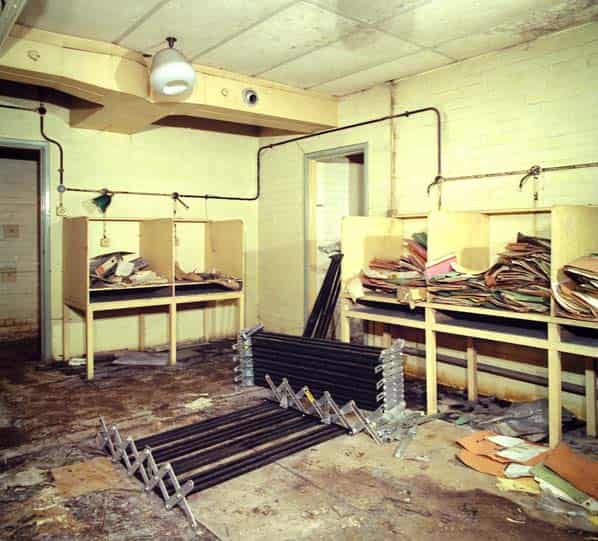
The next room is also ‘L’ shaped and is the ‘Administration Room’ with four acoustic booths along one wall and a further two booths along a second wall, each booth has its own light. There are a large quantity of files stacked in the booths relating to local civil defence matters and the operation of the bunker. Although a little damp, most of the papers are in a readable condition. There are two floor standing lecterns, a blackboard easel and a damaged locations board lying on the floor. There is a doorway into the long rectangular ‘Control Room’ beyond; this can also be accessed from the spine corridor.
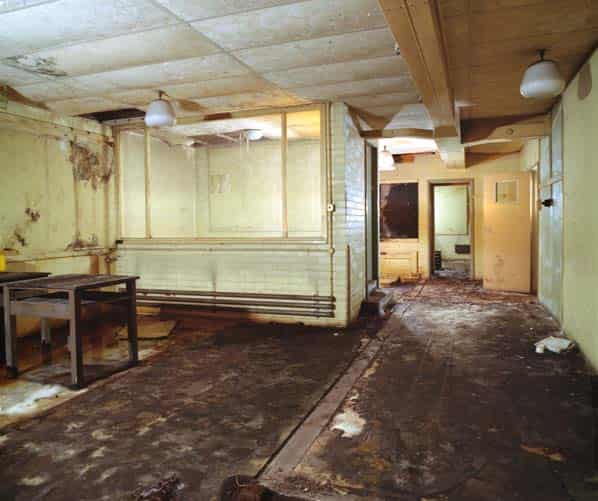
Within the control room there is a step up into the ‘Controllers Room’, which has a large glass window overlooking the control room. There is a large notice board, 8 wooden tables, various GPO junction boxes and two message passing windows into adjacent rooms. One end of the room is very wet with standing water on the floor. In a corner behind the controllers cabin is a small alcove with a ladder up to an emergency escape hatch onto the roof of the building. There is a low covered area on the roof to prevent the ingress of water and a counter balance weight is visible on the upper side of the hatch.
At the north end of the spine corridor is the ‘Signal Centre’ which has further acoustic booths identical to those in the administration room' four along one wall, three along another wall and a further four have been removed from a third wall. There is a message passing window into the control room and an internal directory phone chart on the wall alongside a blank information board.
Three small rooms are accessed from the signal centre; one is the ‘Switchboard Room’, which has a lead acid battery on the floor and some GPO junction boxes and wiring. One of the other two rooms is probably a messenger’s room with another window into the control room. The final room on the west side of the spine corridor is a small kitchen; it has a short counter with a hinged section for access. There is also a large floor standing unit with cupboards and a preparation surface, a table, towel rail and towel. The hand pumped waste tank has been removed although the pump is still in place.
Throughout the bunker is damp and in poor condition with water on the floor in some rooms. Although the power is still connected only half the rooms have working lights. Most of the lights have bulbous white glass shades very typical of the 1950’s. Some of the rooms have a name on the door indicating what the room was used for. There is ventilation trunking throughout all the rooms and rubbish strewn across many floors.
The bunker was built about 1954 and although, in theory, it should have been available for use until the end of the cold war, in practice it has not been used since the disbanding of the Civil Defence Corps in 1968 and all the papers and files predate this. The bunker was supposed to have been kept on ‘care and maintenance’ but as the ‘left wing’ council saw no need for civil defence it was left to rot, hence its poor internal condition.
There is a small lattice communications mast alongside with two UHF aerials. The site is due to be redeveloped for housing within the next two years and the bunker will be demolished at this time.
Those taking part in the visit were Nick Catford, Keith Ward, Bob Jenner, Caroline Ford
UPDATE: The bunker was demolished in October 2007.