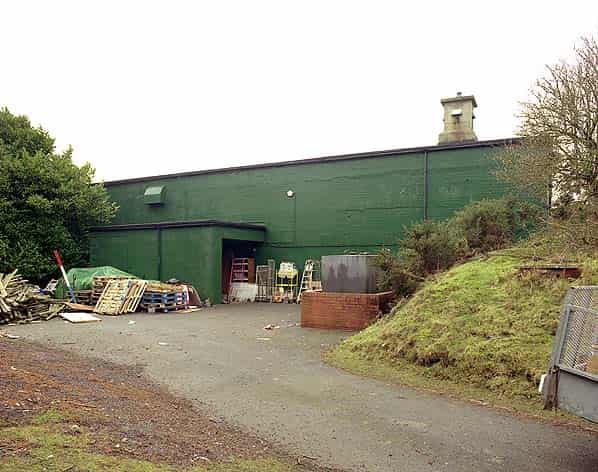
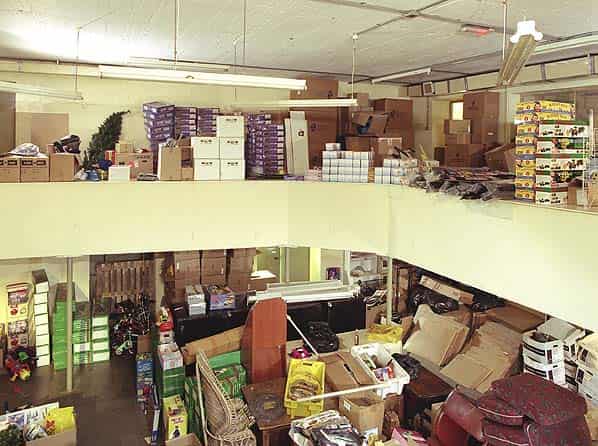
Ridgeway Hill AAOR served the Portland Gun Defended Area. It’s located within a small quarry close to the top of Ridgeway Hill between Dorchester and Weymouth. It almost entirely fills the quarry and is difficult to see from the road or public footpaths. The present owners are Cambridge University who bought the site in 1998 when it was vacated by the MOD. They own all the surrounding farm land and only bought the AAOR for control of the water supply in the area; there is a raised water tank within the compound. The building was immediately leased to one of the other bidders at the auction and it is now used for storage.
Ridgeway Hill AAOR is of the standard design, a two storey rectangular blockhouse; although located on the quarry floor it is semi sunk at the back. The main entrance is into the lower floor while the rear entrance is into the upper floor; externally the building is painted dark green and in good condition.
Like all the AAOR’s, the building was redundant by the late 1950’s and was handed over to the Royal Navy, it’s most recent use was as an Admiralty chart store and evidence of this is still visible with a sign on one internal door which reads ‘Room 7 Australia Material Library Section’. Inside the building is dry and most rooms are lit, the walls are painted a standard light cream which is beginning to peel and all the woodwork is painted light blue.
The original room layout on the lower floor remains largely intact while on the upper floor the sides and front have been opened out creating three long rooms. Access to one of the stairways has also been blocked off on the upper level although the stairs are still in place and can be accessed from the lower level. One now only leads to one of the original toilets which is out of use and unlit.
The two level operations room is intact (with the word ‘Plotting’ on each of the entrance doors) although this too has been altered. The original stepped open balcony remains with Perspex windows into the room behind it; however the curved Perspex windows that went round two sides of the well have been removed. The windows opposite the open balcony have been boarded up while the two side rooms have been opened out so they now form an open balcony around three sides of the well. The operations room, as with most of the other rooms in the building is stacked with boxes and access to some of the rooms is difficult.
On the lower floor one room remains empty, it has ‘GPO’ on the door so was obviously the telephone room. One area of the floor is tiled indicating the position of the standby lead acid batteries, it’s also possible to see where a switching frame was located on the wall. The boiler room still appears to retain its boiler although it was impossible to confirm this as the room is stacked with boxes. The ventilation plant room is relatively clear and still retains all its original plant with ventilation trunking running around the building. The generator is a replacement, probably some time in the 1980’s, it is still in good working order and is retained as a standby power supply. All the alterations to the building were carried out while it was still in MOD hands.
The compound fencing around the site is secure and the quarry edge is alive with snakes during summer months and is best avoided. The present lessee lives in a modern ex MOD house alongside the entrance gate and there are animals loose in the compound to discourage unwelcome intruders.
Those taking part in the visit were Nick Catford, Dan McKenzie, Keith Ward, Nick Mc.Camley, Richard Challis, Bob Jenner, Robin Ware, Tony Page, Robin Cherry and Neil Wilson.