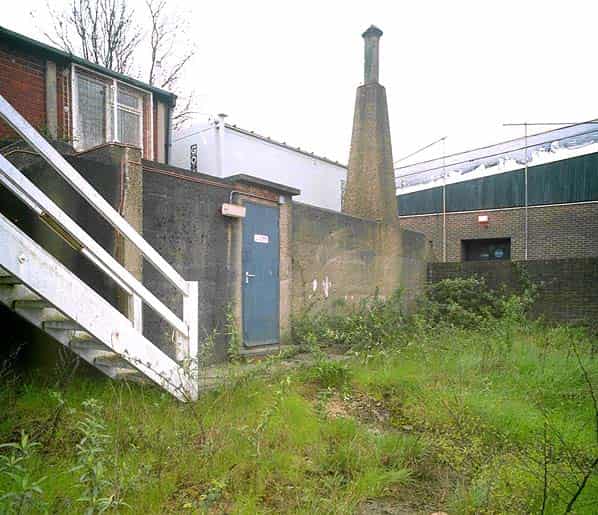
The Southern Railway Control Centre at Redhill is located immediately south of the old Goods Shed at the back of the station car park. There is a rectangular mound covering the bunker and a single storey brick building, now housing the AMEC Estates Managers Office which stands on top it. One entrance is at the north end of the mound where modern double wooden doors give access to a stairway down. The other entrance is on the west side of the mound facing onto the railway line. Here there is a single wooden door giving access to a stairway that dog legs down into the bunker. At the southern end of the mound there is a large metal container and adjacent to this is the ventilation shaft consisting of a squared conical concrete pillar with a ventilation pipe on top of it.
Redhill is one of three divisional control rooms built to regulate the flow of railway traffic on each of the three divisions (South Western, Central and South Eastern) of the Southern Railway, later Southern Region. The controllers would take executive decisions as to which trains have priority, how to allocate scarce resources and so on. In this connection they are provided with dedicated ‘Control’ telephones to every signal cabin in their Division and to other strategic locations (e.g. other control offices, main motive power depots, Electrical Control office, etc.). In more recent times there was also a Control teleprinter network as well. Over and above these Divisional controls there was also a Regional control, which for the Southern Railway during WW2 was in underground tunnels excavated in the hillside behind Deepdene House near Dorking. Both this regional control centre and the three divisional control centres at Redhill, Orpington and Woking remained operational until the mid 1960’s.
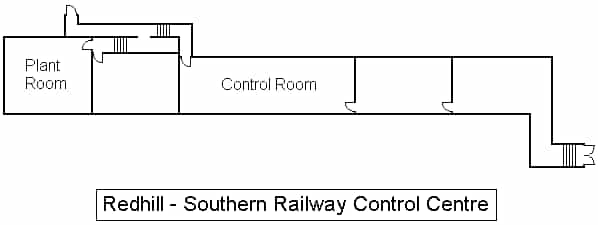
Following closure the bunker and the building above it remained empty until the mid 1980’s when British Rail’s permanent way team at Redhill required new premises as their old huts were due for demolition to make way for the new station car park. The brick building on top of the bunker seemed ideal for the purpose. It had housed exchange equipment and all the remaining switching frames and a back up power supply of heavy duty batteries were cleared at this time and new partition walls inserted inside the building. Two of the rooms inside the bunker were also utilised. A door in the rear (opening on to the railway) of the surface building leads to the main access into the bunker. Having entered the single door the passage turns immediately through 90 degrees to the north where there is a flight of 8 steps down into the bunker. At the top of the stairs is a door on the right. Entering the door and turning right another flight of 9 steps leads to the plant room.
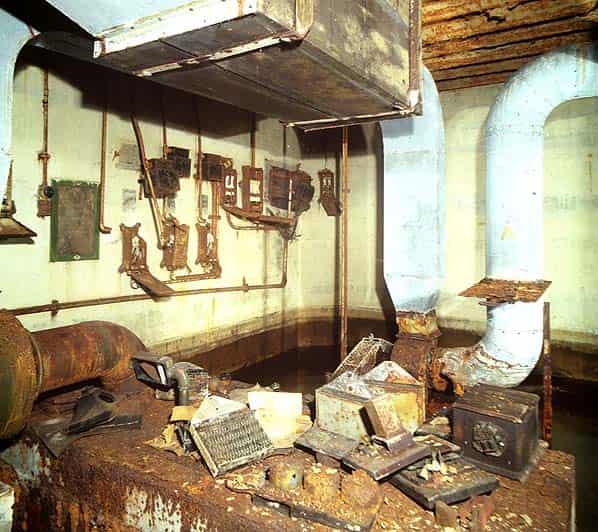
At the bottom of the steps are two doors one to the left and one straight ahead. The room on the left still contains some original furniture while the room on the right contains the ventilation plant and electrical switchgear. All the plant and ventilation trunking appears intact. There is a large metal cabinet lying on the floor, it is unclear how this fits into the ventilation system but a similar cabinet was noted at the Southern Railway bunker at Orpington. The trunking is connected to an intake pipe high in the end wall connecting to the ventilation shaft at the southern end of the bunker. Both these rooms are flooded to a depth of 10" and were not part of the 1980’s conversion. At the bottom of the other flight of stairs a door to the right leads into the former control room.
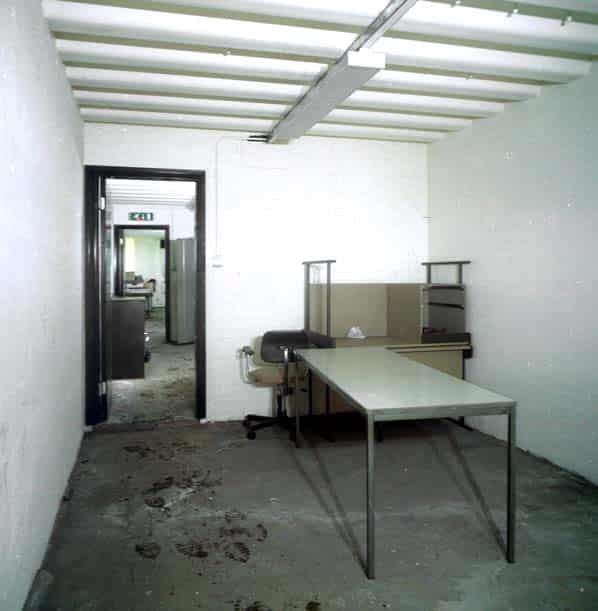
This was a long thin room which has now been divided in two rooms (one longer than the other) with a partition wall and a linking door. At the back of the second room is a brick wall with a door into the final room of the bunker. There’s a circular hole in the long wall which leads to the exhaust ventilation shaft and on the far wall numerous cables (now cut off flush with the wall) enter the building. A door at the far end of the long wall leads to a flight of 12 steps up to the emergency entrance now consisting of twin wooden doors.
All the ventilation trunking in this section of the bunker has been removed, the walls have been painted white and the lights are working. There is some storage in the three rooms but as these rooms also flood in wet weather storage is kept to a minimum and well off the floor.