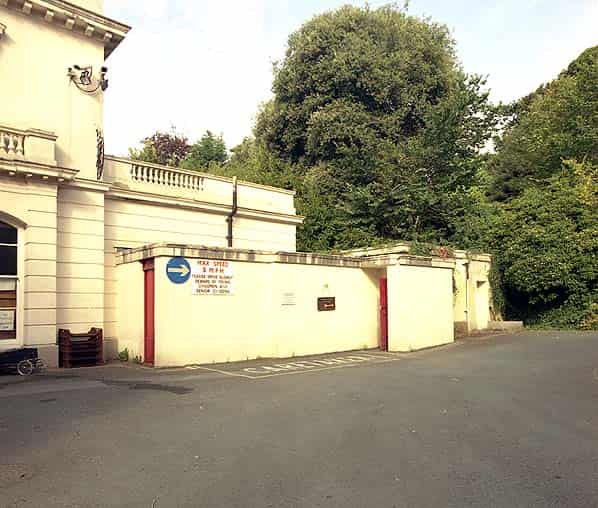
Plymouth Borough Control was opened in 1943 utilising a purpose built single storey bunker alongside Pounds House, a council owned property at the rear of Central Park north west of the city centre. The ARP control centre closed at the end of the war but was reactivated as the Borough Control in 1954. It remained operational as the main control for Plymouth until 1963 when it was re-located to Abbottsfield Hall in Tavistock. After 1966 the Control returned to the City when the Council leased part of Crown Hill Fort which had, until the mid 1950’s, housed the Anti Aircraft Operations Room (AAOR) for the Plymouth Gun Defended Area (GDA). Pounds House remained in use as a civil defence training centre until the abolition of the Civil Defence Corps in 1968, the Control at Crown Hill Fort closed at the same time. The house is now a council hearing and sight centre and parts of the bunker house a jigsaw library, open to the public on Wednesday and Thursday mornings.
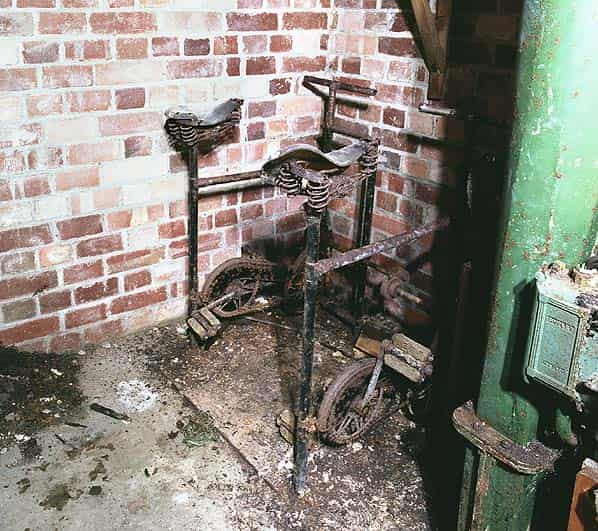
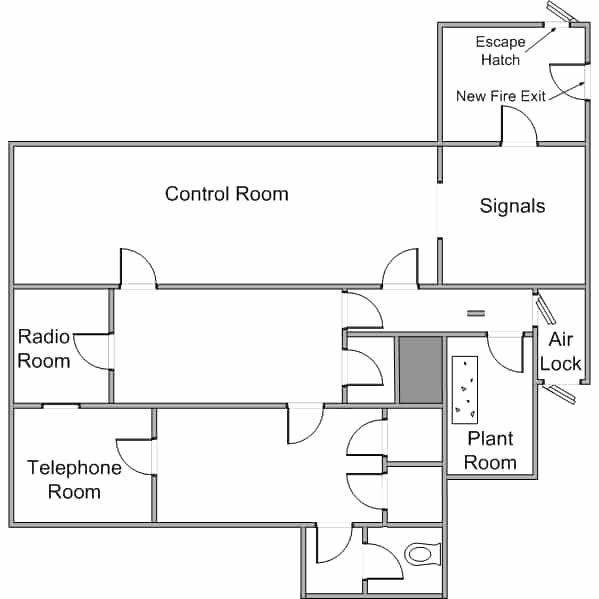
The single storey concrete blockhouse is entered through an airlock formed from two gas tight doors at right angles to each other. Each door has a small glass spy hole. The second door opens onto a short corridor. The first room on the left was the ventilation and filtration plant room. All the plant and trunking manufactured by Sutcliffe & Speakman in 1939, is still in place although now very rusty. There are five filter units and at the back of the room two emergency ‘pumps’ to be used in the event of a power failure. These consists of two bicycles frames with seats and handlebars, set into a concrete plinth. There is a direct drive from the chain to the ventilation plant. A similar set up still exists at WW2 Controls at Hackney and Clapton in North London and modern racing bicycle pumps were installed at the Highlands Emergency Centre at Inverness during it’s 1988 refurbishment.
At the end of the corridor there is a door with a message window in it that opens into a rectangular room that gives access to all the other rooms in the building to the left is a similar sized, unused and unlit room, to the right there are two doors into the ‘control room’ and ahead there is a small ‘radio room’. This still has a sign on the wall ‘be careful to see that the batteries are switched off’. At the back of the room there is a boarded up doorway into the ‘telephone room’. The unlit room has two small store rooms at one end with the only toilet cubicle alongside. At the other end of the room there is a wooden chute from the sealed telephone room.
The control room is now the main reception room for the jigsaw library with shelves stacked with jigsaw puzzles around all four walls. At one end of the room there is a door into a smaller room, perhaps the ‘signals room’ and from there a door into the final room in the building. Both these rooms are stacked with puzzles. There are two doors in this last room, one a new fire door installed in the late 1990’s and at right angles to it on an adjacent wall the original emergency escape hatch. This consists of a single 2' X 2' steel gas tight door three feet up the wall. This door, which has now been sealed, opened onto a wooded bank at the rear of the bunker.
Little else remains inside the Borough Control apart from ventilation trunking which runs into each of the rooms.
When controls were reactivated in the 1980’s, the Borough Control was once again re-located to the gatehouse at Fort Austin which had been the Borough works depot since the 1960’s.
Those taking part in the visit were Nick Catford, Keith Ward and Mike Thomas.