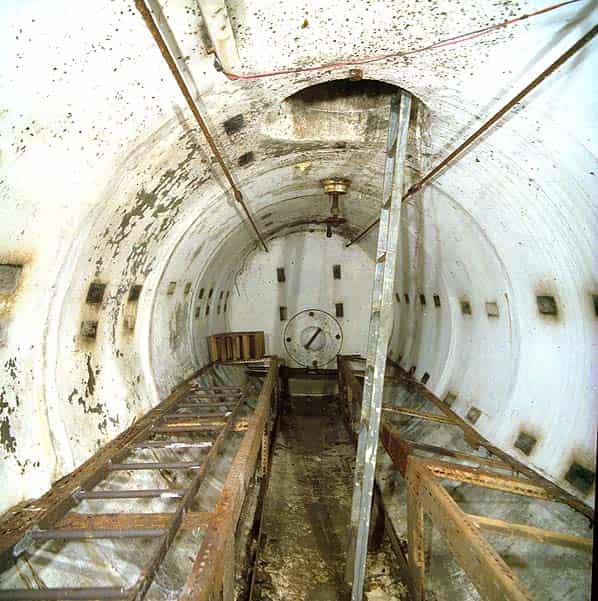
There is a small domestic fallout shelter in the rear garden of Prebbles Hill Cottage, Egerton Road, Pluckley (Kent). The shelter was built in June 1962 by Fall Out Shelters (Deal, Kent) Ltd. at a cost of £920. It is described as their BX model and is intended for 12 adults.
According to the company’s brochure:
‘These shelters are designed to withstand great stress and are virtually indestructible. They will protect their occupants against all known nuclear hazards. They are both blast proof and fall-out shelters. Fall Out Shelters (Deal, Kent) Ltd. build every type of nuclear shelter to suit most areas and conditions. They are constructed only of the best materials and are tested at every stage of manufacture. Family shelters are designed for three, four, eight and twelve persons. We also design special shelters to house more than 12 persons, for factories or offices etc.
Shelters are also designed for storing art treasures and valuables and in some cases we can modify a cellar to suit certain shelter requirements in fringe or rural areas. There are three types of shelter in production to suit any area in Great Britain, the types A & B both accommodate four persons.
Their basic design is such that we can add other prefabricated sections to the unit so that it will accommodate eight or twelve persons (Hence the BX at Pluckley), with additional entrance and ventilator, fresh water tank system, goods store and toilet. The length of time spent in a shelter in the event of a nuclear explosion would be dependent upon the density of the radio-active fall-out. The minimum time would be 48 hours, with a maximum of six or seven days. It is obvious then that the shelter would be your home, with all your necessities and supplies to hand. Remember it could be some time before services were resumed again, and your shelter can hold supplies of food and water etc., for 30 days.
All shelters manufactured by Fall-Out Shelters (Deal, Kent) Ltd. (unless they receive a direct hit) are 100% safe in a war of conventional weapons. The shelters are blast-proof, fire-proof and damp proof. They are prefabricated, precast vibrated concrete units, reinforced with steel and due to their unique design, will withstand great stress. The three types of shelter in production are: ‘A’ type shelter - Designed for industrial areas, cities, docks etc., where the possibility of a nuclear attack would be most probable.
We consider this shelter will be 95% safe from nuclear hazard. if in the area 5 miles from ground zero of a 10- 15 megaton bomb, and 95% safe if one mile from a 20 kiloton bomb. ‘B’ type shelter - This is essentially a fringe shelter by our standards, although it is heavier and able to withstand greater stresses than most front line continental shelters. It is considered 95% safe against nuclear hazards at 6.5 - 7 miles from ground zero of a 10- 15 megaton bomb and 95% safe 2 miles from ground zero of a 20 kiloton bomb. ‘C’ type shelter - We endeavour at all times to keep the cost of these shelters down to a minimum and the ‘C’ type shelters have been designed especially for the man, his wife and one child.
It is the cheapest fall-out shelter in the world and although it was designed with rural areas in mind, it can be strengthened to a fringe area shelter. We consider it 95% safe 2.5 miles from ground zero of a 20 kiloton bonb. It incorporates the same ventilating unit as ‘A’ and ‘B’ type shelters.’ ‘A good family shelter will cost no more than a good second hand car. There are no running costs to consider and of course no depreciation. It does not date, the are no survey fees to pay and the foundation and erection are included in the cost.’
At the surface at Pluckley there are two hinged convex steel hatches and two ‘mushroom’ shaped air vents. The roof of the shelter is 1 metre below ground level and the shelter is accessed by a removable steel ladder. The shelter takes the form of a buried concrete cylinder 6.62 metres long and 1.7 metres wide. A flat concrete floor divides the cylinder into two unequal parts giving a floor to ceiling height of 1.8 metres. There is an access hatch at one end which canot be opened but it would apear to lead to toilets and a battery compartment beneath the floor. The manufacturers artists impression of a fully furnished type ‘BX’ shelter, which this one never was, shows four double beds, cupboards and storage areas. It makes the shelter look quite spaceous which it certainly isn’t.
The toilets on the lower level must have been very cramped as they are shown as less than half the height of the main ‘living’ area. The two rotary controls for the vents protrude down from the roof necesitating a duck to avoid serious head injury not that the beds would have left much room to walk around. Apart from some rust on the rotary vent controls and the rotary control to the lower level hatch, the shelter is still in good condition. The owner, Ken Rawlings, has used it as a wine celler in the past but he found it was too damp so it is now unused. He has considered removing the soil cover and the roof to create an ornamental pond but has now been persuaded him to drop this idea.
It is interesting to note that the shelter was constructed 1 year after the nearby underground ROC post, MAIDSTONE 30 (see ROC Post: Pluckley), now also owned by Ken Rawlings, was opened. No doubt the then owner of the cottage had a conversation with his ROC neighbours about the dangers of nuclear fall-out in the event of an attack.