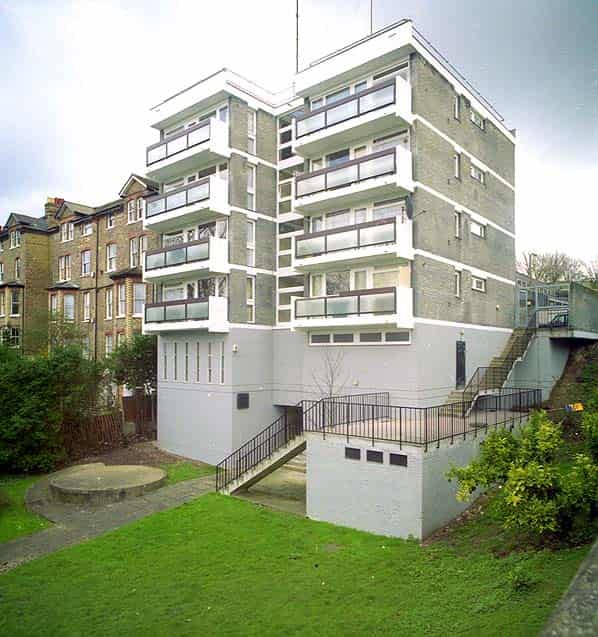
Pear Tree House is one of South London’s best-kept secrets, a block of council flats in Lambeth’s enormous Central Hill Estate. It has 8 two-bedroom flats and the former control centre for South East London in the basement. In the early 1960’s the Metropolitan Borough of Lambeth was grouped with the neighbouring boroughs of Southwark and Camberwell to make up civil defence region 53a. Negotiations were taking place between them on a site for a control centre for the area and the then Conservative-leaning Lambeth were very keen.
A large area near Crystal Palace was designated for a new housing estate and as it was in the extreme south of the borough and well protected by the local hills a site at the junction of Lunham Road and Hawke Road in SEI9 was chosen. Whilst the two-story bunker was being designed and approved the structures of civil defence and London government were changing. Work on Pear Tree House started in 1963 but it was now merely going to be a borough control centre, the existing borough control in St Matthews Road, Brixton was to become a sub-control. It cost £31,850 of which the Home Office paid 75% (£23,25O).
The 18-room bunker and flats were completed in 1966 and the bunker went into care and maintenance when civil defence was stood down two years later. In 1971 London was designated a civil defence region again and in 1973 the Greater London Council set up emergency planning teams looking at the future structures of civil defence in the capital. It was decided that London would be split into 5 groups of boroughs each having its own control centre. The GLC selected the Pear Tree House bunker as the South East group war HQ and although not ideal it was converted in 1979.
Because of its location Pear Tree House received a lot of attention in the 1980s. It was a focus of local CND marches, it’s blast doors were fly posted and it was open to the public for a week in 1982 for CND’s ‘Hard Luck’ campaign which coincided with the dates of the cancelled' Hard Rock' exercise. Speakers during that week included Duncan Campbell and Bruce Kent. In the late 1980s the arrangement to rent the bunker from Lambeth expired and nuclear-free Lambeth threatened the London Fire and Civil Defence Authority with eviction. Another site was looked for but an agreement was made and it remained the SE group emergency centre until 1993. It was later used as a social services store and is now empty.
This bunker was one of the four London group controls. It replaced an earlier bunker at Chislehurst and covered the South East Group (Bexley, Bromley, Croydon, Greenwich, Lewisham, Southwark).
SITE VISIT
The main entrance is a heavy steel blast door into the sub-basement which is actually at ground level. Three rooms at this level are outside of the bunker, these contain electrical switchgear both for the bunker and the flats above, the standby generator and water tanks.
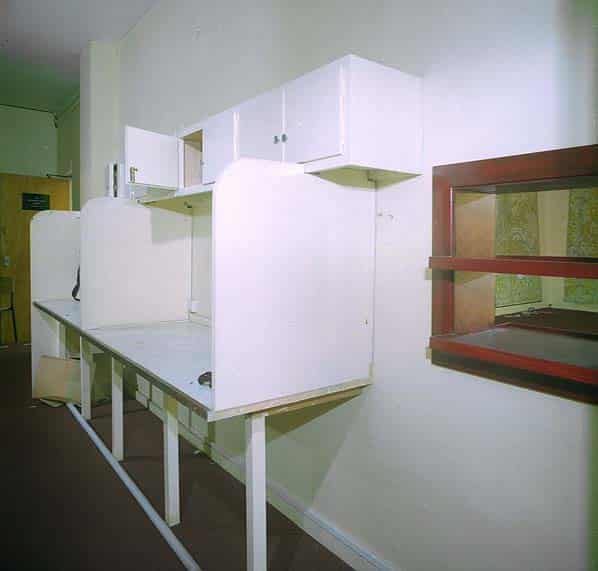
Inside the blast door there is a small lobby area described as the ‘Intake Room’. The first room on the right is the ‘Communications Centre’ which consists of 4 rooms. The ‘Radio Room’ still containg various electrical switch gear at one end including the switch for the standby generator (not working). At the other end, the ECN unit (removed) would have stood. There is still a WB1401 speech receiver mounted on the wall. Next to the Radio Room is the ‘BT Equipment Room’ which is empty apart from a large floor standing fridge. The rest of the ‘Communications Centre’ is divided into a long narrow room containing two booths and larger room that has a small electrical rack and a bank of coloured ‘alert state’ lights (working).
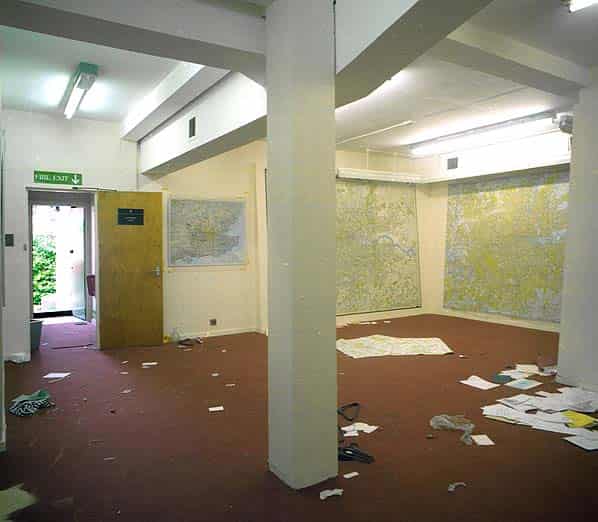
There are two message passing windows in this room and a third between the narrow room and the main control room. This room would have contained MSX and AUTEX units and FAX machines. At the far end of the narrow communications room a door leads into the irregularly shaped (2 offset rectangles) ‘Scientific Advisors Room’ This still has maps around three walls including various home defence boundaries, ROC clusters and a large chart for marking details of nuclear bursts. There is also the control unit for the bank of alert states lights which are situated around the bunker on both levels and along one wall a sloping ‘desk top’ shelf for writing messages.
The ‘L’ shaped ‘Control Room’ has more large wall maps and gives access to the ‘Group Controller’, ‘Deputy Controller’ and ‘Health & Welfare’ Rooms. All these rooms have similar large maps on the walls, many overlaid with thin plastic sheets used for marking during exercises.
From the intake room a door leads into two rooms designated as ‘Works & Rescue’, the second room contains the switchgear for the ventilation plant. When switched on the plant appeared to be in good working order. The plant itself is in an adjacent room.
Opposite the main blast door stairs lead up to the upper level or basement. This consists of 8 rooms accessed from a short spine corridor with a side corridor leading to the second entrance, another steel blast door, padlocked internally. On the right hand side of this side corridor are the male and female toilets (water turned off) and on the left a small kitchen with all the usual appliances intact. There is a serving counter at one end giving access to the canteen which is completely empty.
From the canteen one door leads into the spine corridor and another into the former dormitory. It would appear that the beds had been removed and the room put to other uses. Other rooms on this upper level were for ‘Liaison Officers’, ‘Administration and Essential Services’ and a ‘Conference & Briefing Room’ These rooms had the usual array of wall maps. The final room, immediately above the ventilation plant room is the filter room with the filter units still in place.
Although all equipment (except plant and some electrical fittings) and furniture has been removed there is still a lot of paperwork lying on the floor in many of the rooms relating to the centres operation and exercises. Lights still work in most of the rooms and generally the control centre appears in good internal condition. Being at the base of a block of flats there is obviously no fear of demolition and in fact the exterior of the building was renovated towards the end of 2000. The council have been unable to find a use for the former control centre, the fact that it has no windows being a distinct disadvantage and they are looking for a suitable tenant.
Those taking part in the visit were Nick Catford, Dan McKenzie, Keith Ward, Bob Jenner, Caroline Ford, Tony Page, Alan Lawrence, Robin Ware & Andrew Smith.
Sources:
- Greater London Council Emergency Planning Division, (1975)
- Emergency Plannng Bulletin, no 1. Greater London Council Emergency Planning Division, (1977)
- Emergency Planning Bulletin, no 3. Spark Communications, (1983)
- Lambeth and the Nuclear State: A Local Perspective on the Nuclear Issue
- Metropolitan Borough of Lambeth Civil Defence Committee Minutes 1955-64
- Metropolitan Borough of Lambeth Town Planning Committee Minutes 18/11/1963
- London Metropolitan Archives, GLC/AR/PL1307, Lunham Road Home Defence Headquarters