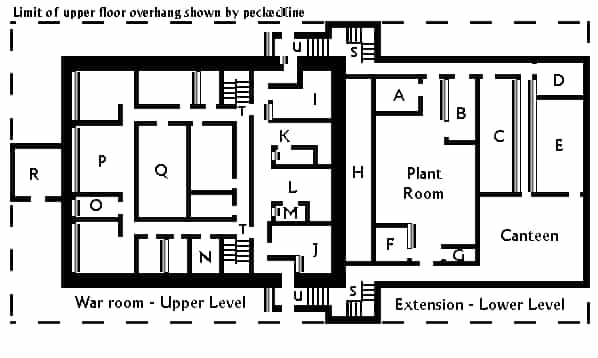
Nottingham’s War Room was built during the early 1950’s to the standard design, consisting of two levels, one below ground and one above with the main control room spanning both levels. The network of 13 Regional War Rooms was quickly redundant being replaced in the early 1960’s by the Regional Seats of Government (RSG). Most of the war rooms did not fit into this scheme and were put to other uses, three however were retained and enlarged, those at Kirknewton and Cambridge were extend by adding another larger block at one end of the building.
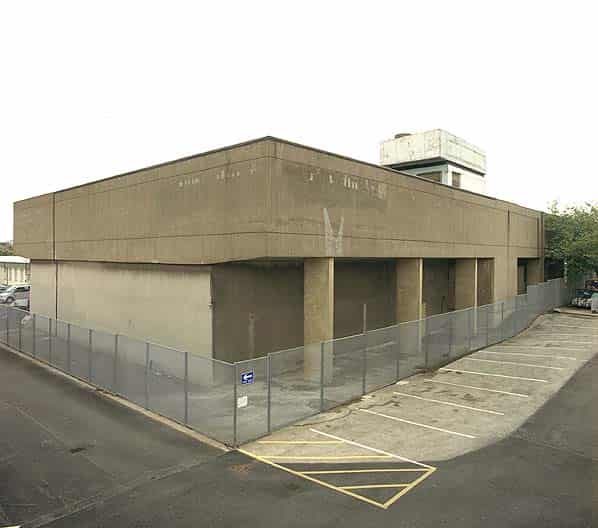
That at Nottingham was enlarged in a bizarre manner as there was insufficient land available on the tightly packed government estate for a large extension on one end, a three-level extension was built with two short storeys (the lower slightly sunken below ground) butting on to the southern end of the war room and a longer third storey across the top of the new extension and the existing war room. This floor was cantilevered, jutting out at one end and the two sides. This overlapping floor is supported along the sides on concrete stilts and the two side stairwells and at the northern end by an emergency staircase from the top floor directly down to ground level. This stairway has been added onto the outside of the north face of the war room.
The building was redesignated RSG3 and remained in use until 1965 when the RSG network was abolished. It was probably used as an SRHQ until 1969 (telephone directories found date from that year). It’s unclear why it did not continue as the East Midlands SRHQ or SRC, as no replacement site was found until Loughborough in 1984. Skendleby became a subordinate SRC to Nottingham about 1966. There is some evidence that it may have been an RSG until 1969 as there was an overlap in decision making in the mid 60’s, nobody seemed sure what to call Regional Controls although RSG’s and area /sub area controls were officially abolished in 1965. The issue of dates is further confused by a document in PRO about the use of Brancepeth Castle (Region 1) as a dispersal location for RSG staff in 1967!
Since 1969 it has been used by MAFF (now DEFRA), in part, for furniture storage although most of the rooms are now empty and unused. Mains water has been disconnected although the power is still on and most of the rooms are lit. The building has ben surrounded by a high fence as it contains asbestos and is considered a health hazzard. The future of the building is unclear although following a survey by English Heritage in May 2002 it is now under consideration for listing.
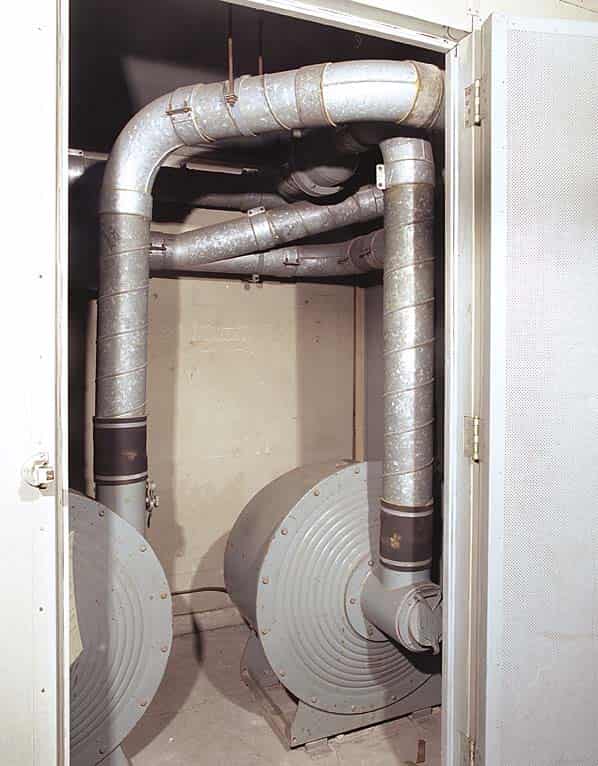
Entry into the building is through a door into a new lobby area that juts out on the east face of the building, to the left into the war room and to the right down a short flight of stairs to the bottom level of the extension with its floor approximately four feet below ground level. The war room still retains its original internal steel blast door and beyond it the male toilets (female on the other side) at one corner of the upper ring corridor. On the south side of the corridor is the original plant room divided into two sections with an interlinking doorway. All the original ventilation and filtration plant remains in place on one side of the room.
The original intake and exhaust stacks on the roof of the war room have gone and the trunking now enters a new vertical shaft between the old building and the extension. The other side of the ventilation plant room was originally an engineers area with tables and cupboards. These have been removed and replaced with a large cupboard containing two pumps for the ‘Lamson Tube System’, a pneumatic message handling system that was installed during the buildings conversion to an RSG. The two Lamson pumps (one suck, one blow) are still in good order and were found to be working when power was applied. The operating instructions for ‘Motor’ and ‘Turbine’ are also there. The equipment was manufactured by Lamson Engineering Company Ltd, Hythe Road, London, NW10.
Through the door into the other half of the plant room there have been no alterations since the 1950’s. The standby generator is still enclosed within its own room and appears to be in good condition. Outside the room is a large panel of electrical switchgear and fuse boxes and a floor standing cabinet with the control equipment for the generator. There is a rack of lead acid batteries for use as a back up power supply and a large floor standing battery charger with a separate rectifier unit.
On the opposite side of the corridor from the plant room two doors open into rooms that had curved Perspex windows that overlooked the two level control room. A floor has now been added and the Perspex windows have been removed and the holes blocked up. The smaller of the two rooms was locked while the larger room, allocated to the ‘Principal Officer’ during RSG days was open and empty.
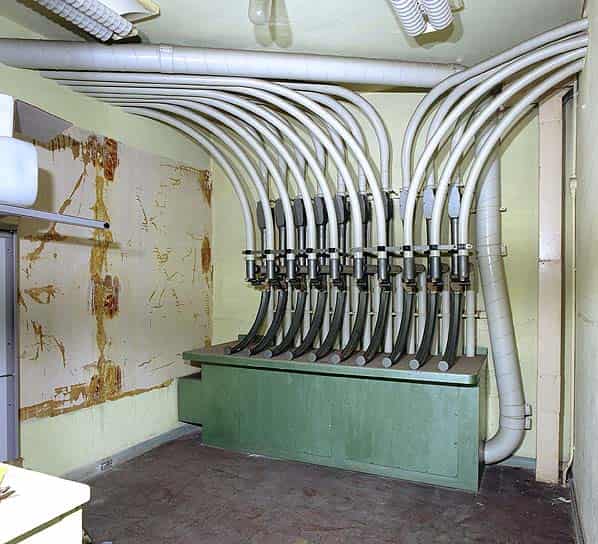
Back at the entrance turning left into the ring corridor, one of two stairways down to the lower level is immediately on the left. The first room on the left contains the 10 pairs (suck and blow) Lamson Tube terminal with tubes fanning out in different directions. There is also a wire basket and a system of ropes and pulleys for lowering the basket to the lower corridor. The basket locks in position in the upper room but can be released by pulling on the rope from below. The system is also manufactured by Lamson and is an original feature still found in some other war rooms. The original kitchen and canteen on the opposite side of the building to the plant room has been partitioned into two rooms. The kitchen still retains a Butler sink, water heater and a Viscount cooker. Most of the other rooms on the upper floor were locked and are used by DEFRA for storage.
The bottom level of the war room appears to have been used for communications for the RSG and some alterations have been made to the internal walls and corridors. The two stairways open onto opposite sides of the ring corridor. Descending the stairs from the main entrance (previously described), the first room on the left is a tank room and beyond that there is a dog leg in the corridor and in a recess the bottom station of the Lamson message basket system. Although jammed we were able to free the ropes and the basket could be raised and lowered.
Beyond the message basket is the ‘Counter Room’ with a half height door with a small counter across the corridor. The counter room has the only Lamson Tube terminal in the old building. From the ‘Counter Room’ there was originally a curved Perspex window looking into the well of the control room. The control room has now been partitioned into two rooms and the window has been replaced by a door into what is now the ‘Voice Procedure Room’ with 6 acoustic booths still in place. Alongside the ‘Counter Room’ is the ‘Teleprinter Room’ which has low tables around three walls. Turning through 90 degrees out of the ‘Teleprinter Room’ is a large room with three floor standing wooden unit numbered 1, 2 & 3 and a very large peg board on one wall with hooks on it. This may have been the tape relay room, the hooks being for the tapes. There are message passing windows into the control room, teleprinter room and the equipment room. There is still a large sign on the wall that reads ‘Take care when disposing of smoking material’.
Passing through 90 degrees back into the ring corridor, the first room on the left is the ‘Equipment Room’ which still retains its GPO Main Distribution Frame (MDF). Beyond this is the ‘Telephone Exchange’ with a panel of lights indicating problems in various parts of the building. There is a second tank room on this side of the building and beyond that the other stairway back up to the upper level.
On the inner side of the ring corridor there is a door into the other half of the now partitioned control room and along another side three rooms that originally had Perspex windows looking into the control room. All the windows have been removed and blocked up and the rooms are empty.
Back at the main entrance into the building a short flight of steps leads down into the bottom floor of the three level extension. At the bottom of the stairs is the main stairway for the new building. There is still a sign at the bottom of the stairs pointing to ‘Canteen’ and ‘Plant Room’ on the ground floor or upstairs to ‘1st Floor Ladies toilets and dormitories J - M’ and ‘2nd Floor Rooms No. 1 - 54’
Passing along the corridor the first room on the left is the new plant room which contains ventilation and filtration plant, fans and ventilation trunking with the air intake and exhaust trunking utilising a 30' wide shaft that runs the full height of the building from a further filter room on the roof. There are four rooms within the plant room, one in each corner these are ‘Engineering Store’, ‘Battery Room’, ‘Generator Room’ and ‘Boiler Room’. The Generator Room can also be accessed from the corridor on the opposite side of the building. The battery room still contains a number of lead acid batteries and a large battery charger. The boiler room still has its locally made Beeston Robin Hood oil fired boiler, heat exchanger, pumps and a control cabinet. The boilers flue enters the main air intake shaft running the full height of the building. The standby generator has been removed through a large hole in the outer wall which is now covered by a thick steel plate. This feature for the installation and removal of heavy plant is seen at other RSG’s. Only the concrete plinth where the generator stood remains.
Back in the entrance corridor on the right, steps lead down into two large rooms that originally contained water and diesel tanks, the buried tanks for the war room were probably re-used. At the end of the corridor is the large canteen which is now stacked with rows of Dexion shelves. At the far side of the canteen is a door into the kitchen and alongside it a large roller shutter above the serving counter and a third door into another corridor.
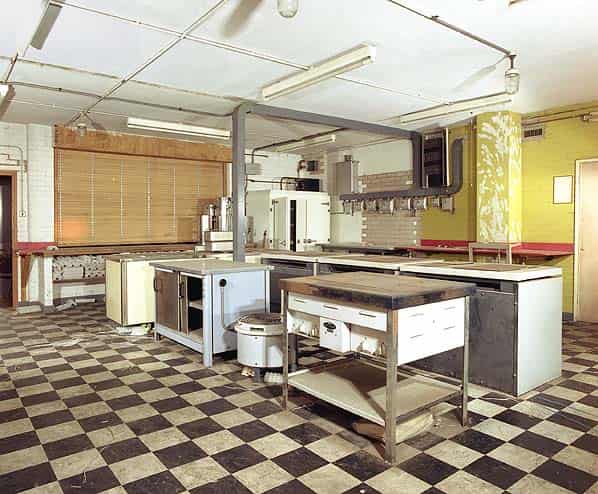
The spacious kitchen still retains all its appliances including 3 hot plates, hot food cabinets, hot water dispenser and a large freezer. There are sinks along one wall and a long food preparation surface along the opposite wall. A door at the back of the kitchen opens into a corridor that leads back into the canteen in one direction and turns through 90 degrees to the rear stairs and exit lobby. Along this corridor is a small ‘Sick Bay’ a large store room and the other entrance into the generator room and plant room. This corridor ends at the other staircase and entrance lobby, a mirror image of that on the west side.
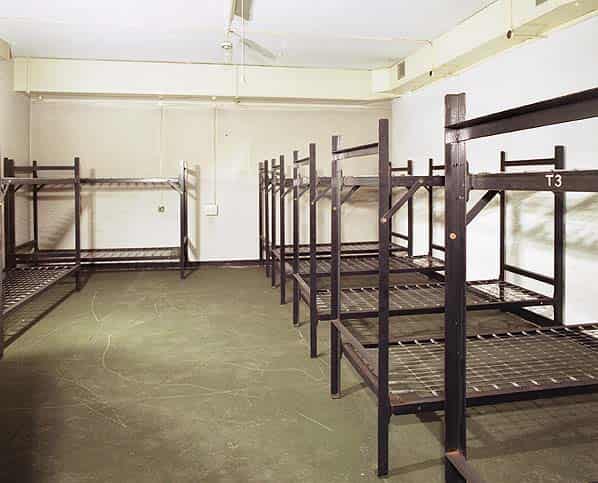
The middle floor consists entirely of dormitories and toilets. There are two long corridors one with dormitories on both sides and the other with dormitories on one side and toilets on the other side. At the landing on the east stairs there is a sign that reads ‘Male Dormitories N - U’ and an arrow pointing upwards to ‘Top Floor’. Close to the stairs are the male toilets and then dormitories left and right of the spine corridor. There are thin partition walls which don’t reach the ceiling between the corridor and the dormitories. Some of the rooms have all their twin bunks intact while others have dismantled bed parts. Along the other spine corridor are female dormitories on the inside and female toilets on the outside.
At the top landing of the western stairs are further male dormitories A - H (all empty apart from some bed frames) to the left and corridors H, J & K to the right. On this level there are two parallel north - south corridors with a room linking them together at the south end and an east - west corridor (H) linking them at the other end. In the middle of this east - west corridor is another north - south corridor (J) and at the end of it a ‘T’ junction with another short east - west corridor. At the end of the eastern of the parallel north - south corridors there is a small ‘Committee Room’ and through it a large room allocated to the ‘Ministry of Power’. This large room has a number of small partitions within it with rooms allocated to ministries of Power, Transport, Labour & Aviation, Board of Trade, Treasury & Banks, Treasury, Finance (2 rooms), Pensions & National Insurance and Social Services. The large room is stacked with old furniture but it’s unclear whether it’s from the RSG or elsewhere.
The east - west corridor has a number of store rooms. One room contains a junction where four pairs of Lamson tubes converge and plunge down through the floor. There is also another male toilet. Just inside the door there is a ladder to a trapdoor in the ceiling. This leads into the roof filter room. This is where the main filters are located along with the ventilation and exhaust trunking. There were doorways onto the roof but these have been bricked up. There is a door into the 30 foot wide shaft that runs the full height of the building. This is filled by the intake and exhaust trunking and the boiler flue.
The other parallel corridor (K) has rooms allocated to MAFF, Secretariat and more female toilets. From the middle of the east - west corridor (H) the north - south corridor (J) has rooms on either side. Many of these rooms are partitioned with numerous smaller rooms. There are rooms allocated to Chief Clerk, Principal Medical Officer, Illustrators, Scientists, Regional Scientific Advisor, Home Office Committee Room, Home Office Assistant Secretary, Regional Director of Civil Defence, Regional Police Commander, Regional Fire Commander, Ministry of Housing and Local Government, Regional Director of Housing and Local Government. One room is allocated to military staff with partitioned rooms within it for the General Officer Commanding (GOC), NRM (Navy), Air Officer Commanding (AOC). At the end of the main corridor is a ‘T’ junction. At the right hand end of the ‘T’ there are rooms for the GPO and the Central Office of Information (COI) and a wireless room with sections of a mast on the floor. At the middle of the ‘T’ is the emergency stairway directly down to ground level. To the left of the ‘T’ is the ‘BBC Corridor’ with a BBC office accessed from a door on the right and at the end a door into the BBC control room which is lined with acoustic panels. At the far end is a glass panel and a door into the BBC studio. The studio is also lined with acoustic panels one of which is hinged and forms a low door into the adjoining room.
Many of the large rooms on the top level have Lamson tube terminals and nearly all the rooms have a printed sheet on the wall listing who was allocated to the room.
On the outside of the building there is a ladder surrounded by a steel cage up to the roof. The bottom ten feet has been removed but we were able to find a wooden ladder to reach the bottom rung. The filter room sits in the middle of the flat roof with intake and exhaust louvres. There are several heavy steel blast doors but these are badly rusted and cannot be opened. In total we spent 5 hours at the site photographing and exploring the building and by the time we left most of the office staff on the estate had gone home and left us to it. There are numerous items of redundent electrical and electronic equipment around the bunker, none of this appears to have any connection with the RSG.
Those taking part in the visit were Nick Catford, Keith Ward, Nick McCamley, Steve Fox, Robin Cherry and Bob Jenner.
Sources:
- Keith Ward