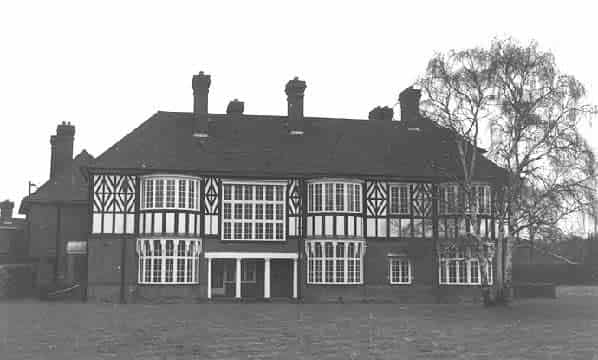
57 London Road was originally in civilian occupation and named ‘Fairlawns’. The property was requisitioned in 1939 as a new headquarters for No.1 Group of the Royal Observer Corps, who had previously been stationed in rooms above Maidstone Post Office. An operations room was built in the house using the ground floor and basement. Fairlawns was in use throughout the war until stand down. In the 1950s Fairlawns was relegated to being a training centre for the group control at Beckenham (19 Group). In 1961 a new semi-sunk control was built to the rear of Fairlawns with administration located in the house. Beckenham was then relegated to being training centre for 1 Group at Maidstone. The former 19 Group HQ at Dura Den, Park Place, Beckenham was absorbed into No. 1 Group in 1953 but was retained for as a secondary training centre until 1968 In 1976 Fairlawns was renamed Ashmore House in memory of the Corps' founder Major Ashmore. On closure Ashmore House and the bunker behind was sold to a local solicitors.
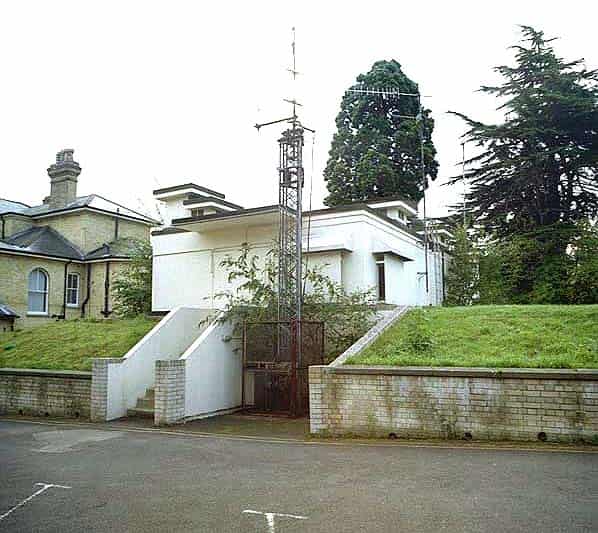
Maidstone is similar in construction to other semi-sunken group controls, consisting of three levels. The upper level is a surface concrete blockhouse often referred to as an ‘Aztec Temple’. The middle level is partly below ground, mounded over with soil and grassed, the bottom level is completely below grown. Externally the bunker is in excellent condition and well maintained. The grass on top of the mound is regularly mown and the surface blockhouse is painted white. The telescopic aerial mast is still in place alongside the entrance steps and unusually the aerial is also still there on top of the mast. Two other UHF aerials are also still in place on top of an adjacent pole. On top of the mound the FSM and BPI pipes are in the middle and close to them is a metal cover over what might be part of the AWDREY (Atomic Weapon Detection Recognition and Estimation of Yield) equipment consisting of a white metal box mounted at an angle on a square concrete plinth. Several pipes protrude from the mound alongside. At the east end of the mound is the original emergency exit consisting of an ROC post hatch on a raised concrete plinth with a rail around it. The later emergency exit door is at the back of the mound.
The surface blockhouse still has its external ladder giving access to the roof. Here the GZI mounting is to be found on top of one of the ventilation stacks.
At the top of the entrance stairs is a steel blast door giving access to the upper level corridor. There are two rooms on the left, the decontamination room and dressing room; both still contain sinks and water tanks. There are two rooms on the right, the first has a gas tight door and houses a small fan for cooling the plant in the room below, the adjacent room contains a bank of filters. Beyond these rooms is another gas tight wooden door which, together with the entrance door, forms an air lock. Beyond this door stairs to the left lead down to the middle floor and ahead was the winch room. The winch has been removed as has the floor. There are railings just inside the entrance door to stop anyone falling. A hole has been cut into the right hand side wall of the winch room to give access to a large water tank.
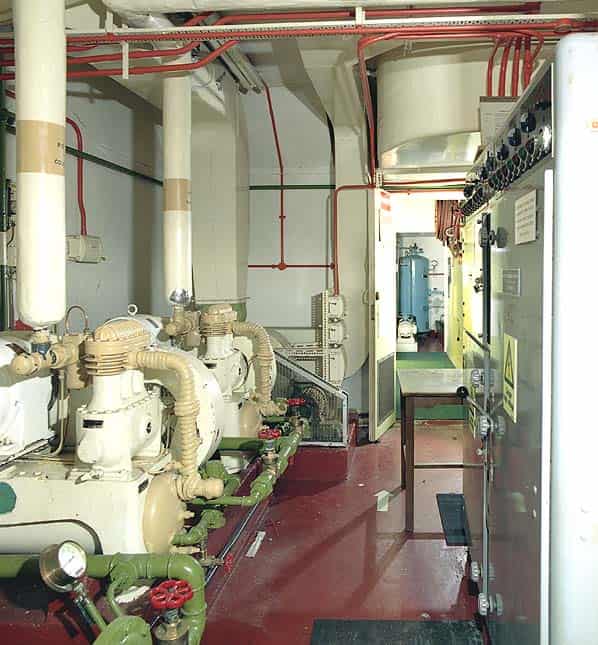
At the bottom of the stairs is a dog leg into the main east - west spine corridor. The first room on the right is the ventilation and filtration plant room which is in immaculate condition with all the brass still polished and gleaming. All the plant remains in place including two chiller pumps, the main ventilation fan, two smaller fans, two compressors and the floor standing electrical control cabinet. There is a filing cabinet full of wiring diagrams, instruction books, maintenance logs etc. Although unused for ten years the plant is almost certainly fully operational with the chiller system still charged.
In one corner of the plant room is a separate filter room with it’s own gas tight door. The bank of filters are still in place. At the back of the room two wooden door open into the generator room which is noticeably narrower then the same room in other semi-sunken group controls. The generator and its control equipment is also in excellent condition with 1518 hours on the clock.
The next room on the right is the canteen, accessed along a short corridor. On the right hand side of the corridor is the kitchen which is largely intact with a Creda industrial cooker, Creda grill, hot food heater, stainless steel sink and draining board and stainless steel covered units. There is a sliding glass hatch for serving food. The canteen is now used for storage of old files and retains nothing original apart from wall cabinets at the back with electrical switchgear.
Next door to the canteen is the BT equipment room, again this is now used for the storage of old files but there are two BT wall cabinets on the end wall and the remains of two racks with some wiring looms. Beyond the BT room is an empty store room and stairs down to the lower level. The final two doors on the right lead onto the balcony looking down onto the control room. Nothing is left in the room at all although in the triangulation alcove it still says ‘Triangulation’ on the wall and there is a small shelf with a slot for an FSM and in the ceiling the bottom of the FSM pipe.
There is a gas tight door in the corridor between the two doors onto the balcony with another gas tight door beyond giving access to the emergency exit. These two doors form a second airlock. There is a ladder on the wall up to a short landing and then a second ladder up to the emergency escape hatch. This was replaced in the 1970’s by a stairway with a door on the south side of the mound.
Back in the spine corridor the first door on the left is the sewage ejection room with two compressors and a compressed air receiver just inside the door and two pumps in the sump underneath a metal grille. This plant also looks immaculate. The next two rooms are the male and female toilets which are complete although no longer connected to the mains water supply. The female toilet has a hot water tank, two hand basins, two WC cubicles and a shower. The male toilet is similar with one of the WC cubicles replaced by a urinal. The next two rooms are the male and female dormitories, these are used for the storage of confidential client files and we had no access. The final room on the left is the small officers room which is empty apart from a Tanoy loudspeaker on the wall.
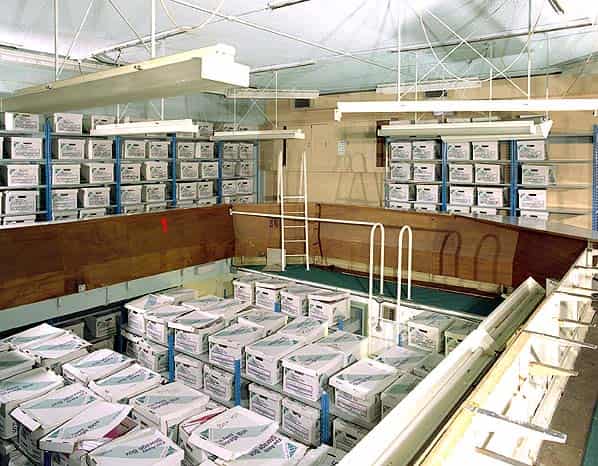
On the bottom level the control room at the bottom of the stairs to the left has been fitted out with Dexion racking and is the main storage area for old files. Nothing from ROC days remains apart from one floor standing display board. The adjacent communications centre is empty. The walls are covered with acoustic tiles and the original tables and chairs are still in place. There are three windows looking into the control room one with a small message hatch beneath one.
The radio room was to the right of the stairs, this has been divided into two rooms, both of which are empty. There is a small store room under the stairs which is also empty.
During the 1990’s numerous ROC items including maps and signs were sold to the Kelvedon Hatch cold war museum. The only remaining signs are fire prevention notices which are screwed to the wall in various rooms.
The owners have no plans to remove any of the remaining equipment and will continue to use the bunker for the storage of redundant files. It is clean and dry throughout and the lighting works in all the rooms.
Those taking part in the visit were Nick Catford, Keith Ward, Robin Ware and Bob Jenner.