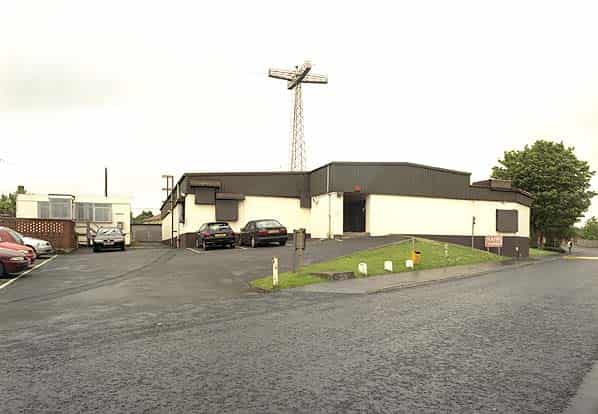
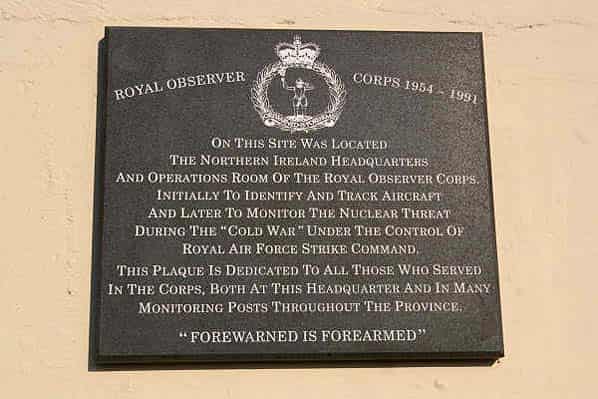
The Lisburn Anti-Aircraft Operations Room (AAOR) was built in the early 1950’s to control the Belfast and Londonderry Gun Defended Area (GDA). It was located within the Thriepval Barracks complex in Lisburn and was built to the standard design with one floor above ground and one floor below with both entrances on the upper level.
It was originally planned to split the GDA with another AAOR at Campsie on the outskirts of Londonderry. This second protected blockhouse was nearing completion when the advent of guided missiles and the H bomb led to the abolition Anti-Aircraft Command in 1956; the gun sites and AAOR’s became redundant. Campsie was never fitted out and commissioned and is now a derelict shell while Lisburn was put onto care and maintainence until 1963 when it was adapted as the new 31 (Belfast) Group ROC Control.
Like the Lansdown AAOR at Bath which was adapted as 12 Group (Bristol) Control, the former operations room was given a major refit.
During the conversion it was extensively modified both externally and internally with partition walls being altered on the upper level. The front entrance was lengthened forming a large enclosed porch with another extension to one side housing ventilation and filtration equipment. The original rear open porch was retained and is now used as a car port. New blast doors were fitted for emergency access.
Internally there have been numerous modifications, some post ROC. The most notable being the blocking of all doors and windows onto the gallery, the central well can now only be accessed from two doors on either side of the lower ring corridor.
The building is now largely used for storage by maintenance staff although many of the rooms are empty and unused while still retaining some of their ROC furniture. Since the ROC moved out, the upper ring corridor has been blocked on one side while the lower ring corridor is still passable. The ROC kitchen remains intact and usable.
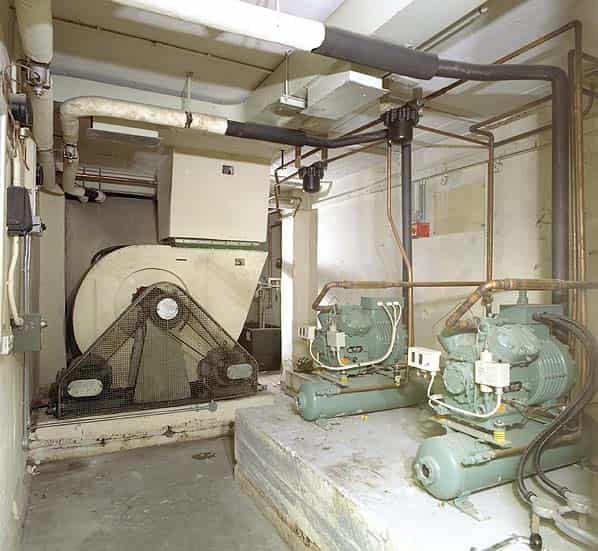
On the lower floor the standby generator has been removed and the room is now empty. On the opposite side of the lobby the original AAOR ventilation plant has been retained but some new plant, including two compressors, were added during the refit.
The male and female toilets have been modernised with new showers installed but remain in their original positions. A large water tank has been installed in one of the rooms on the lower floor. Throughout the bunker new ventilation trunking was installed during the ROC conversion and this runs into all the rooms.
Apart from furniture there is now little evidence of the ROC’s presence. The original four fingered 1950’s aerial mast still stands at the rear.
The building which front’s onto an internal road was painted brown and cream in 1998 and now has a slightly hipped roof with brown corrugated metal cladding coming part way down the walls, this was installed after the ROC moved out in 1992. The pre-fabricated ROC administration block still stands alongside.
Those taking part in the visit were Nick Catford, Keith Ward, Wayne Davies & Roy Coulter.