On 17th January, 7 members of Subterranea Britannica and 2 non-members visited the former AAOR at a former WW2 anti aircraft gun site at Lippitts Hill on the south side of Epping Forest.
The site first saw action in the first world war as an anti-aircraft site and remained operational through the second world war eventually becoming a POW camp, housing both Italian and German Prisoners until 1948. It was used as an army training camp between the wars, After the war the site was home to an Anti Aircraft Operations Room serving the London North GDA (Gun defended area) in No. 1 Group, the bunker housing the control centre being built in 1953. In the early 1960’s the site had become surplus to requirements and was acquired by the Metropolitan Police as their North London emergency war HQ.
A similar bunker at Merstham adjacent to the M25 in Surrey became their southern HQ. Both bunkers ceased to be used for this purpose in 1989. Merstham was eventually sold but Lippitts Hill, which is a large site, is now used as theNational Police Training Centre with firearms, pursuit and all other kinds of training undertaken. Helicopters of the Police Air Support Unit cover Southeast England from a purpose built heliport. I would like to thank the Met Police for allowing this visit.
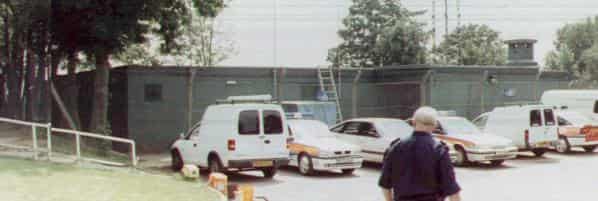
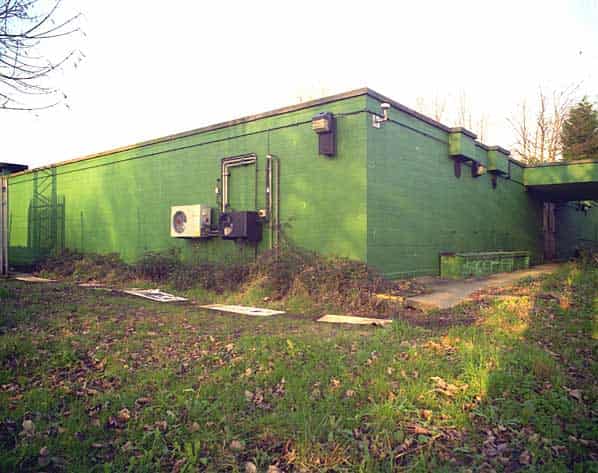
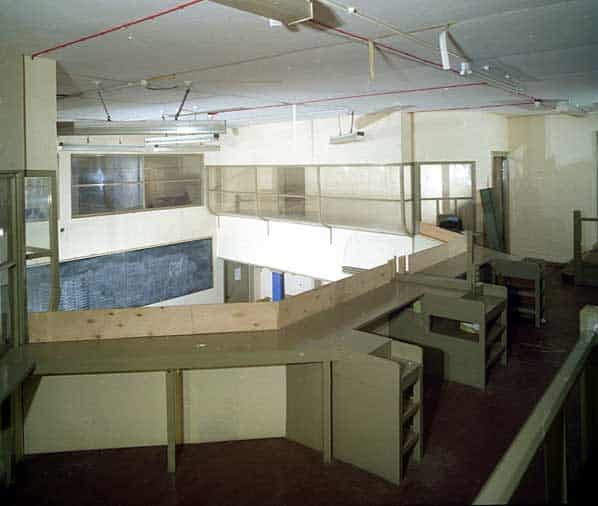
We first saw the bunker itself, which is visible, albeit through trees, from the public road and the footpath that rings the camp. The bunker is within its own secure enclosure. It has a large aerial mast (Home Office, still in use) at one side and various other aerials attached to the wall. It is painted dark green and externally is in excellent condition. It is on two levels, one above ground and the other sunken. Both entrances are on the upper level. Internally everything is painted light cream and appears little changed from operational days although there appears to be a certain amount of extra wiring and smoke detectors have been fitted. We looked first at the balcony around the central well, which still retains its original woodwork and distinctive curved Perspex windows. All three rooms around the balcony appear to be unused.
The window through to the upper control room has been boarded up this room is used for gas training. Having smelt the room we quickly closed the door. There is a small operational kitchen on this level but most of the other rooms are used for storage (mainly targets) or are empty. There are two stairways down to the lower level. Both the control room well and the rooms adjoining each side have been converted into a gym and contain various pieces of apparatus. As with the upper floor, there is a corridor running around the lower floor.
We had access to the ventilation plant room with its original plant. Everything appears to be in excellent working condition including an ‘ozone’ electrostatic filter unit. Unfortunately the key to the standby generator room didn’t fit the lock and we were unable to report on that or the boiler (The standby generator was original and looked in good order in 1998- ed). Most of the other rooms on this level were locked and inaccessible including the radio room, which is still in use. We were able to wander around the bunker at will and photograph anything we wanted.
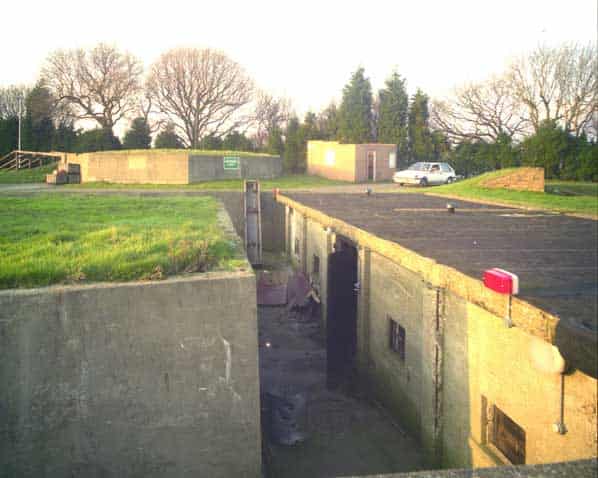
From there we moved through the camp with all its original wartime hutting intact and in use. At the top of a short hill was the gun site itself. Two of the gun pits still remain standing 5' high. They have however been infilled with soil and are used for dog training. Close to one of the pits the sunken magazine is still extant and in good condition. Close to the other pit the battery command post also still stands. One door into it was locked and another section was partially flooded. Other structures still remaining included the gun store, MT shed and a concrete ramp that may have been the radar platform.
We were able to look into one of the wooden huts used by the police as a dormitory and the original kitchen/canteen, which is still in use. At the southwest corner of the site is a war memorial to the US 184th AAA Battery who manned the guns after America’s entry into the war. The memorial is now outside the camp and accessible from the footpath around the perimeter.
Those attending were Nick Catford, Dan McKenzie, Andrew Smith, Keith Ward, Caroline Ford, Andy Wells, Alan Lawrence, Bob Jenner & Robin Cherry. Thanks to Keith Ward for arranging this one.
References: Historic England Listing