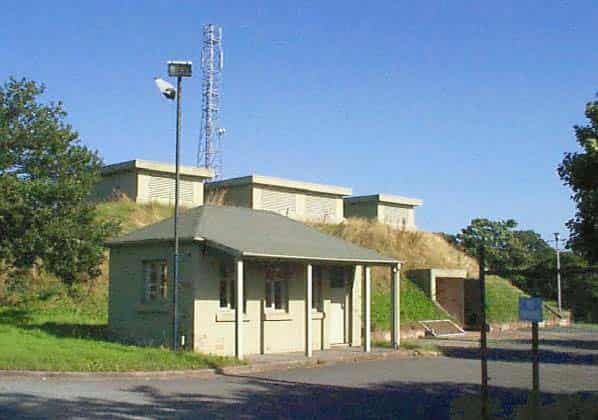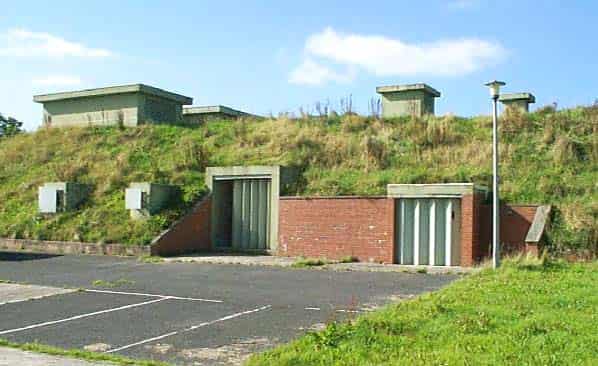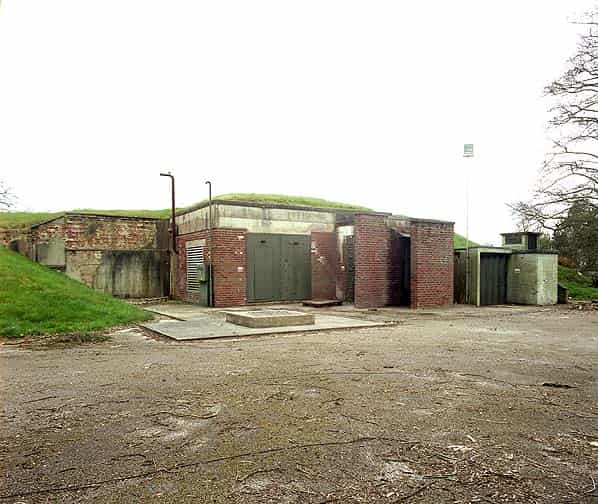
EXTANT. The Group HQ used the adapted WW2 9 Group Control (the site was also previously adapted as a ROTOR SOC - see below) with the administration in a pre-fabricated building alongside. The complex also housed the Western Area Sector Operations Centre. The Former ROC Group HQ is now owned by a veterinary practice who use the administration block alongside although the bunker itself is empty. In the past, been used for training by the emergency services. 21 Group was only formed in 1962 incorporating posts from the redundant Lancaster and Manchester Groups. The former SOC operations bunker was refurbished at great cost and to a high specification. The end was removed from the earth mound and an extension built to house a state of the art ventilation/heating and filtration plant room and a separate standby generator room with two generators.
The site is on the east side of Langley Lane. Going through the main gate, the prefabricated administration block, now used as the veterinary practice is on the left hand side with the rectangular grass covered mound of the bunker running east - west on the right hand sand. There is a small guardhouse just inside the main gate and a 100 foot high permanent aerial mast, now used by Vodaphone on the south side of the bunker. There is a set of steps onto the top of the mound which at its eastern end has three large ventilation towers above the generator room. Behind these towers are three small ventilation towers above the ventilation plant room. One of these has steps up with a GZI mounting plate on the top. Further back on the mound the BPI and FSM pipes are still visible.
The main entrance is on the north side at the eastern end. Passing through two gas-tight blast doors leads to the east - west corridor running the length of the north side of the bunker, there is a similar corridor running the length of the south side. Having passed through the two blast doors, a door leads into two decontamination rooms with sinks and water tanks, the second of which leads out into a north - south corridor linking the two east - west corridors, this corridor also contains male and female toilets which are intact but not working. There are a number of rooms between the two corridors that probably housed dormitories and one long room with a blackboard that was probably a briefing room.
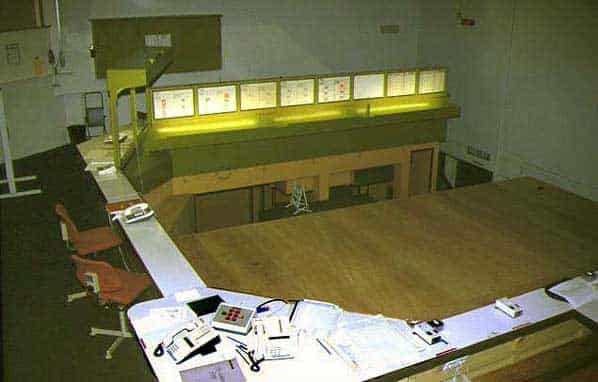
At the end of both long corridors a short set of steps lead down to a sub level balcony which runs three sides around the main control room with steps down into the well of the control room at each end of the balcony. As with most rooms, this area has been completely stripped but a mounting for an FSM is still in place in the middle of the balcony. Beyond the steps down to the balcony is an unusual long room linking both east west corridors. This room is at the lower balcony level with steps down into it from each corridor. This was probably part of the original war time balcony around a much larger ops. room. At the far eastern end of the upper level is the kitchen which has been completely stripped apart from the ‘dumb waiter’ lift (still working) to take food down to the canteen on the floor below.
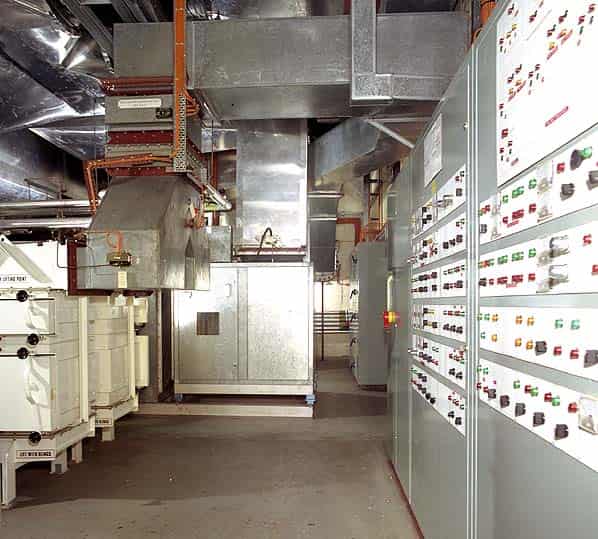
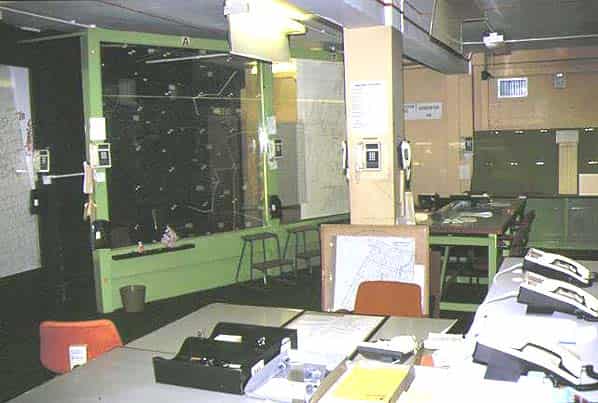
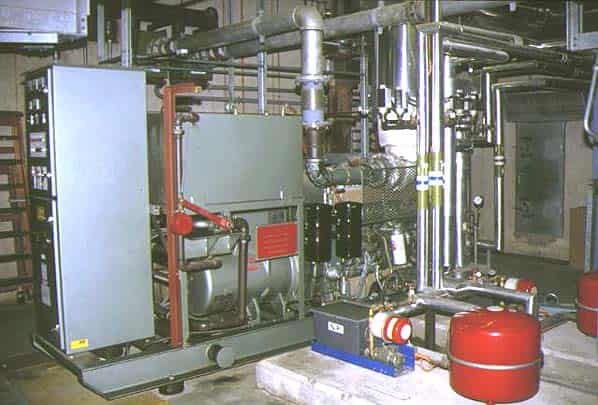
Next to the kitchen which is accessed from another north - south corridor linking the main east - west corridor there is a set of stairs leading down to another sub level which contains the emergency exit on the south side of the bunker and a door into the impressive ventilation/heating and filtration plant room. Contrary to reports that the plant has been stripped out and sold for scrap everything is intact and gleaming with all the plant and associated control cabinets in excellent condition. There are three windows into the generator room to the east. Returning to the emergency exit a second flight of stairs lead down to the lower level which also has two east - west corridors running the length of the bunker. At the eastern end on this level there is a network of small rooms and interconnecting passages all of which have been completely stripped. The only recognisable room is the canteen with the bottom end of the ‘dumb waiter’ lift. Both corridors lead into the well of the operations room which has obviously been taken out of use at some time as another room has been built inside it. At the back of the operations room a doorway leads into the communication centre with its walls covered in peg board. At the back of this room two steps lead up through a low doorway (anyone over about 5' 10" needs to stoop) into another communications room and through another door into a very large rectangular room with two supporting pillars in the middle and a dais along one side. This would appear to be the later control room. The BT room is accessed from the southern corridor and has some racking still in place together with some modern Vodaphone equipment and one telephone.
At the eastern end is another set of male and female toilets. The bunker is clean and dry throughout and the power is on in all rooms. Apart from one room that contains a few items of old furniture there is no evidence that it is used for storage and no evidence that it is being used by the emergency services for training.
The generator room is accessed through a door on the outside alongside the emergency exit. Steps lead down into the large square room which has been completely stripped of everything apart from the concrete bases for the generators, the fresh water borehole is locted here.
Three doors in the west wall lead into three smaller rooms which are used to store straw. These rooms have doors into the western face of the mound. The bunker is securely locked.
HISTORY
Langley Lane, also known as Longley Lane, was one of four similar bunker complexes built by the RAF in the 1940s. The others were at Inverness, Kenton Bar (Newcastle-upon-Tyne) and Watnall, Notts.
Each of these four complexes consisted of no less than three bunkers, typically a few hundred yards apart. One was the operations room, another was the filter room, and the third was a communications centre. The complex acted as 9 Group Operations Centre Fighter Command.
After the war the operations room was adapted as one of 6 Sector Operations Centres as part of the Rotor Radar Project with the code name LOA. Longley Lane and Box SOC’s were the first to become operational in 1950.
There has always been some confusion over the name this probably dates from a change of name in 1950 when under the Fighter Command Outline Plan (AIR2/11178) RAF Barnton Hall was re-named RAF Longley Lane. It seems likely that it was a typing error at that time but the incorrect name was retained.
The SOC’s were designed to exercise the intermediate control and reporting functions under Fighter Command HQ, Bentley Priory. The UK was divided into 6 sectors, each with an SOC. Fighter Command HQ and the SOC’s received raw data from radar stations and ROC Group HQ’s; after filtering to remove anomalies this data was retold to the SOC’s who were responsible for the actual control and interception via GCI stations. Army AAOR’s also received the same information to integrate defences.
With the introduction of the Type 80 radar in 1953 it was apparent that the control and reporting functions could be provided at the same installation and with the delay in data transfer to the SOC’s and back it was found quicker to control the interceptions from the GCI sites.
With the advent of the H bomb in 1955 together with modern bombers, the rotor system as it stood was superseded by technology and events and the network of Master Radar Stations (MRS) was introduced. Several rotor sites became Master Radar Stations but the SOC’s and the AAOR’s became redundant. Longley Lane was one of the first SOC’s to close, probably in 1956.
During the war the filter room, which is located half a mile from the main site, acted as a collecting point for information. Duplicate and irrelevant information could be filtered out here. It was later used for many years as the Preston AFHQ. The two level bunker had been empty since 1992, its last use being as a military firing range. It was offered for sale by tender by the Ministry of Defence in June 2000. Prior to the sale there were two public open days for potential buyers. The bunker no longer had any power and was flooded beneath the floorboards in the lower level and in the lower plant room. Before the public could be allowed in temporary lighting had to be installed and most of the water was pumped out.
Documents in the PRO (namely the Operational Record Book (ORB) or ‘Form 540’[1], located together in the same class with other ROTOR period ORB’s) show that the Langley Lane site (the WWII operations room) was used as a Sector Operations Centre (SOC) in the ROTOR air defence system, other authorities claim that documents may indicate that minor works were completed but the site was never equipped. [2][3]
The communications site is now derelict and a local farmer uses it as a vehicle store.
Those taking part in the visit were Nick Catford, Dan McKenzie, Richard Challis, and Andrew Smith.
Sources:
- Bob Jenner
- Dr. James Fox
- [1] PRO: AIR 29/2485
- [2] Appendix ‘D’ to OMR 1818/50, 4th December 1950
- [3] Ref. G.379853/BR/10/53/85
- PRO: AIR8/1630
- PRO: AIR2/11178
- PRO: AIR8/1630