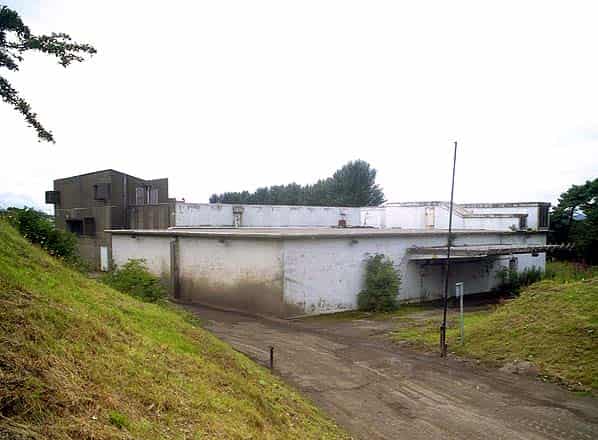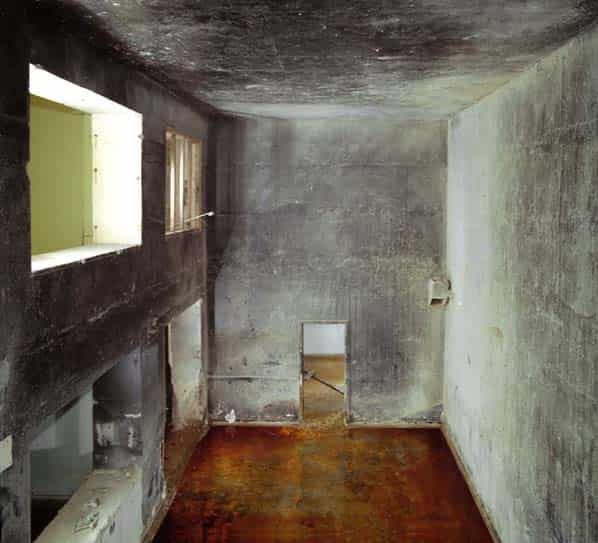
Since being decommissioned in 1993 the former Kirknewton War Room on the south side of the B7015 between East Calder and Kirknewton (NT104684) has been put to a number of different uses including a night club, recording studio, a military style training area and most recently storage. All these diverse uses have left their mark, as have the Scottish Office after they conducted a controlled explosion in the two storey ‘control room’.
Kirknewton is very similar in design to the Regional War Room/RSG in Brooklands Avenue, Cambridge. The war room, built in 1953, was of the standard two storey design with all external walls five feet thick; in this case one storey was above ground and the other below ground.
In 1965 Scotland was divided into 3 zones, North, East and West with controls at Anstruther in Fife (north) , Kirknewton in Lothian (east) and Torrance House in East Kilbride (west) . These reported to a Scottish Central Control at Barton Quarry in Edinburgh. At this time the building was extended with the original regional war room butting onto a second two storey blockhouse with both levels above ground.
It later became RSG for Scotland but by 1970 it had reverted back to Eastern Zone HQ with Scottish Central Control back at Barnton Quarry. This arrangement continued until 1983 when the East and West zones were merged to form the new South Zone. The Zone Headquarters at Kirknewton then became the Scottish Central Headquarters housing the Scottish Commissioner (the peacetime Secretary of State for Scotland), the Headquarters was know to many as ‘Central’.
Originally built for around 50 people it would have been too small for its role as an RGHQ (Scottish Central Headquarters) and it was replaced in 1990 by a new, purpose built bunker at Cultybraggen near Stirling. The Anstruther ZHQ became the Standby Scottish Central Headquarters. It continued in this role until 1993 when it was abandoned following the end of the cold war; shortly afterwards it was sold to the current owner, a local businessman. In 1996 the bunker was opened as a night club. The council insisted on the addition of fire exits which closed the club for many months and this together with only a 1 a.m. licence (when nearby Edinburgh is 4 or 5 am) and an ongoing drug problem forced the owners to close the popular venue. Since then a small area in the lower level of the extension has been used as a recording studio producing several chart hits and the war room was leased by two former SAS men who operated a team building and stress release training programme converting the bunker into an assault course with red and green zones and battle headquarters. This area was also used by the Scottish Office who carried out a controlled explosion in the control room leaving it little more than a blackened shell.
Since then the lower floor of the extension has been used for storage and although it is still partly used for this purpose the future of the building is in the balance and it may be demolished and used by the recycling company who operate at the rear of the site.
There is little to see in the war room with most rooms wrecked and empty, there are holes in the floor in both levels making exploration dangerous especially as this level is damp with flooded open drains. All the curved glass windows looking into the control room have been removed as have some of the walls. The control room itself has not been modified by adding a new floor and it is still possible to look down into the well below from the upper level. Some rooms have been painted red or green as part of the stress release course and on the lower floor crawling ramps have been placed in front of the message passing windows. Only the two toilets with plant rooms in-between remain intact and in original condition. All the ventilation plant is in place including two fans, trunking and filters. The adjacent room houses the standby generator; it is a room within a room with the generator in the small inner room and outside the control equipment and switchgear in a large floor standing cabinet. There are also two rows of lead acid batteries for use in emergencies and a battery charger and rectifier unit. The two toilets at either end are in original condition with a shower, wash basins, cubicles and a water heater each.
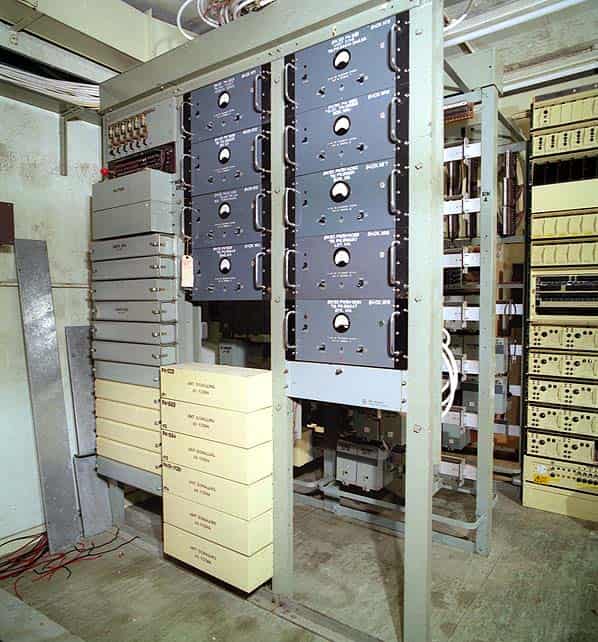
Beyond the male toilet there is a dog leg in the corridor linking the old building to the new extension. The original entrance blast door is still there but has been welded in place so that it cannot be closed. The corridor in the lower level of the extension forms an inverted ‘T’, on entering the extension from the war room, the first room on the left is the GPO frame room. This appears to be still fully equipped with line interface equipment, relay units and tag blocks in floor standing racks. There is also a rack of teleprinter interfaces with one linking to ROC Group Headquarters at Turnhouse. The next room is the switchboard room with 5 key and lamp manual switchboards still in place. There is also a small GPO jackfield on one wall for linking private circuits; some are labelled ‘radio’.
Beyond this room on the left are two further plant rooms, one contains a second and larger standby generator and it’s associated floor standing control cabinet and next to that the second ventilation plant room. This room also contains the main electrical control cabinets for the bunker and the mains input feed. All this plant and the generator are still in good working order. In between the two plant rooms the other arm of the ‘T’ shaped corridor enters. Beyond the plant room there is a tank room on the left and the stairs to the upper level on the right. Stairs also go down to a small basement containing more tanks and the sewage ejection plant. There is a confusing sign on the wall of the stair well pointing down to levels 1 - 19, this might date from the night club era. At the end of the corridor is a small lobby and the main entrance into the bunker. Just outside the door, and accessible only from the outside, is the boiler room with the boiler still in place. On the opposite side of the corridor most of the rooms are locked and used for storage, one room however has a large floor standing camera with lights on either side. This appears to be some form of document or map copying camera, a similar one still exists in the Skendleby RGHQ. There is also a large 1960’s photocopier.
Along the other arm of the inverted ‘T’ corridor there are large offices left and right many of them partitioned off into a number of very small rooms presumably for the various agencies that would have occupied the building. All these rooms are empty apart from rubbish. The last room on the left is the former BBC office, leading to the BBC studio. This appears to be unmodified since the 1960’s with original acoustic wall panels still in place. These are now painted in a variety of different colours. There is a double wooden door between the two rooms and a glass window. It is this area that was used as a recording studio with a new entrance door into the building installed in an adjoining office and the original doorways into the rest of the building bricked up. Most of this brickwork has now been knocked out again, restoring access.
The corridor turns to the right at this point on the left is the second stairway to the upper level and to the right a room that was used for strip searches (for drugs) of people entering the night club.
The upper floor has changed out of all recognition with most of the partition walls (between the former spacious dormitories) including part of the main spine corridor being removed. At the top of the stairs there is a short corridor, to the right the offices have been converted into a long changing room with two large cubicles (male and female) and the walls covered in graffiti, some of it rude. On the opposite side of the corridor a door leads onto the back of the stage and beyond this a second door leads into the night club which was known as ‘Fallout’ alongside the stage. The main area of the night club consists of a vast ‘L’ shaped room with a stage at one end and a large bar still with racks of glasses to one side. There are also two emergency exits (in each side) with double doors opening onto wide metal fire escapes on the outside of the building. These were put in at the request of the council before granting a licence to the night club. The club is painted black throughout and there is no evidence of a fire that is reputed to have been started deliberately after the closure of the venue. At the opposite end to the stage a door leads out to the male and female toilets, as built in 1965 and the stairs down to the lower level. At one side of the bar a corridor leads to the nightclub offices on the left and into the kitchen and canteen. The area is now all painted red. The kitchen still contains all its 1965 appliances and although used by the night club was far too large for their requirements which was rarely more than hamburgers and chips.
Externally the building is generally in good condition with a large awning over the original war room entrance. There are a number of prefabricated huts in the ground but these are derelict and wrecked. The yard behind is occupied by a waste disposal company and there are heavy vehicle movements around the bunker all day. The owner has made it clear he would not welcome further visits.
The Kirknewton War Room/Eastern Zone HQ was demolished in August 2003.
Those taking part in the visit were Nick Catford, Keith Ward, Robin Ware and Robin Cherry.