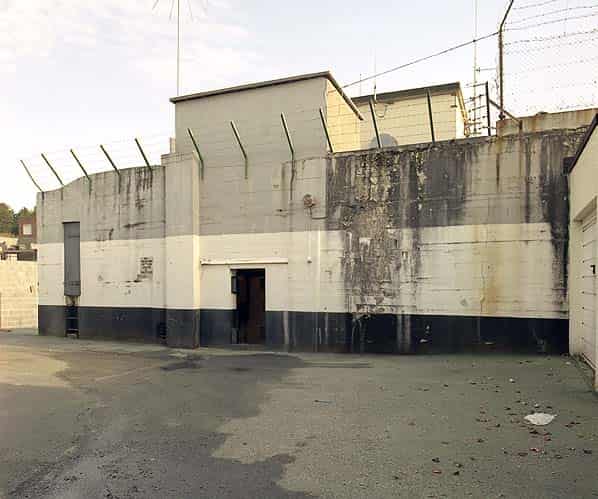
Jersey’s Civil Emergency Centre is located in a former German telephone repeater station in Trinity Road, St. Helier.
In the Spring of 1940 the British Military authorities laid a new submarine telephone cable linking Jersey with France in order to improve communications between the British expeditionary force and London. The cable ran from Pirou in Normandy to Fliquet Bay in Jersey. Shortly after the cable had been laid it was cut as the German army began its advance on Western France. When the Germans landed in Jersey, the cable was soon reconnected to improve communications with Berlin. The signal however was weak and needed boosting so a repeater station was built in Trinity Road, St. Helier, at the rear of Springfield Crescent. Building commenced in late 1943 and was completed by May 1944. Having been brought on line the life of the repeater station was brief; within two months the adjacent French coast was in American hands and the underwater cable was severed once again.
For some years after the war the bunker was used by the Leonis Boxing Club before being taken over by the States of Jersey Civil Defence as their emergency control centre. The original German room layout remains largely intact although some new partition walls have been added and the original entrance has been blocked and a new secure entrance constructed through the original German generator room. Few modifications have been made in recent years apart form the installation of a heavy steel and concrete entrance blast door in the 1980’s.
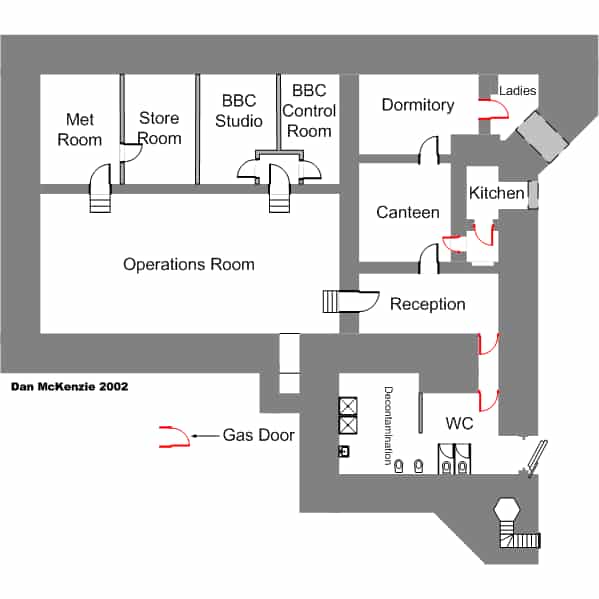
The old ‘generator’ room has now been subdivided with two flushing WC cubicles and a partitioned decontamination area consisting of two showers, two urinals and a hand basin. An original two part German steel gas tight door leads from here into the bunker.
The first room entered is described as a reception room with a counter and a long table with telephones. An SX50 ECN unit is mounted on the wall close to the counter. From this room there is access to the operations rooms down a short flight of stairs and to the domestic area which consists of a kitchen, canteen, dormitory and ladies wash room. The first room entered from the reception room is the canteen which has five tables and stools. To the right is the kitchen which is located in the original entrance corridor and air lock. The two steel air lock doors are still in place and fixed open. The small kitchen has a 1960’s Belling electric cooker, hot water dispenser, a wooden shelf for utensils and a small cupboard for crockery and cutlery. In the short entrance corridor beyond the air lock is a small stainless steel sink and draining board and a water heater. A dog leg to the right leads to the now blocked entrance.
From the canteen another door leads into the ‘L’ shaped unisex dormitory with four wooden triple bunks still in place. A Perspex display screen is stored in here. At the far end of the dormitory there is another German gas door and beyond that a small room with a blocked loophole in the wall which was a defensive firing position covering the bunker entrance. The loophole has now been blocked and the room converted into a ladies wash room with two hand basins and a sanitary towel disposal unit. There is a curtain across the entrance doorway.
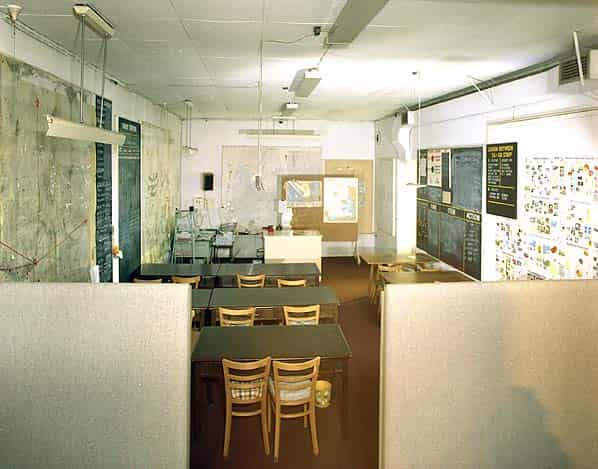
From the reception room steps lead down into the former German equipment room which is now used as the operations room for the Emergency Centre. It is also regularly used as a training room. The back of the room has been partitioned off with wooden screens forming a small signals area with a long table with acoustic booths and telephones. There are various situation boards fixed to the walls together with local and regional maps depicting the most recent INTEX exercise. Jersey always takes part in the international exercises. There are also details of red and black warnings. At the back of the room is the siren control equipment. Unlike Guernsey, the siren network was dismantled 1995 in line with the mainland and half of the sirens have been physically removed. Current thinking supports a reintroduction of the siren network but there is no money available to pay for this.
There are two further short flights of steps into what was another large German equipment room. This has now been subdivided into 4 rooms. The steps at the back of the room lead into the meteorological room which still has a bank of redundant printers and other equipment. Although the current EPO would like to reactivate this room, the Met Office in Bracknell refuse to supply detailed weather and forecast information saying it is no longer required. A door leads from this room into a store which includes a stock of Plessey PDRM82 dosimeters.
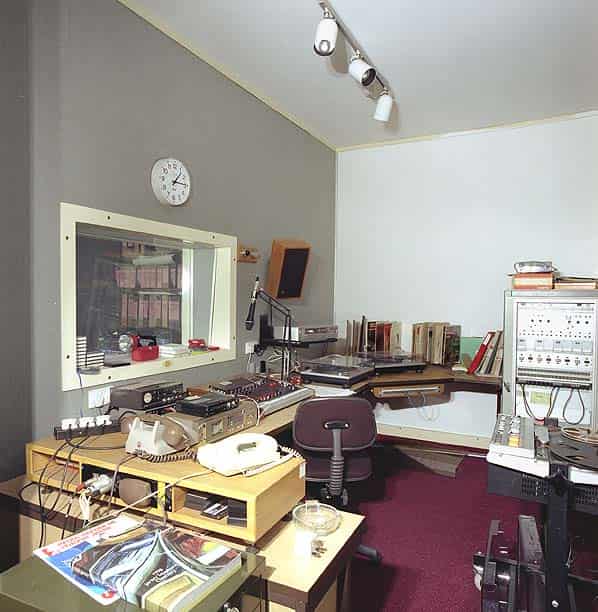
The second set of steps from the Operations Room leads through a small lobby into the BBC Studio and Control Room with a red ‘on air’ light above the door. It is from here that the Bailiff would have broadcast to the island. The studio itself is largely empty with acoustic tiles falling off the ceiling. It has a large table in front of the window looking into the control room with cables for a microphone (Mic 2). The control room also doubles as a ‘self op’ studio and is still fully equipped with similar equipment to that found in all 1980’s RGHQ’s. This includes an Audix mixer, AKG D202 Microphone (Mic 1), UHER reel to reel portable tape recorder, Revox reel to reel studio tape recorder, Sony professional cassette recorder, Marantz cassette recorder, 2 Technics SP1200 record decks, Technics tuner, lip microphone, loudspeaker, clock and a floor standing 19" rack of line interface equipment; all incoming and outgoing audio lines pass through this unit.
There is a stack of LP records, all from the 50’s and 60’s, supplied by the BBC when the studio was installed and a selection of ‘radio play’ (no needle time) themed (male artists, female artists etc) music cassettes. On a small shelf are the nuclear warning cassettes provided by the Home Office. The studio was linked to the BBC’s radio transmitter at Les Platons (OS Nat Grid 655554). The BBC hasn’t taken part in any exercises since the mid 1990’s and although the studio is still fully operational and much of the equipment permanently switched on the line to the BBC has now been severed. In the event of a civil emergency the Bailiff would now have to broadcast to the Island from Radio Jersey in Parade Road, St. Helier.
On the outside of the building there is a recessed ladder adjacent to the new entrance, originally for access to a Tobruk gun emplacement on the roof. It is now used for access to the two plant rooms on the roof, one housing a large standby generator and the other the ventilation and filtration plant that blows filtered air through a network of ventilation trunking running into each room in the bunker. There are also various communications aerials mounted on the roof.
The bunker is still fully operational as the States of Jersey Civil Emergency Centre and Nuclear Monitoring Station although the nuclear threat these days is from the large nuclear reprocessing plant at Valognes near Cherbourg and from 2 nuclear power stations. These sites are still perceived as a serious nuclear threat by many people on the island. These days the monitoring is done automatically with detectors and sensors on the roof sending data to a single monitoring instrument manufactured by Mini Instruments which records temperature, wind speed, wind direction and radiation levels.
There are also three underground monitoring posts serving a similar purpose to the former mainland Royal Observer Corps posts. These are all located in ex German bunkers and although originally manned they are now unmanned with identical instruments sending data back to Trinity Road. The three monitoring posts are at Gouray (714504), Egypte (663557) and St. Queens Church (579533).
Those taking part in the visit were Nick Catford, Keith Ward, and Robin Cherry.
Sources:
- Michael Ginns