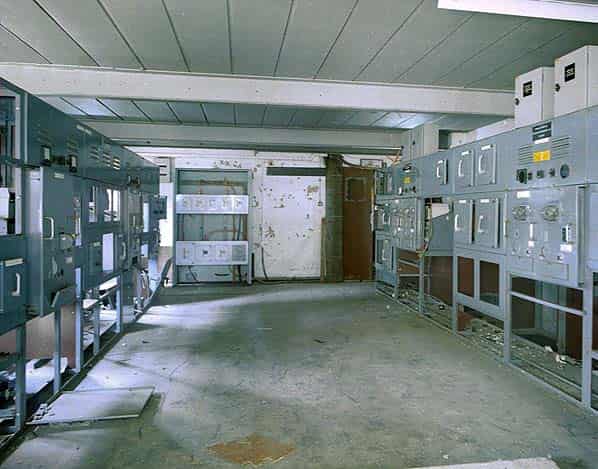
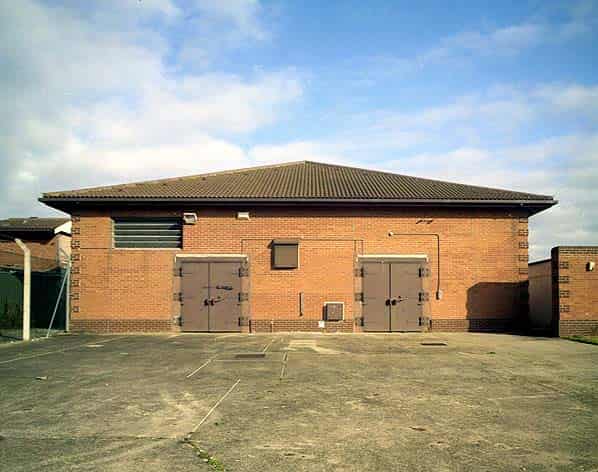
The US Autovon Telephone Exchange at Martlesham Heath, between Ipswich and Woodbridge is currently abandoned. Much still remains to be seen, including both of the generators, aerial masts, some of the control equipment and various items of electrical plant. Most of the buildings on the site are however completely derelict and empty and have suffered from 10 years of vandalism. When visited in 1999 the site and most of the buildings were open, one brick building with heavy steel doors was however securely locked. There was no evidence to indicate what the building was used for. The site has now been secured and all the buildings sealed.
AUTOVON was until the early 1990’s, the United States' Department of Defence Military Voice Communications System. AUTOVON stands for AUTOmatic VOice Network. The system dates back to 1940’s, it has now been deactivated and replaced with DPSN (Defence Packet Switched Network).
The AUTOVON systems primary mission was to provide rapid, world-wide command and control communications for the National Command Authority (NCA) and other high priority subscribers. Its secondary mission was to provide an acceptable grade of service for operational, intelligence, logistic, administrative, and diplomatic users. In other words the military used it so that no one could listen in to anything in the ‘cold war’.
The Global AUTOVON was the principal long-haul, non secure, common user voice communications network for the US Department of Defence. It provided worldwide direct distance dialling station to station service through a system of government owned and leased automatic switching and transmission facilities.
AUTOVON spanned the earth from Asia to the Middle East, and from Alaska to Panama with approximately 18,000 subscribers having direct access to the network. It was a major and integral part of the Defence Communications System (DCS). It was comprised of all Department of Defence non-tactical long-haul point-to-point communications facilities and personnel. It was the non-secure common user switched voice network of the DCS.
The AUTOVON telephones were like a normal telephone but they had a fourth row of priority buttons. A different 3-number prefix was used when dialling a military base using AUTOVON than the prefix used when dialling through the civilian phone system. Usually, AUTOVON was accessed by dialling 8 or 88 and waiting for a dial tone (on any phone connected to the AUTOVON system). A phone call made in this manner was limited to “ROUTINE” Priority. There were “ROUTINE”, “IMMEDIATE”, “FLASH”, and “FLASH OVERRIDE” priorities, with ROUTINE being the lowest and FLASH OVERRIDE the highest. To dial higher priority phone calls than routine, access to Technical control equipment was normally needed.
Each Military Installation had its own prefix for use in the AUTOVON system. Not all telephones on military installations had the capability to call another military installation via AUTOVON. However, they could all receive an AUTOVON call coming from another installation.