The original WW2 Sector Operation Centre at Raigmore, Inverness consisted of three separate bunkers, an ops room, a filter room and a communications centre. The ROC used the ops room and that has now been demolished as has the communications centre. The filter room has had a five million pound refit which includes a massive water tank in the basement and an new ventilation system and blast doors. The bunker is manned daily and is used by the Highland Council as their emergency planning centre
The bunker is one of three that formed the RAF 13 Group Control at Raigmore during the last war. Of the three, only the filter room is still extant. It was used by the Civil Defence Corps from 1958 - 1968 and was then used by the ROC in addition to their own protected accommodation in the former control bunker. In more recent times it was used by a local theatre group for painting scenery which was suspended from the balcony.
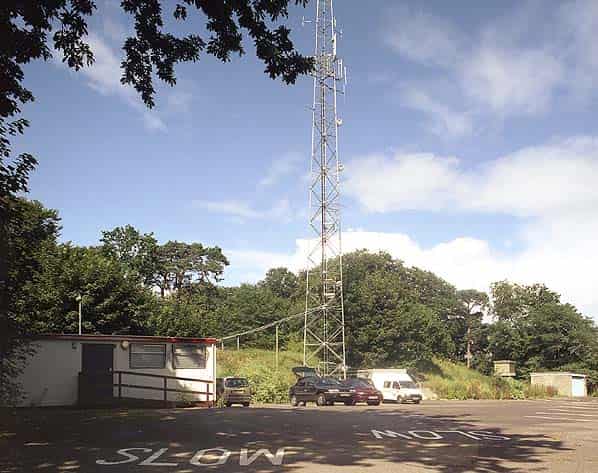
In 1988 the site was acquired by the Highland Council and with a 90% Government grant it was converted into their emergency centre, also incorporating the Inverness Borough Emergency Centre. Externally the grass mounded bunker is little altered although the main access has been rebuilt. There is a large lattice communications tower at the rear and a porter cabin in front which is used by the emergency planning team as their day to day office. In times of emergency, however small, a team is moved into the bunker.
The filter room was identical to those at Watnall, Goosnargh and Kenton, built on two levels with an operations room in the centre with a balcony looking down into the ‘well’. During the conversion, the balcony was floored across.
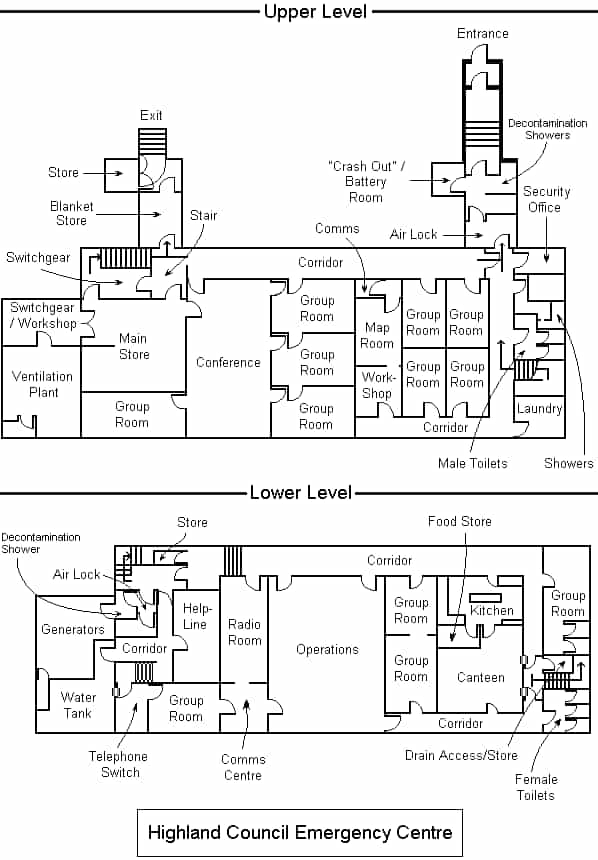
Inside the new ‘front door’, steps lead down through a decontamination area and blast doors into the main upper corridor running around two and a half sides of the bunker. The room formed from flooring across the balcony now houses a conference and briefing suite consisting of the main conference room with a large central table, chairs, projection screen and audio visual equipment, around it are five smaller rooms. The two dormitories are on this level although their beds have now been removed and adjacent to them is the controllers room and sleeping quarters. The original stairs are still in use at both ends with the male toilets adjacent to the stairs at the west end and the ventilation plant room at the eastern end with a workshop alongside.
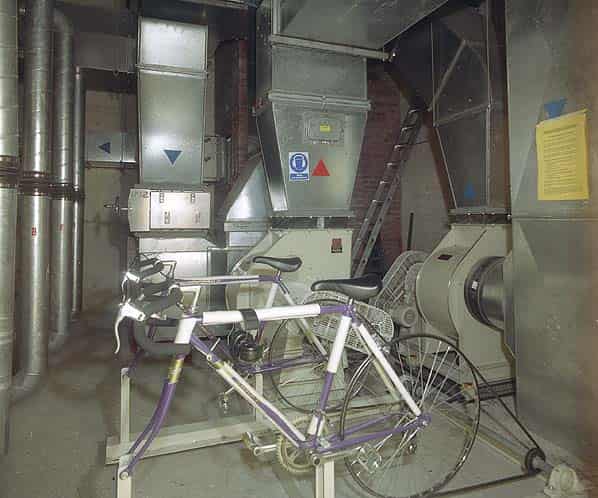
All the ventilation plant was new in 1988 and it includes two modern racing bicycles (including gears and back brake) mounted on concrete plinths. Their front wheels have been removed and the back wheels are connected to a belt drive. (This practice was common place during the last war and has recently been noted in STASI bunkers in East Germany) These would have been used to keep the air circulating in the event of a power failure.
At the rear of the room two steps lead up to a small filter room. A collection of ex-ROC equipment is kept in the workshop including a ‘Secomec’ hand operated siren, ground zero indicator (GZI), bomb power indicator (BPI), two portable dosimeters with chargers and a variety of different radiation meters. There is also a complete aircraft instrument from a nearby post consisting of a tripod, circular metal chart and the Micklethwaite sighting instrument. Close to the workshop is the second exit consisting of two heavy blast doors and a short flight of stairs up to the original emergency exit. Between the two blast doors is a blanket store with blankets still there ready for use.
The hub of the new bunker is on the lower floor where the original well floor now forms the control room with desks and computer terminals for the various agencies and maps around the walls. Adjacent to the control room is the radio room consisting of acoustic booths along each wall and at one end the Communications Centre. At most emergency centres Raynet provide an important part of the communications network but unusually they were unable to provide the service here and a local amateur radio group has been formed to provide this function. Next to the Communications Centre a room has been set aside for the Service Liaison Officer if the services were involved in the emergency and next to that is the small telephone exchange but without the usual ECN unit.
From the telephone exchange, a few steps lead down to what would have been the original ventilation plant area. This has now been divided into several rooms including a ten bay help line which was manned through the foot and mouth crisis and beyond that the generator room leading through into the tank room. The two Perkins diesel generators are kept permanently heated to 60 degrees to aid easy starting. They have a small fuel tank alongside which is automatically filled from the main tanks on the surface. As this is a ‘dirty’ area there is an air lock with two gas tight doors and a shower between the room and the main lower corridor which again runs around two and a half sides of the bunker. On the west side of the control room is the kitchen and canteen with female toilets along the eastern end corridor.
The bunker is kept in a state of readiness and is regularly used for training exercises. When fully manned there would be a staff of approximately 30, a small number for such a large bunker.
Those taking part in the visit were Nick Catford, Keith Ward, Bob Jenner and Robin Ware.