This site is open to the public as Hack Green Secret Nuclear Bunker
Hack Green started life as a GCI (Ground Controlled Intercept) radar station in World War II.
After a period in mothballs in the late 1940s, it was resurrected - again as a GCI station - as part of the ROTOR project. It was equipped with Type 7 VHF radar and a two-level R6 bunker. The site developed into a major air traffic control station - civil and military - known as Mersey Radar. It operated continuously until the mid 1960s.
In the late 1970s, the Home Office took over the site and used it to build SRHQ 10.2 (which became RGHQ 10.2 in about 1985). Every trace of the radar site was removed, except the reinforced concrete box that formed the the Rotor bunker. A new two-level semi-sunk bunker was built in it. A mezzanine floor divides up part of the lower floor, giving three levels in part of the bunker. In total there is about 30,000 ft2 of floor space.
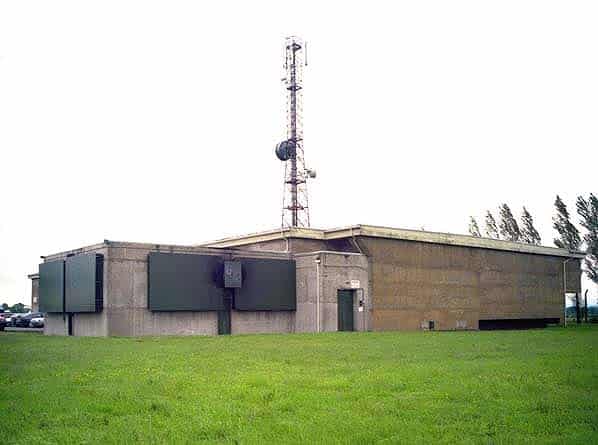
A generator building was added to the side of the bunker. It is shown on the left in the photograph above. The two large green-painted steel plates act as splinter guards to protect the air intakes against flying debris. Behind each of these guards there is a Dawson-Keith generator set comprising a 6-cylinder water-cooled Cummins diesel engine, with electronic governor, and a 250 kVA 3-phase alternator with electronic voltage regulation. These generators can be operated individually or in parallel (using either automatic or manual synchronisation) under remote control from the switchroom in the main part of the bunker. (This is a more sophisticated standby power arrangement than existed at most RGHQs, which typically had two diesel sets of 125 kVA capacity or thereabouts, which could not be paralleled.)
The 37-metre (122 ft.) high radio tower was designed by Eve Construction to carry a variety of antennas, including a ‘chinese hat’ UHF discone for RAF ground-to-air communications, 18 assorted VHF and UHF dipoles, Yagis etc., (side-mounted on the top 10 metres of the tower) and two large BBC microwave dishes at the 18.6m level. In the end the tower seems to have supported rather fewer aerials than it was designed for: the RAF discone at the top, two 1500 MHz shrouded Yagis to provide ECN (RN2) links to the Old Pale hilltop site, a folded dipole for the Army’s Mould home defence radio network, and about half a dozen assorted BBC aerials - but no dishes.
Nowadays space on the radio tower is leased to communications firms. Ironically, it has just (January 1998) acquired two large dishes.
The air filtration is unusually modern too. It uses ceramic filters, rather than the charcoal filters or air scrubbers used elsewhere. The generators and the air conditioning are maintained in full working order and tested regularly.
This bunker, like most of the RGHQs, was sold off in the early 1990s. It was then and still is in exceptionally good condition. It was acquired in about 1994 by Omnicorp Ltd.
Part of the bunker has been turned into a museum, housing both radar and civil defence exhibits. This started as the private collection of curator Rodney Siebert, and was available to individuals and groups by appointment only.