Last week saw Nick Catford, Keith Ward and myself visit what must be one of the most unusual places ever for a nuclear bunker… beneath Eton College near Windsor!
The bunker is set beneath one of the many college buildings and I found out about it through a personal contact. After lengthy negotiations the college finally agreed to a visit.
Constructed in 1959 by H D Bowyer of Slough the bunker is sited underneath one of the Boys' houses and was constructed as an integral part of the building. There are 3 entrances to the bunker via staircases and the bunker is also served by the lift for that building.
We entered the building and then took the lift to the basement with the engineer who was to be our guide.
The lift opens out onto the main corridor which runs the length of the bunker and all rooms are off this corridor. The bunker is divided into 2 sections - ‘public’ and ‘private’ with the lift shaft almost right on the dividing line.
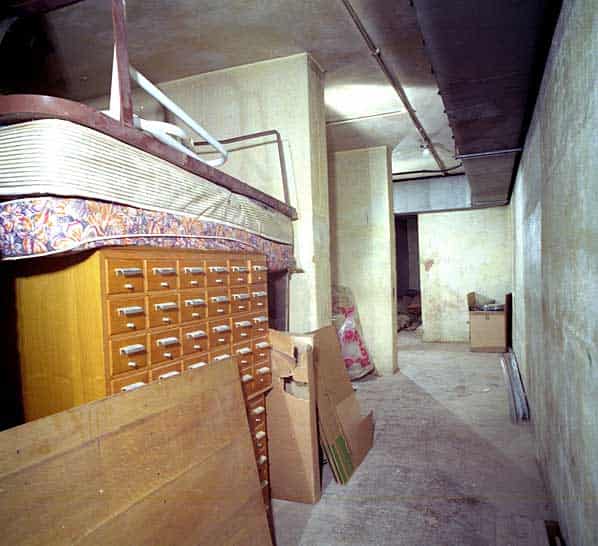
Leaving the lift we are in a concrete walled corridor, to the right is the private section and to the left the public area. We turn right and pass through an ordinary wooden door into the private area. The corridor and room walls in this area are all painted cream. Immediately on our left is the first room. This measures 3M x 2.5M and is totally stripped (as is most of the bunker) and is now used for storage by the house master who lives directly above this section of the bunker (hence how this is called the private section). There are vents from the extensive air con system at the far end of this room.
Returning to the corridor we continue along and on our right is a blast door made by Haywards of Borough, London SE1 with the date ‘1959’ stamped on the identification plate. This door was locked but as we later found out leads into the current boiler room (more on that later).
Directly opposite this blast door is a conventional wooden door into a room. This door was locked and the room contained a small wine collection belonging to the house master.
Further along the corridor turns sharp left and there is a room 3m x 3m on the right hand side. In the ceiling of this room is the large emergency escape hatch which opens into the car park above. Or rather would if it had not been covered in tarmac outside!!!
Just past this room on the right is one of the staircases. This has a double dog leg and leads up to a locked internal door which leads directly into the house masters living accommodation.
Directly opposite the staircase is another room 4m x 2m which again is used for storage by the house master.
All along the corridor and in each of the rooms are vents from the air con system.
Let’s retrace our steps and go back to the ‘public’ section of the bunker.
Directly opposite the lift shaft is a dog leg into a bare concrete room 4m x 3m which is used for storage of general items for the college. We concluded that as this room was directly opposite the unprotected lift shaft the dog leg was built in for blast protection.
Moving along the corridor the next door on the left was a blast door which until the day of our visit had not been opened. Behind it was the generator for the bunker and the back up battery supply. Both of these were coated in a thick layer of dust but amazingly the battery back up was still active and on charge with the lights glowing beneath 20 years of dust. This room (and the rest of the bunker) were in excellent condition with no evidence of damp at all.
Continuing along the corridor there are a further 3 rooms on the right all 5m x 3m all of which are used for storage but are fitted with vents for the air con system. At the end of the corridor there is a double dog leg to the second staircase which again has a dog leg on it. This leads up into another section of the house via a door at the top. Returning back to the main corridor the room directly opposite the dog leg leading to the stairs is the power and air con room. The power system is still active and today supplies the bunker and the rest of the house. The air system is located at the far end of this very cramped room and consists of 2 fan and filtration units but the filtration appeared to be fairly basic.
Turning back towards the lift the final doorway on the right leads into a small corridor. This has a series of bays along it which used to have bunks in them and there are some bunk bed ends still in situ along with the maintenance materials being stored there. At the far end of this corridor is the final staircase which dog legs up to an external door.
Directly opposite is the entrance to the boiler room which today houses an oil fired boiler (the original ran on Anthracite coal) and again has a lot of materials stored in it. There is a very interesting brick plinth built into the floor in this room which obviously used to have something very big mounted on it but our guide was not able to enlighten us further on its purpose.
We were told that the bunker was provided to house 48 people and those with places would have been the Provost and the fellows of the school. It was interesting to note that whilst there was a generator there was no running water or toilets but our guide informed us that the bunker was once fully equipped and even had tinned food in place although there is no kitchen as such. There is no suggestion that any young member of the royal family would have had a place in the shelter.
All too soon it was time to leave. We took a substantial number of photographs which will appear on a web site near you soon (yes please!-ed).
I would like to thank Eton College for allowing access to this part of the school and thank Nick and Keith for their excellent company on the day. Regrettably it is not possible to arrange a second visit.