Epping Forest District Emergency Centre is located just outside the perimeter fence of North Weald Airfield in Merlin Way (TL494045), 200 yards south west of the control tower. The emergency centre consists of an ‘L’ shaped surface blockhouse partly mounded over with soil and grassed. The sections of the building protruding above the mound are painted light green. The building is contained within a large securely fenced compound that also contains a WW2 decontamination centre. The blockhouse itself started life in the last war as a fighter sector operations block and was partially rebuilt internally in 1986 when it was converted into the Epping Forest District Council Emergency Centre.
The entrance is on the north side and is protected by a short section of blast wall. The heavy entrance blast door is of steel and concrete which gives access to a small lobby area. To the left and right two locked doors probably leading to filter rooms. Beyond this is an air lock with two gas tight doors followed by a short corridor to the left, with a door on the right leading into two small rooms that now house walkie talkies and other transceivers that are owned by Raynet. At the end of the corridor is the ventilation plant room with all the plant intact functioning. The ventilation ducting passes through a small heavy concrete blast door at floor level.
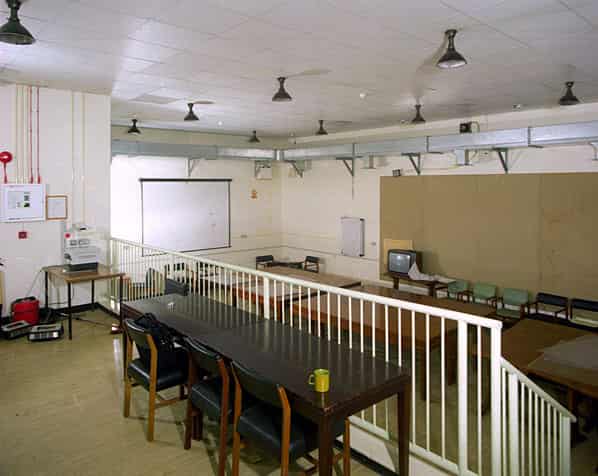
Returning to the lobby area, a door on the right leads into the main control room at balcony level. The control room has been little altered from WW2 days retainins its balcony with railings and a sunken well. Wide wooden steps lead down into the well which has a number of large wooden tables in the centre with chairs around them. There is a projector screen at one end and a television in the centre. Along the back of the balcony, doors lead into three offices with a small window from each looking onto the balcony. At the far end of the balcony is a small hand pump which appears to be part of the air-conditioning system and beside it a door into the canteen which is now stacked with furniture. Having entered the canteen there is a corridor to the left and alongside it a door to the left giving access into the kitchen which is fitted out with 1980’s furniture and appliances. There are two doors along the corridor, both on the right. The first leads to the ladies and gents toilets and the second gives access to a small room which still contains the ECN unit. From here, a further door leads into a small room with three steps up to a shower cubicle and a further door from this room leads into another short corridor. On one side of the corridor is the standby generator room to which we had no access and on the other side of the corridor one door gives access to the electrical switchgear room and the other door to the emergency exit which consists of another heavy steel and concrete blast door.
The part of the building on the far side of the balcony has been considerably altered since WW2 days with progress through the bunker taking a ‘zig zag’ route through a number of small rooms and corridors. Throughout the bunker almost all of the internal doors are gas tight and most are painted bright yellow as are the blast doors. There appears to be no obvious dormitory although if necessary camp beds could have been set up in the canteen or other rooms.
The Emergency Centre is still functioning although only occasionally used for exercises. Apart from the ECN unit and the portable Raynet equipment there appears to be no other communications equipment or telephones and there were no papers anywhere other than a box containing plans of the bunker before conversion.
Following the departure of Raynet the building was broken into and badly vandalised internally and after lying empty for some years it was demolished in December 2007.
Those taking part in the visit were Nick Catford, Keith Ward, Duncan Halford and Andrew Smith.