Our first visit was to the Dagenham Borough Control at the rear of the Civic Centre at the junction of Wood Lane and Rainham Road North, Beacontree Heath. The bunker was built in the 1953 and was designated 51B2 reporting to the North East Group Regional War Room at Wanstead Flats. It is a purpose built underground bunker beneath a low grass covered mound to the rear of the Civic Centre and on the western side of Central Park. There is an aerial mast on top of the bunker. The main access is a small concrete block with a wooden door surrounding the top of the stairway (similar to Stoke Newington and Hackney Town Halls).
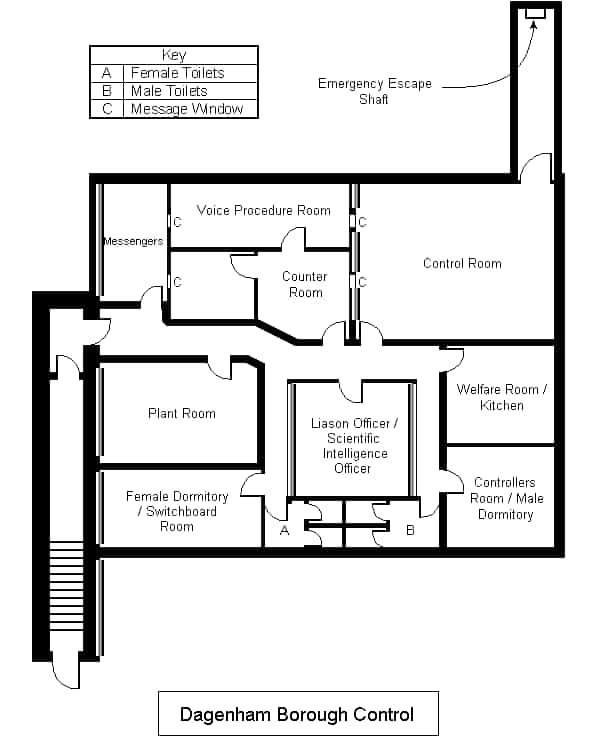
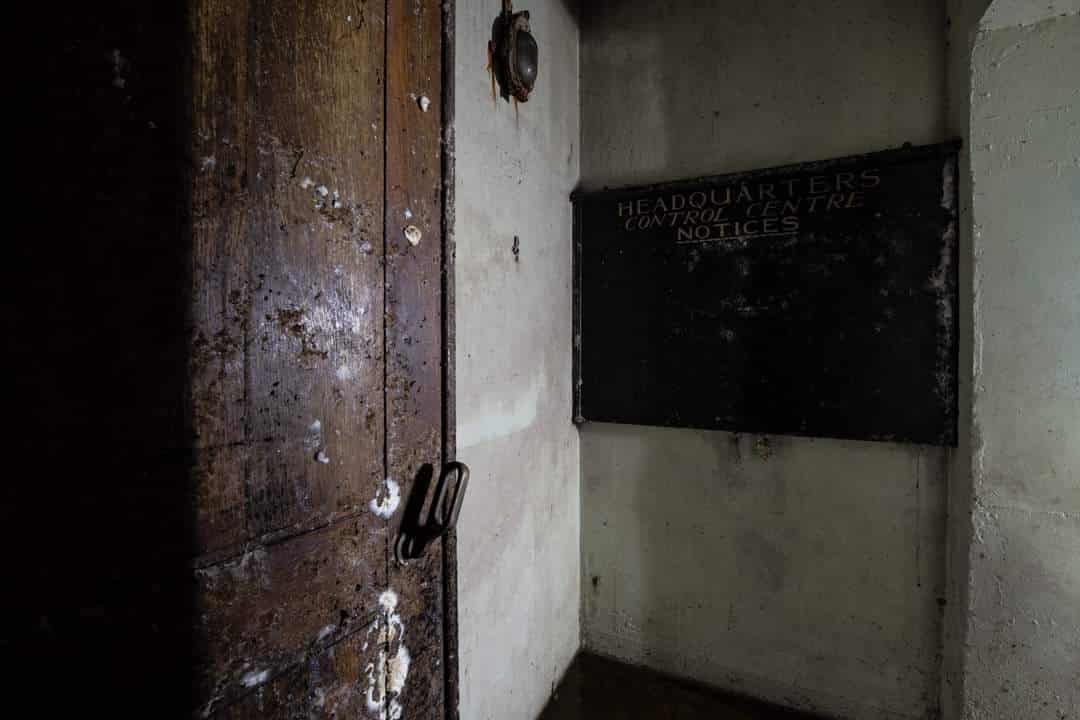
The emergency exit is at the rear of the mounds and consists of an ROC type metal hatch. At the bottom of the stairs there is a right turn through an airlock into the main north-south dog-legged spine corridor. The airlock consists of two heavy wooden doors with a gas seal (now perished) but no blast protection. The first room on the left is a small messengers room with a message passing window into the adjacent room. This room is now used for document storage and is kept locked.
The next room is described on the original plan as the ‘Message room’ and would have had acoustic booths along one wall. It has since been partitioned into two rooms rooms, the ‘Voice Procedure Room’ and the ‘Counter Room’. The Counter Room has itself now been partitioned into two. The voice procedure room has most recently been used as a communications room and there are still various BT junction boxes, telephones, computer keyboard, monitor, several desks and an Autex Telex Manager. This equipment probably dates from a very short lived reactivation of the bunker in the early 1990’s where several operators manned the phones during an unusually cold winter. There is also a 6" to 1 mile map of Barking on the wall and a message passing window into the control room. The room is also used for storage with large quantities of crockery, boxes of papers and numerous files including the emergency plans for Dagenham and all the neighbouring boroughs.
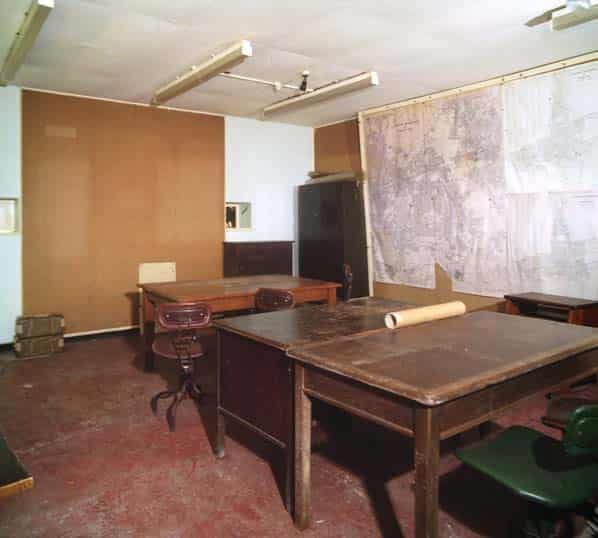
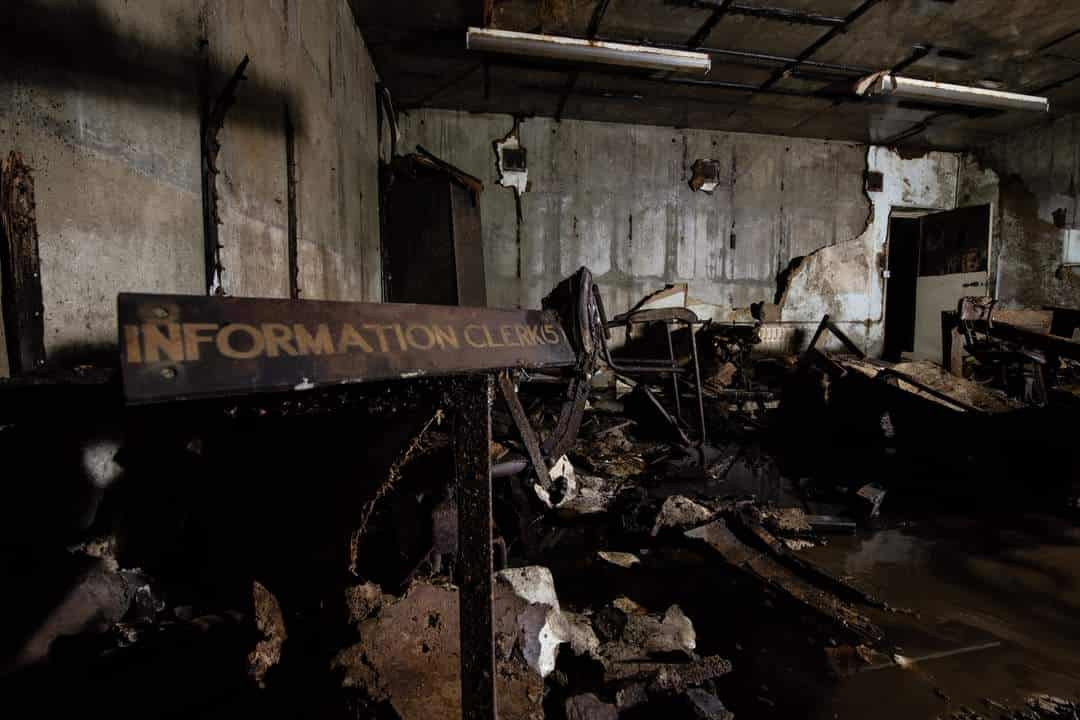
The next room is the ‘Control Room’ which still retains much of its furniture including wooden desks, a number of slightly curved tables that could be joined together to form a circle or semi circle, several lecterns, a chest of very small draws and several metal cabinets. There is a large 25" to a mile map of Barking on the wall and numerous Ordnance Survey maps, 2.5", 6" and 25" strewn around the room. There are several rolled up maps on a rack on the wall. There is a wall mounted board titled ‘Special advisors display board’ divided into two columns ‘Date’ and ‘To be seen by’ There are numerous triangular wooden named bocks for placing on tables and desks. These included ‘Signals Clerk’, ‘Operations Clerk’, ‘Signal Master’, ‘Assistant Controller (Ops)’, ‘Specialist Advisors’, ‘Education staff’, ‘Information Clerk’, ‘Messenger’, ‘Liaison Clerk’, ‘Operations Officer’, ‘Information Clerk’ ‘Intelligence Officer’ and various other general clerks. At the far side of the control room a narrow passage leads to the escape shaft with a ladder up to the surface.
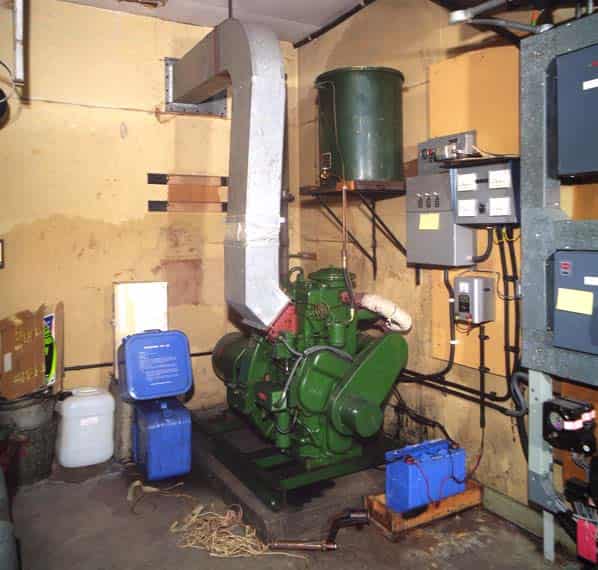
Back at the main entrance, the first room on the right is the plant room with the standby generator, ventilation plant and electrical switchgear. The generator is still tested occasionally. On the dog leg on the main corridor there is a short corridor leading to the female dormitory now stripped of its original fittings. It was later used as a switchboard room but is now used for storage. Beside it is the female toilets with two cubicles, two sinks and a water heater.
Back in the main corridor the next room on the right was originally the ‘Liaison officer’ but was later used by the Scientific Intelligence Officer. It is now used as a store and was locked, we had no access. Beyond that is another short corridor leading to the male dormitory (later the controller’s room) and the male toilets with the same fittings as the female toilet. The final room at the end of the main spine corridor started off as the ‘Welfare Room’, it has a Butler sink, metal draining board and water heater so it must have doubled as the kitchen. In later years it became the ‘Information Liaison Room’
The bunker was decommissioned around 1968 and apart from a the brief reactivation in the 1990’s its only other use has been as a social room for the Emergency Planning staff and in recent years in has featured in various films and documentaries including ‘Adolf and Eva’ when the welfare room was transformed into a bedroom and the communications room into a parlour. It served as another fuehrer bunker in ‘Hitler’s Fixer’ a film about Martin Bormann, and again in ‘Battle of the Atlantic’ part of the Time Watch series. There is a quantity of 1930’s wooden furniture (wardrobe, dressing table etc.) stored in various rooms. It seems likely these were brought in by one of the film companies and left there. Although derelict, the bunker is clean, dry, lit throughout, and largely unaltered since the 1960’s giving a good flavour of a borough control from that period.
Those taking part in the visit were Nick Catford , Keith Ward, Bob Jenner and Duncan Halford.