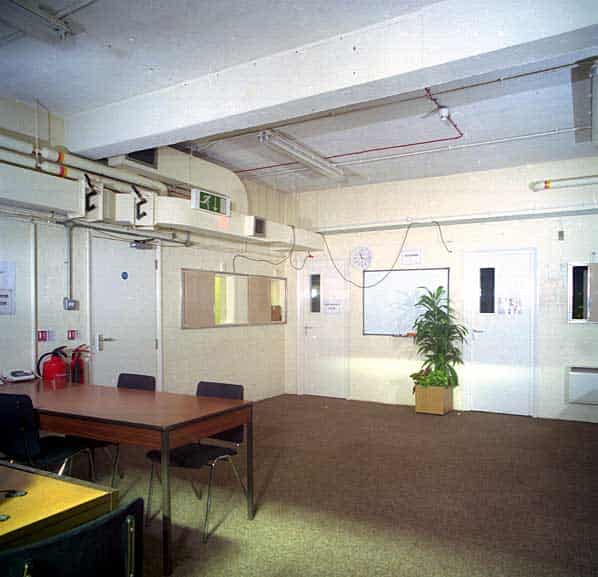
On the 19th December, 4 members of Subterranea Britannica, Nick Catford, Keith Ward, Robin Cherry & Neil Harley visited the Dacorum Borough Council Emergency Centre at Hemel Hempstead.
The bunker is in the basement of the Civic Centre and was built in 1966. There have been few modifications to its structure since that date and it still serves as the borough’s emergency centre dealing with several local emergency situations each year, most recently during the fuel crisis.
Entry into the bunker is from the sub basement where there is a wooden door with a combination lock, any earlier blast doors having been removed. It is a relatively small bunker housing 20 people in 6 rooms. Having entered the bunker, a short corridor ends at a door left into the communications room and right into the control room. Another short corridor runs from this point to the ventilation plant room and the standby generator. The 1960’s Lister generator has recently been replaced and the ventilation plant has been rewired and is fully operational; this was demonstrated. The original ventilation ducting runs along each wall with an outlet in all rooms. The ‘L’ shaped communications room still contains the ECN exchange equipment which is operational and there are several aerial feeds for Raynet’s radio equipment which is brought in during exercises. At the other end of the room a door leads into what was the scientific advisors room but it is now stripped and used for storage. Although described by our guide as ‘fully operational’ the control room is very bare with a few tables and chairs, a map of the locality on the wall and little else. There is a double message passing window into the communications room and smaller windows into two other rooms one of which contains the council’s own emergency radio communications equipment which is regularly used. Various stores are kept here including protective clothing and hard hats. A fourth door in the control room leads through another empty room into the boiler room and emergency exit. There are no toilet or shower facilities and no kitchen. Our guide thought chemical toilets and canvas beds might have been provided when originally fitted out.
Much of the furniture is original from the mid 1960’s, and includes a teleprinter table and a couple of items of associated equipment. The council have agreed to donate the furniture and equipment to a cold war museum and it will probably go to Kelvedon Hatch.