This purpose-built RGHQ is located in the Army camp at Cultybraggan north of Stirling. It was finished in 1990 and was constructed to replace Anstruther. The bunker has now been sold to the army.
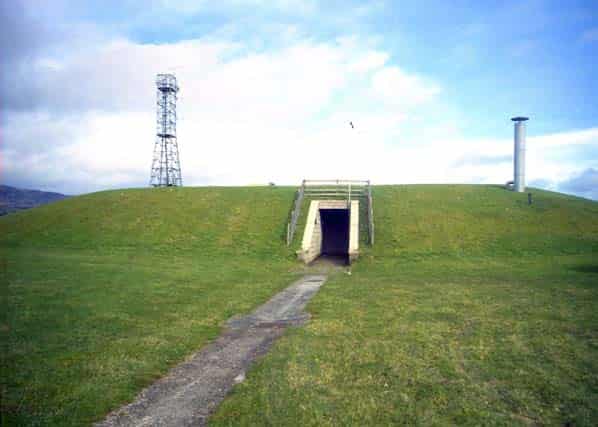
On the 8th March 2000 a very small party from Subterranea Britannica visited Cultybraggan RGHQ one mile south of Comrie in Perthshire and fifteen miles north of Stirling. The bunker is located within the Cultybraggan army training camp at NN768203. We had arranged to meet two officials from the Scottish Office (The Scottish equivalent of the Home Office) at noon but we arrived a little early to find the camp almost deserted. There was no guard on the gate so we drove on to the camp office where we found the caretaker and his daughter; he told us we could go anywhere on our own until the man from the Scottish Office arrived. The camp consists of little more than rows of WW2 Nissan Huts (It had been a prisoner of war camp) interspersed with a few small brick buildings. The bunker was obvious in the north east corner of the site; it’s within its own fenced and locked compound. There is a large aerial mast on the north side and a long brick ventilation/exhaust tower on the top. On the east side of the compound, and within the camp is the Comrie ROC Post. All surface features of the post are intact and in good condition as is the green paint. The hatch is locked.
The bunker is on two levels, the upper level being above ground but mounded over with soil and grassed. The main entrance is on the west side of the mound where a blast door leads into a lobby area with a door into the decontamination room and a second blast door into the bunker. There is also a a bullet proof glass panel looking into a guard/control room. Going through the 2nd door there are stairs to the left down to the lower level and a door into the control room. In the room there is a large electrical panel with the controls for the bunker including fire protection, intruder alarm and controls for the filters and ventilation plant. The panel is still functioning. There are also two key cabinets full of keys. Beyond the control room the next door on the right leads into a small preparation room and then into the decontamination room where there are three shower blocks (the showers still work) with a door at the other end back into the entrance lobby.
Returning to the top of the stairs, a short passages opens into a large open plan office area running two thirds the length of the bunker and across two thirds of the width. This area has been completely stripped of everything. There is a concertina partition across the back third of the room and this area appears to have been used as a conference room. On the left (north) side of this room is a long thin room with evidence that it had contained tele-printers and next to that a small tea room with evidence of the tea making machine that stood there. From the back of the conference room a passage leads to the upper plant room, passing a second stairway down on the right and the emergency exit. This plant room contains all the ventilation plant with its associated control cabinets plus two air compressors for pumping out the sewage. All the plant is still operating and every time a toilet was flushed one of the compressors would start. There is a well down to the lower plant room with a hoist on the east side of the room and through a door on the north side, behind some of the ventilation plant there is a ladder down to the lower plant room.
On the right (south) side of the large open plan office/conference room there are doors into approximately 8 square rooms some of which are now used by Cultybraggan Camp for storage. One room however contains a number of brand new telex machines, some of them still in their original packing crates. Apparently some of these machines, and their monitors have gone to Anstruther Museum. Returning to the entrance area and descending the stairs. There is a long corridor straight ahead with dormitories left and right, all these rooms are now empty. At the end of the corridor there is a cross passage, turning right leads into a store room while straight on leads to the bottom of the second stairway and then into the lower large plant room which contains a long water tank and the ventilation plant, all of which is functioning. A door at the far end leads into the standby generator room with two large diesel generators still in place. A door from this room leads to the generator exhaust and up into the ventilation tower. Returning to the cross passage there is a door to the right with a combination lock on it, this was the strong room. A short corridor then leads to a second cross passage.
A door to the right leads into the BBC Studio which is kept locked at all times. The door opens into the control room which is approximately 25' X 25' in size and lined with acoustic sheeting. The studio itself which is about 8' X 8' stands in the opposite corner. There are two floor standing racks on wheels, one has a stack of control units including a large jack panel. The other rack contains two Technics tuners the remote controls for which were found, still in their plastic bags, in a filing cabinet. There are also two private wires to radio repeater stations in the locality. There is a red light above the door into the studio which contains a chair, a custom made mixing desk, a Technics cassette player, a UHER portable reel to reel tape recorder (there is a tape on it which has a series of tones on it) and an AKG D202 microphone. There is a glass panel looking into the control room. All the equipment in the studio is still functioning and the private lines to the radio repeaters are still live. Turning right out of the studio leads to the BT room. In the centre of the room is the ECN (Emergency Communications Network) unit an SX 2000. There are racks of private wires and a programming terminal. There is a small room next to it containing two operators positions still in place. Next door to the BT room was the radio room with a large floor standing rack that had once contained all the radio equipment. The various receiver and transmitter units from the rack lie on the floor in an adjacent room.
Opposite the BT room a door leads into the medical room where there are two beds, a moveable screen and a door leading into a toilet and washroom. Returning to the second cross passage another long corridor gives access to three dormitories on the left hand side which still contain all their twin bunks and on the right hand side first the gents toilets with all the usual facilities, (WC, urinals and showers). Next to the gents toilets are two washrooms with sinks and the plumbing and notices for a KEF washer and tumble drier and a washing up machine and then the ladies toilets. The final room at the end of the corridor is the canteen with hot plate which is rather corroded and an extractor above, preparation area and sinks. This opens out into the canteen which is completely empty. The door from the canteen leads to the bottom of the entrance stairs which has a storage area beneath.
Throughout, the bunker is carpeted and generally in excellent condition although it is a little damp in places and there are a number of rabbit carcasses on the floor. Most of the lighting works, all the ventilation plant and air conditioning works and is permanently operating. The telephones and intercoms all function, all the taps and showers are working and the toilets flush. The visit was arranged by Ward Westwater who was allowed to remove certain items for his own bunker, the former ROC 28 Group Control at Dundee (see Craigiebarns). The bunker has been sold by the Scottish Office to the MOD although at present it is still in the hands of the Scottish Office. The Army have removed some items while other items have gone to Anstruther. As the army have keys to the bunker and use some rooms for storage, the BBC studio and control room has always been kept locked as it is still fully equipped.
Since the visit all the equipment from the studio and the adjacent BBC office has been removed and taken to the Hack Green Museum.
Those taking part in the visit were Nick Catford Dan McKenzie, Ward Westwater and Caroline Westwater.