This site was originally home to a high-power (600 kW) medium wave broadcasting transmitter, built for the Political Warfare Executive in WWII. This transmitter was purchased in the USA in 1941 and consisted of three 170-kW units connected in parallel. The underground site had been prepared with the assistance of Canadian forces personnel.
The BBC obtained partial use of the station from 8th November 1942 to broadcast its European Service. At other times this transmitter, known colloquially as Aspidistra, was used by the PWE for ‘black’ broadcasting. This started on 30th January 1943.
After the war the transmitter was operated for many years by the Foreign Office’s Diplomatic Wireless Service, and hired by the BBC to broadcast the World Service to Europe. After the transmitter closed, the Home Office built RGHQ 6.1 here in 1984-6 to replace the former site underneath Dover Castle known as Dumpy.
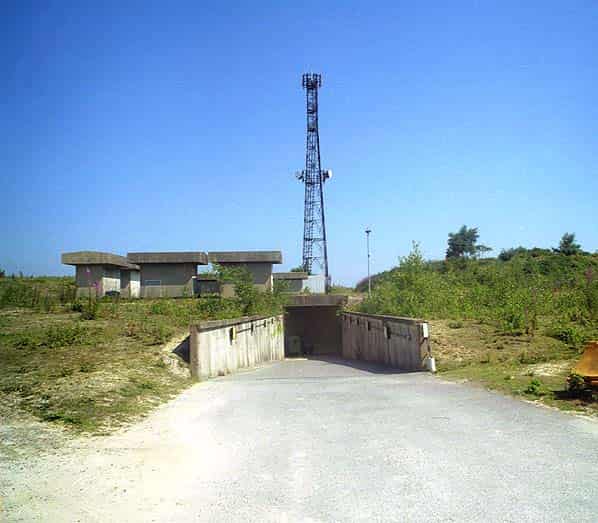
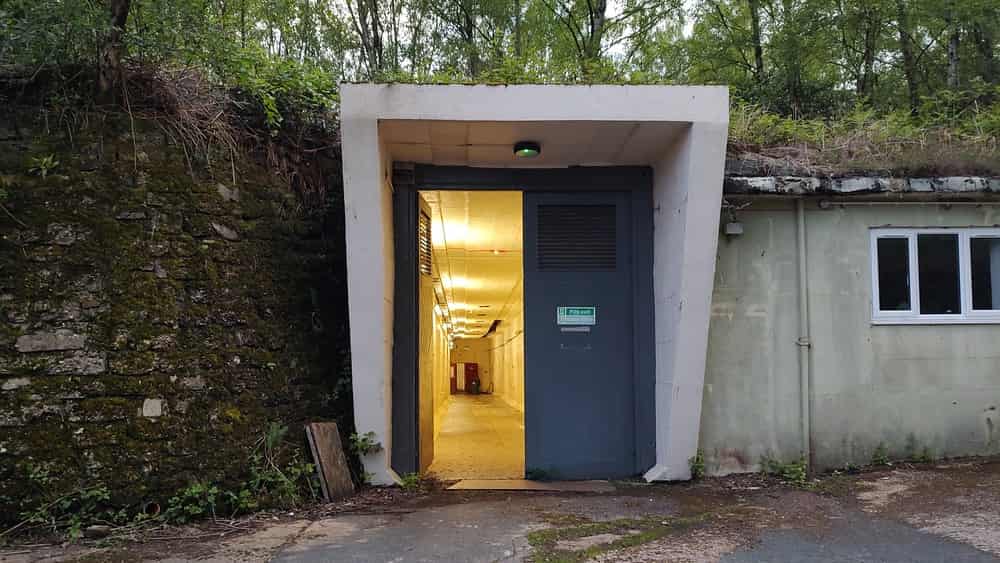
The RGHQ was constructed by gutting the original Aspidistra bunker and inserting a mezzanine floor. A new wing at the uppermost level was added to house the generators, air conditioning plant, etc., and to provide a new entrance.
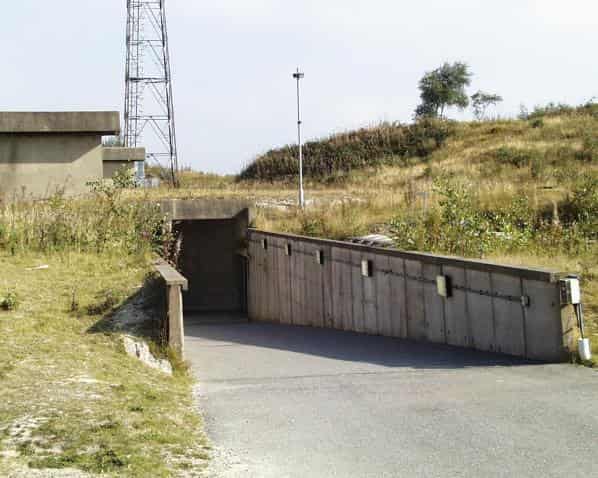
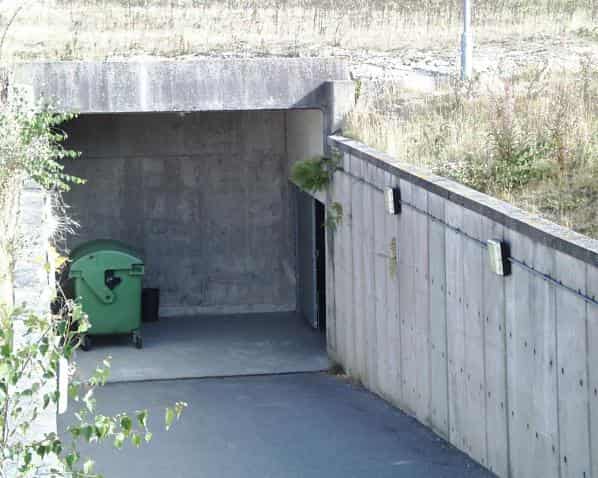
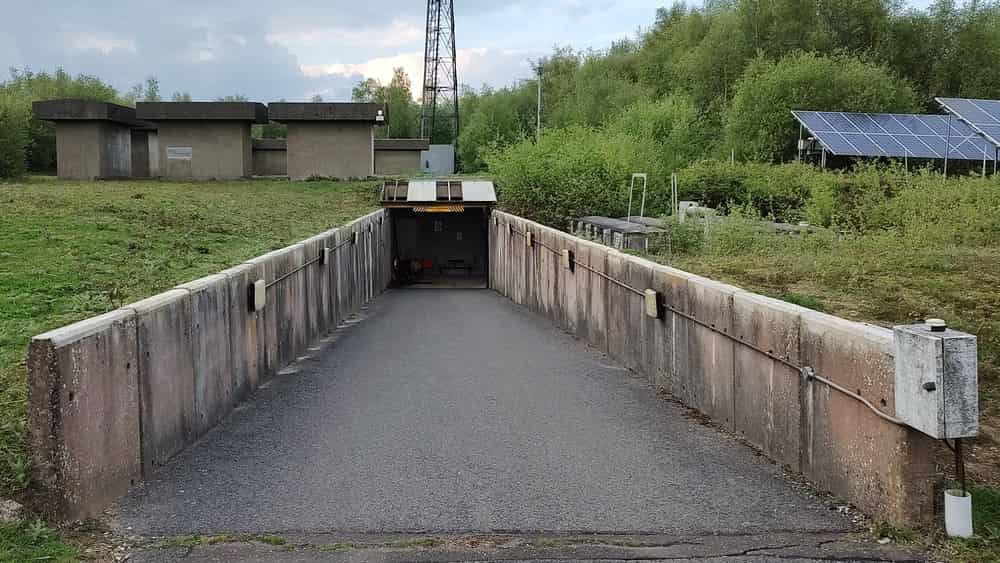
The original Aspidistra entrance on the lowest level has been retained and there is a vehicle ramp to that level.
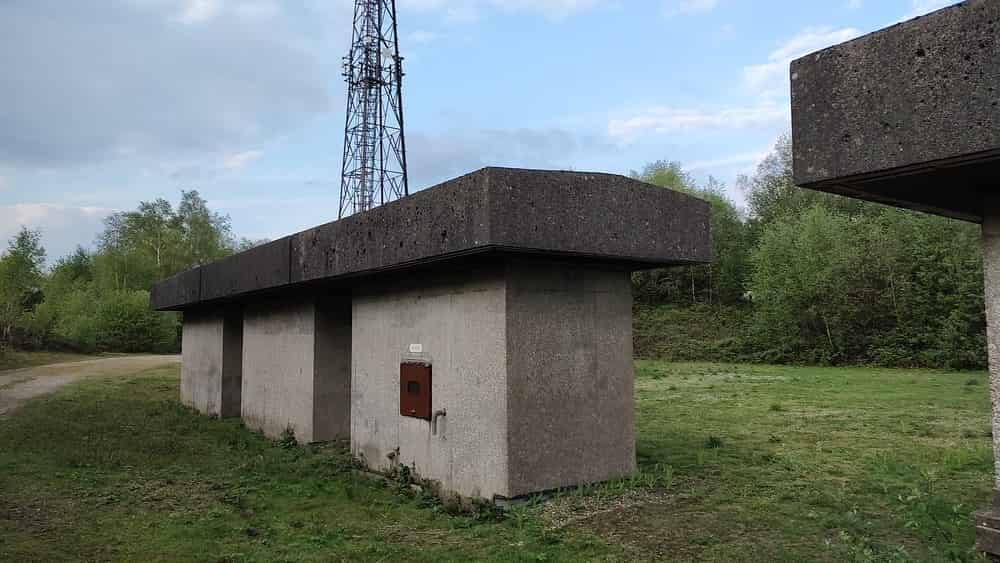
The remainder of the Kingstanding site is largely intact, although many buildings are in a poor state. The above-ground Aspidistra transmitter hall is interesting because it was designed by a cinema architect, as was the original bunker.
The Home Office closed this site, with the rest of the RGHQs, in 1992. Since then the bunker has been used on all three levels by Sussex police for training.
SITE VISIT REPORT
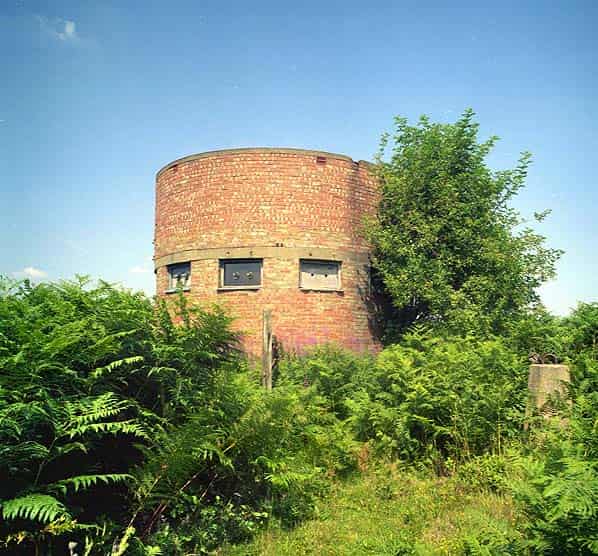
On Saturday 28th July 12 members of Subterranea Britannica and friends visited RGHQ 6.1 at Kingstanding near Crowborough in Sussex, we were also able to see the remaining buildings from the Aspidistra Complex a WW2 ‘Black Propaganda’ radio station, later used by the BBC to broadcast the BBC World Service to Europe. The whole site is now owned by Sussex Police who use it for training. The entrance is on the B2188 at where the original guardhouse still stands at the entrance gate. Having passed through the gate into the outer compound we proceeded along a road passing a circular brick building on our right, approximately 100 yards from the road. This building housed an aerial allocator, the feeds from the various transmitters would first go to this building where they would be fed to the appropriate aerial array consisting of rhomboid shaped wire aerials strung between 30 or so aerial masts spread around the complex. Although all the original transmission aerials have now gone the concrete bases where the masts were guyed are to be seen everywhere. The aerial allocator building still has the glass insulators around the top of the wall allowing the aerial feed to pass out of the building.
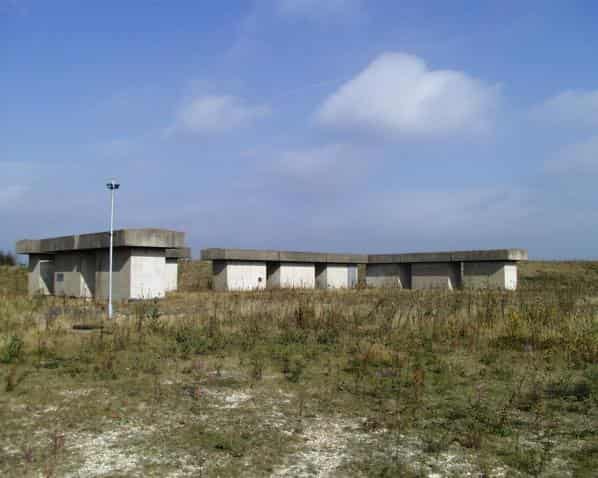
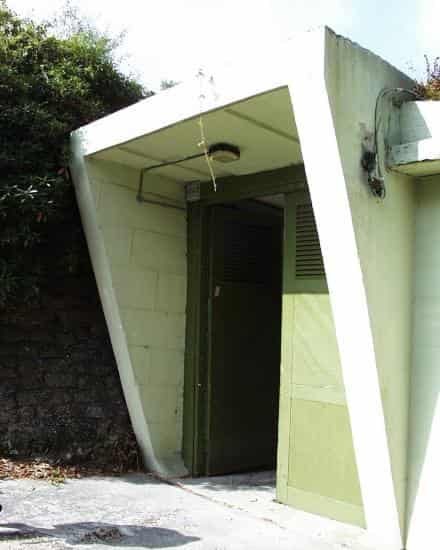
After about 200 yards we entered the middle fenced compound and immediately through the gate on our left was the gate into the inner compound containing the RGHQ bunker and the one remaining radio mast, erected in the mid 1980’s. The bunker was built between 1984 - 1986 replacing the former RGHQ in ‘Dumpy’ Level at Dover Castle. It was closed in 1992 following the end of the Cold War and the whole site was bought by Sussex Police in 1996 for £200,000. There is no raised mound indicating that the whole of the bunker is below ground with only the four concrete ventilation towers protruding from the ground. A sunken roadway leads to the entrance blast door which gives access to a lobby area with three heavy blast doors. Two of these are for heavy equipment leading directly into the plant area and the narrower door is the main entrance into the bunker. There is also a ‘dirty’ access into the bunker through a decontamination area with showers.
The original ‘Aspidista’ bunker which housed a 500 kilowatt medium wave transmitter was constructed by a Canadian Army road building unit by excavating a 50 foot deep hole. This was roofed with re-inforced concrete, four feet thick. The site took three weeks to excavate with the 600 strong civilian work force working 24 hours a day and the transmitter complex was completed within 9 months of receiving approval from Churchill. Aspidistra was ready in early 1942 but did not come on line until 8th November with pre-recorded speeches from President Roosevelt and General Eisenhower on the American landings in North Africa.
The three level RGHQ bunker was constructed by completely gutting the WW2 Aspidistra bunker, inserting an intermediate floor in what was the cable tunnel between floors (as at Skendleby) with additions to the upper floor to house the plant. The only part of the original Aspidistra bunker remaining is the entrance tunnel at the lowest level (now floor 1). The highest level, our point of access, is floor 3. Immediately inside the bunker are the two plant rooms one containing all the ventilation and filtration equipment and its associated rack of floor standing control cabinets. This plant is still in good order and permanently running, as are the pumps which ensures that the bottom level remains dry. Adjacent to the ventilation plant room are the two standby generators which are tested regularly and kept in good order. Between the two rooms is a small engineers room with a large chart draw where all the plans of the bunker, including those from the WW2 bunker are kept. One of the larger blast doors enters this room directly. These rooms are in the extension and along the passageway leading into the main body of the bunker is the canteen and kitchen. This is a long narrow room, smaller than at similar bunkers but adequate to feed the 150 people who would have been working there had there been an attack. The canteen area is surrounded by wooden trellis garden fence panels, reminiscent of a restaurant, with a serving hatch into the fairly spartan kitchen, again much smaller than at similar bunkers. The canteen is still used by the police during the week but hot food is brought in from elsewhere so there is no need to employ a cook and ancillary kitchen staff.
Having passed the kitchen/canteen, the main corridor passes through 90 degrees into the main body of the bunker, on the left and right are the large dormitories. These were fully fitted when the police took over the bunker but the beds have since been sold and the sheets and blankets sent to Kosovo. It’s still possible to see how closely the double bunks were positioned to each other, with only room for a narrow floor standing cabinet for personal belongings. Narrow as these cabinets are each one is divided into two and was used by two people. One of the dormitories although completely empty is used by the police as a gym, while the other, containing all the dormitory lockers is a recreation area with a modern vending machine. At the end of the north - south spine corridor are the stairs down to the lower levels, both the stairs and the landings are constructed of metal slats giving a view down to the bottom level. Beyond the stairs is a short tunnel and a set of concrete stairs leading to the north emergency exit with a heavy blast door (and beyond it a fire door) out to the surface.
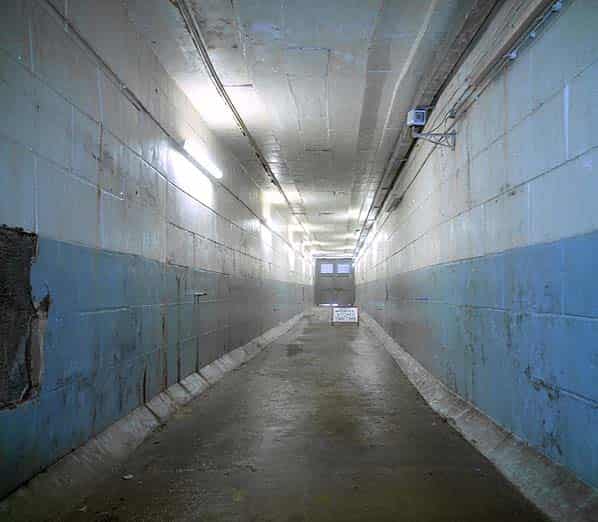
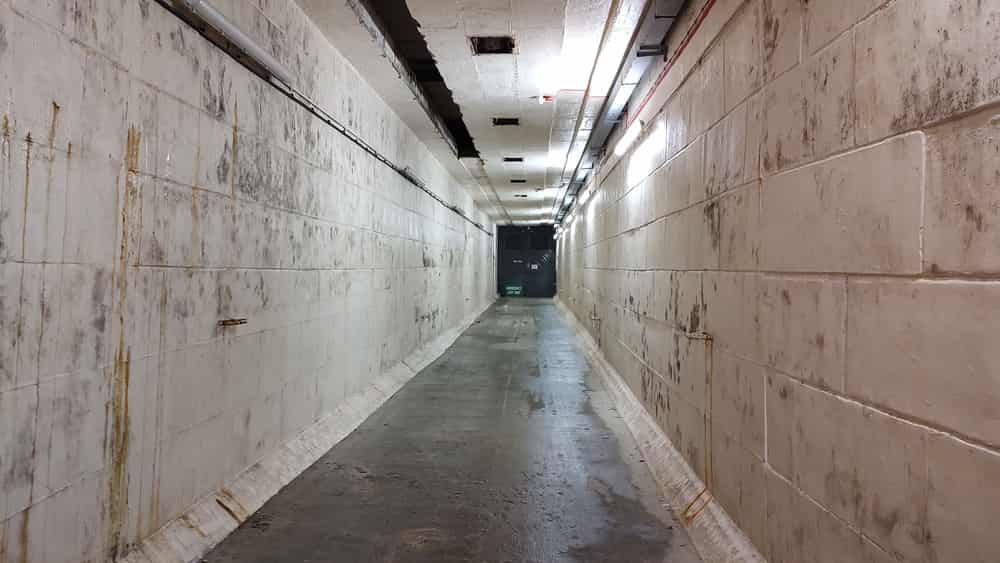
The middle level is basically two very large ‘L’ shaped rooms which were the administration area of the bunker, these would have housed all the desks for the various agencies and a hinged panel on the floor where there is a phone and power socket shows the position of each desk. There is a ladder on one wall giving access to a small tank room. Both rooms are now completely empty apart for modern chairs and are used by the police for lectures etc. We were unable to see inside any of the rooms on the lowest level (floor 1) as they are used to store evidence but we were shown which were the BBC studio, ministers bedroom and the work shop. At the far end of the lower spine corridor is the second stairway and a narrow passage that leads to a blast door and the gently inclined entrance tunnel into the original Aspidistra bunker.
This has been retained as a 2nd emergency exit and is wide enough to take a vehicle. Although we had come down to the third level, the tunnel exits to daylight as the level of the surrounding land had dropped off and the WW2 buildings were built in a hollow to keep them hidden.
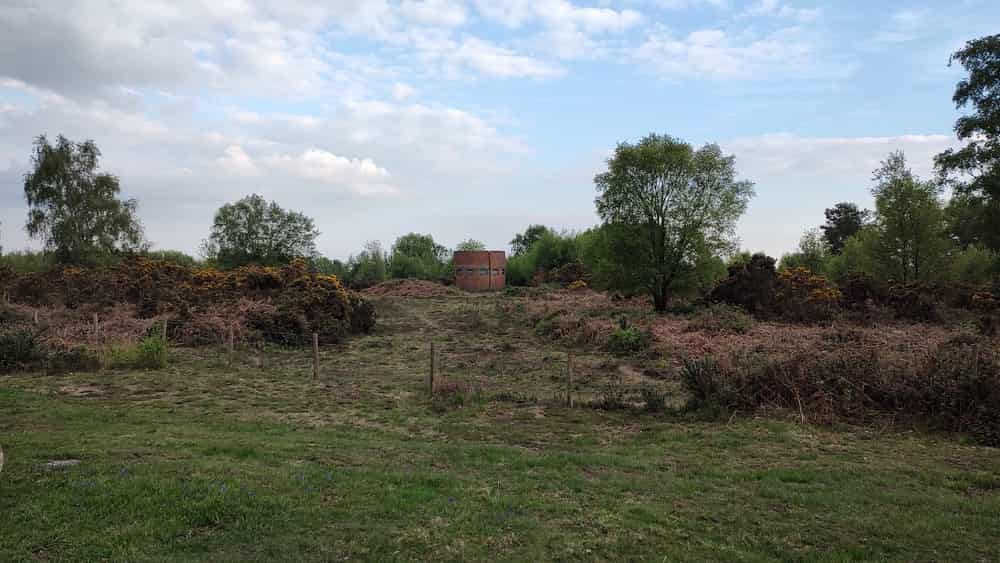
We returned to the entrance and made our way along the road to the WW2 complex which first came on line on 8th November 1942. Most of the buildings are derelict and ruinous and will be demolished in Sussex Police’s long term plan to develop the site as a training centre; none of the buildings are listed. The buildings are within a roughly circular complex with each road given a name by the Police. There are a number of substantial brick buildings that housed the transmitters and generators surrounded by various wooden huts including the canteen, architects building (with large windows to admits lots of light) and the coach house where they kept a coach to collect the workers each day from the surrounding villages. There is also a circular brick water tower and a small circular brick pillbox with two loopholes looking down the access road.
There are three large buildings the most impressive is the original short wave transmitter house which is built in typical 1930’s art deco style similar to cinemas of the period. The building includes glass bricks, a mirror on top of a column on the curved staircase and upturned lights. Unfortunately the building is very delapidated and the parquet flooring in the transmitter hall is beginning to lift. As with the aerial allocator building there are a number of glass insulators high in the wall. Although this building is not due for demolition it is proposed to add a second storey. Adjacent to this building is the later long rectangular transmitter hall where a further three transmitters were located. On first inspection this appears to be painted in camouflage paint but apparently this was done to appease the locals to help the building blend in with the surrounding woodland.The final building in this complex is the vast generator hall with concrete outer walls for blast protection. Although all the generators have gone it still contains all the gantries and hoists for moving heavy machinery around.
Those taking part in the visit were Nick Catford, Andrew Smith, Robin Ware, Richard Challis, Terry White, Keith Ward, Caroline Ford, Bob Jenner and Tony Page.
Sources:
- Pawley, E., BBC Engineering 1922-1972, p.256. (BBC Publications, 1972, ISBN 0 563 12127 0)
- Briggs, A., The War of Words, The History of Broadcasting in the United Kingdom Vol.III, p.426 (Oxford University Press, 1970)