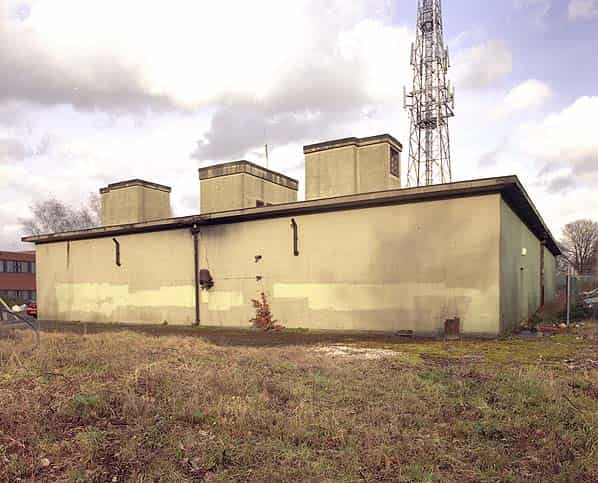
The Manchester Regional War Room was opened in 1952, it is now located within a secure compound in the car park of the Alexandra Hospital in Mill Lane, Cheadle (off Manchester Road). The bunker remained operational in that role until 1958 when the network of 13 Regional War Rooms was replaced by the Regional Seats of Government (RSG’s). From that date the building was designated Sub Regional Control 103 for the Manchester Sub Region becoming Joint Area Control 103A in 1961. In 1964 it became Manchester City Control when it’s Sub Regional Control function was abolished. After the disbanding of the CD Corps in 1968 it was placed on care and maintenance until about 1981 when it was reactivated as the Greater Manchester County Main Control (later Emergency Centre) remaining operational until 1991 when the Emergency Centre was relocated to Bury Fire Station to the north of the City. The building was purchased by the Greater Manchester Fire Brigade in 1996 but they have been unable to find a use for it as it would cost too much money to bring it within current health and safety regulations. It has now been sold to the Alexandra Hospital who intend to demolish it to create extra car parking space.
When the emergency centre was moved to Bury, the SX2000 Emergency Communications Network (ECN) unit remained at Cheadle where it is still maintained by BT. This will be moved to Bury before the building is demolished. Internally the bunker is clean and dry with power, water and telephones still connected. The building is of the standard war room design, semi-sunken with the lower floor below ground.
Entrance is through a wooden door which opens into a small porch with a heavy steel blast door offset to one side. Once through the blast door the male toilets are on the right. They consist of three hand basins, three WC cubicles, 4 urinals a shower and two water heaters. Originally the cubicles would have had curtains for privacy but these have now been replaced by doors. Beyond the male toilet is the upper ring corridor.
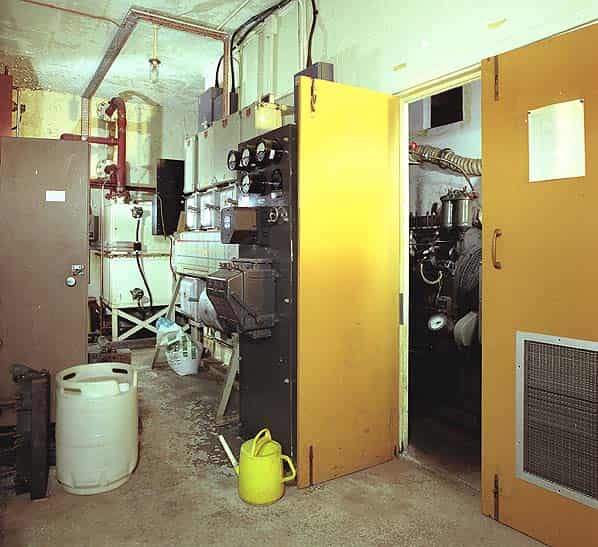
The first door on the right is the ventilation and filtration plant room. All the plant is intact and appears to be in good order. A thin partition wall has been installed down the middle of the room forming a workshop. A door in the far side of the plant room leads into the generator room which is itself divided into two rooms. In the outer room is the control cabinet for the generator, electrical switchgear, fuseboxes, several racks of emergency batteries and alongside a large floor standing battery charger. The generator is housed in a small room within this room. It is the original generator and appears in good working order.
Passing out of the generator room back into the ring corridor, the ladies toilets are on the right with two water heaters, 4 hand basins, 4 WC cubicles (with curtains replaced by doors) and a shower. Beyond the toilet is the emergency exit through a second heavy steel blast door. The ring corridor turns to the left past the stairs down to the lower level. All the rooms in the bunker have had various uses and the descriptions here refer to the most recent use as Greater Manchester County Emergency Centre. There are four rooms on the right, one of which was a food store and beyond that two rest rooms which now contain Dexion racks with files. The corridor then turns to the left again opening out into the canteen and kitchen. The original kitchen fittings have been replaced by modern appliances with a water heater, sink and serving counter remaining. There are a number of tables in the canteen area.
Passing out of the kitchen the corridor once more turns to the left passing four rooms on the right, these were, military liaison, military radio, WRVS and regional health authority. In this last room there is an intriguing message handling system for passing paper messages to the floor below. It consists of a wire basket and a system of ropes and pulleys for lowering the basket to the lower corridor. The basket locks in position at either level but can be released by pulling on the rope from below. The system is manufactured by Lamson who are better known for the ‘Lamson Tube’ a pneumatic message handling system used in many government buildings and still used in some department stores. At Cheadle the cord is missing so the basket is stuck on the lower level. Similar message baskets still exist at the Brislington, Leeds & Birmingham war rooms and seem to be standard feature. Beyond the regional health authority room are more stairs down to the lower level and beyond these we are back at the entrance door.
There are two rooms on the inside of the ring corridor, on the same side of the building as the plant room. These were the original controllers rooms with several Perspex windows overlooking the well on the lower level. The smaller of the two rooms has had its window removed and boarded over. The larger room has two windows overlooking the operations room. This room has been divided with a flimsy partition wall, one room housing police, ambulance and fire brigade representatives and the other the county controller and support officer. Unless otherwise described all the rooms on the upper level are empty.
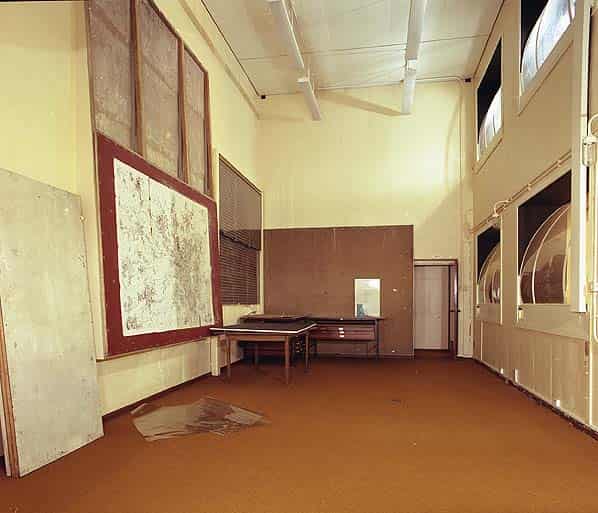
On the lower floor there is a second ring corridor. In the centre of the bunker is the two storey control room which still retains three large tables and a large angled wallboard with a map of the Manchester area with a large blackboard beside it. There are curved Perspex windows along one side into three rooms allocated to the fire service, police and ambulance service. At the back of the room there was originally another Perspex window but this has now been completely removed incorporating the room beyond into the control room, this area was for the scientific advisors and still retains maps around the walls including one showing nationwide ROC clusters. Next door to the scientific advisors a new room has been created utilising part of the ring corridor and a small messengers room; this was allocated to the county engineer. This room also still has maps on the walls and a message passing window into one of two communications rooms. This is one of the largest rooms in the bunker with a further two message passing windows, one in to the control room and one into the smaller communications room which still contains the SX2000 County ECN. This room was locked and we were unable to gain access.
The final two rooms in the bunker, opposite the entrance to the control room were the communications suite and the transport room. The communications suite still contains a floor standing 1960’s manual switchboard and there is evidence of a distribution frame that was mounted on the wall. There are also two tank rooms on the lower floor adjacent to the two stairways and an alcove in the ring corridor housing the bottom ‘station’ of the Lamson Message Handling System. Externally there is a large communications tower adjacent to the bunker, although this is still used it will be removed when the bunker is demolished. This bunker has now been demolished.
Those taking part in the visit were Nick Catford , Keith Ward , John Fogg, Ron Shiel and Simon Hooley.
Sources:
- Keith Ward