Castle Point Borough Emergency Centre is located in the basement of the council offices beside the A13 at Thundersleigh, six miles west of Southend. This was the last local authority protected emergency centre to be built and was brought on line just before the end of the cold war. It takes the form of a protected basement in an extension to the council offices. The total cost of the basement, which contains some non protected rooms, was £500,000 of which there was a 75% government grant towards the cost of the bunker. It remains fully operational and although it has never been used in a genuine emergency the emergency planning team, a maximum of ten people, are ready to move down at short notice and regular exercises are held both at Borough and County level.
At the bottom of the stairs into the basement is a heavy steel and concrete blast door and beyond it the decontamination room consisting of a shower, glass fibre water tank for the shower and a chemical toilet. To the left another blast door leads into the standby generator room. Until recently the generator was tested regularly but it is now redundant and the council are considering stripping the room to create storage space. On the far side of the decontamination room is an air lock consisting of two blast doors which lead directly into the control room. There is a large spanner on the wall in the air lock so that the door can be locked shut from the inside to stop anyone else getting in. The control room is rather spartan with white painted brick walls. Four wooden tables are arranged in a circle in the centre with chairs around them. There is an audio visual system and various maps of the locality on the walls.
On the same side of the room as the entrance is another blast door into the ventilation plant room. The ventilation plant and filters are still in place although the fallout filters have been taken out of the circuit. The plant is still fully operational and is run from time to time to change the stale air. At the back of the room is a further blast door into a small filter room. There is a short corridor to the ‘domestic’ area accessed from the control room. At the end of the corridor is the small kitchen with all the usual appliances including a hand pumped sink and water supply. The council are hoping to install mains water here at some time in the future. To the left is the canteen with a couple of tables and some chairs and through the canteen is the dormitory.
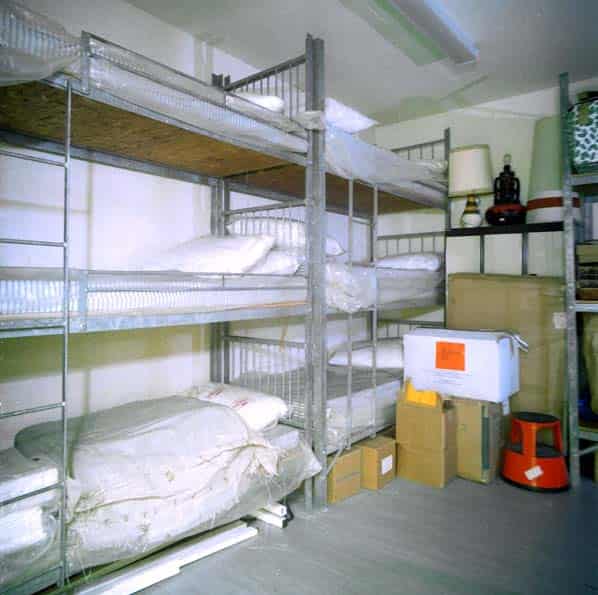
It is unusual to find the bunks still in place but this dormitory is complete and usable with 4 triple bunks with mattresses, sheets and blankets, 12 metal lockers and a metal framed stretcher hanging on the wall. On the right hand side of the short corridor is a small wash room with three stainless steel sinks, each with a hand pump and another hand pump for waste water. Through the washroom is a 3 cubicle unisex toilet with a chemical toilet installed in each cubicle. Through the toilet is a tank room with three glass fibre water tanks. None of the water tanks in the bunker have any had any water in them as it would get stagnant. It was always considered that there would be a build up to war giving sufficient time to fill the water and fuel tanks.
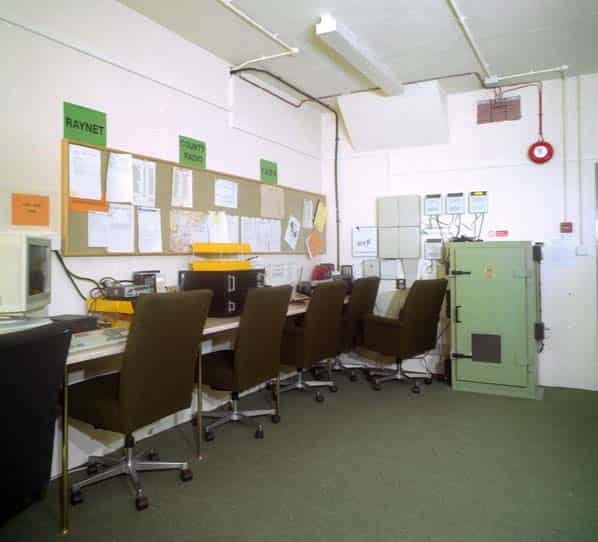
The final room is the communications room, also accessed from the control room.
There is an amateur radio system operated by Raynet and the county radio network. There is also a recently installed computer, fax machine, photo copier an SX50 ECN (Emergency Communications Network) unit which is still functioning. At the far side of the room is another blast door leading in to the non protected area of the basement. Having passed through two rooms now used for storage there is a second stairway up to the surface and beyond that a long narrow room with a small blast door in the end wall. Beyond this is the emergency escape shaft with a ladder up to a manhole cover in the grounds behind the council offices.
This is one of the most complete emergency centres visited and although a very late build it should be retained intact. Unfortunately the council didn’t share that view and although the emergency centre is to remain operational some of the unused rooms are to be stripped and put to other uses. A number of emergency stores are kept in the bunker including food rations, rest centre ‘starter packs’ and fluorescent jackets.