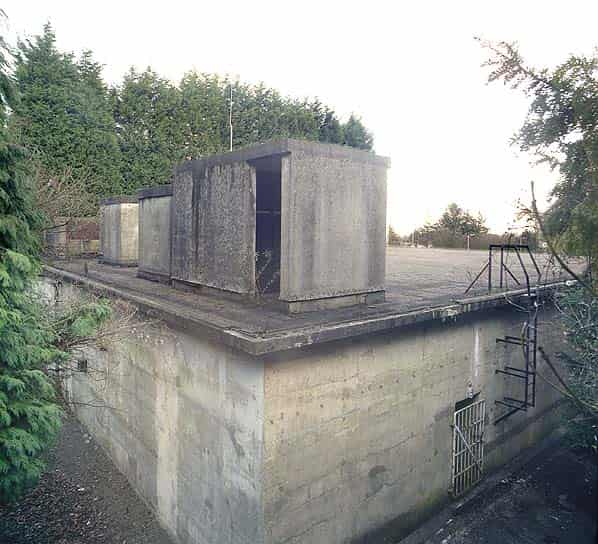
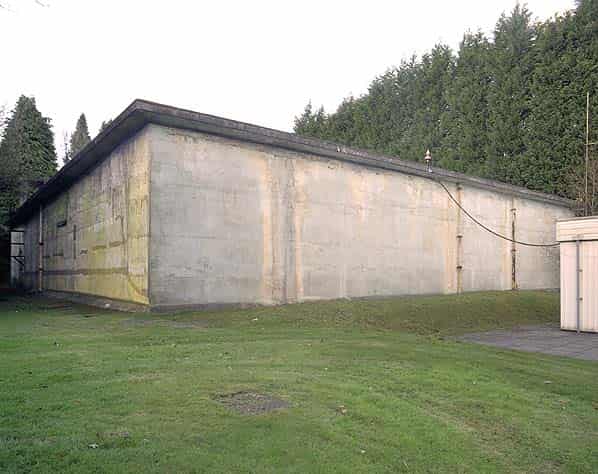
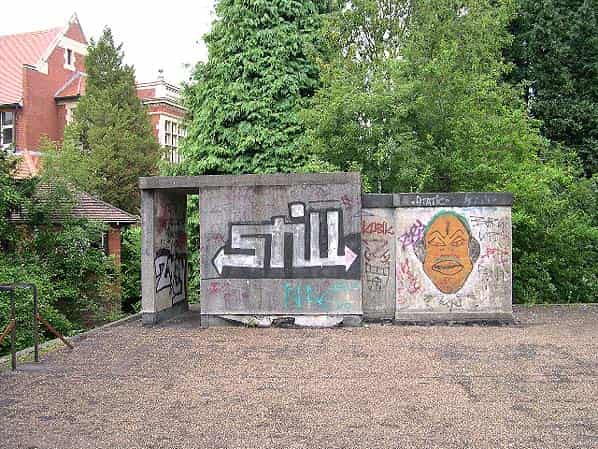
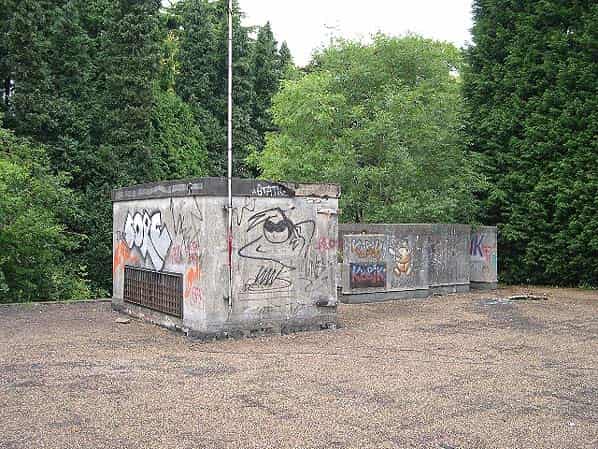
The Cardiff War Room was located at the rear of the Wales and the Marches Telecom Board HQ at Coryton close to Junction 32 of the M4 motorway. The site was sold to a property developer and the office block and the war room were demolished at the end of 2003.
Coryton was one of 13 Regional War Rooms built in 1952 to house the regional administration for Wales in the event of a devastating nuclear attack on Whitehall making central government impossible. It remained operational until approximately 1958 when the network of Regional War Rooms were replaced by the Regional Seats of Government; Coryton being replaced by RSG 8 at Brecon. The old war room was retained as a training centre for RSG personnel until 1965 when it was reactivated as the Cardiff Corporation Main Control Centre. It performed this function until the disbanding of the Civil Defence Corps in 1968.
With the formation of South Glamorgan County in 1974, it was reactivated as the South Glamorgan County Control and later South Glamorgan Emergency Centre remaining in use until the end of the cold war in 1991.
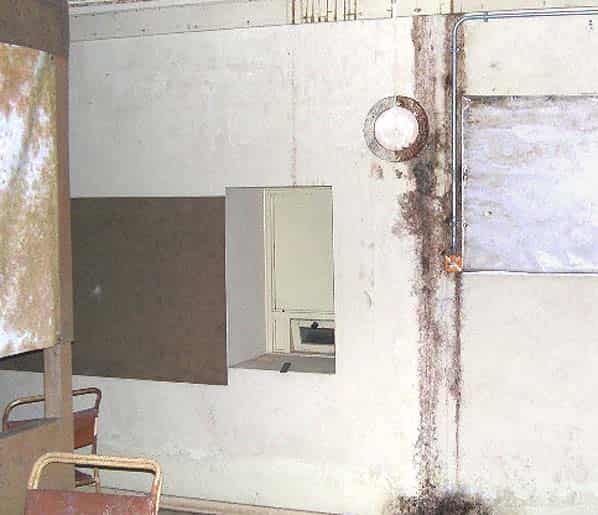
After that date the building was abandoned and once the ventilation plant was switched off the bunker deteriorated quickly and is now very damp with standing water on the lower floor. At the time of our visit there was no more than half and inch but after periods of wet weather it can be several inches. Power and water to the bunker is now disconnected.
The building is of the standard Regional War Room design with one floor above ground and one floor underground. Only that at Newcastle (Kenton) differs as it utilises a former WW2 Sector Operations Centre (SOC). London is divided into four regions each with a single story war room and Glasgow also has a single level war room (East Kilbride) being a sub region of the main Scotland war room at Kirknewton. The other war rooms were at Tunbridge Wells, Reading, Cambridge, Nottingham, Manchester, Leeds, Belfast, Birmingham and Bristol. Of the two level bunkers only that at Tunbridge Wells has been demolished (1997) and possibly Manchester (Cheadle) where demolition was expected in 2003.
Members of Subterranea Britannica have now been allowed into all the sites except the Northern Ireland War Room at Mount Eden Park which is a secure document store and Newcastle which was cleared of asbestos a few years ago and a visit is expected later this year.
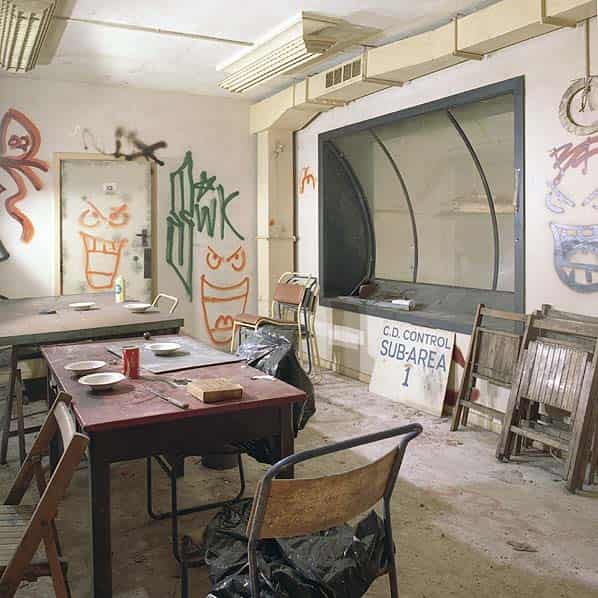
In recent years local children have broken into the Cardiff war room but there is little internal damage although all external walls are now covered with colourful wall art. The following paragraphs describe the inside of the building as it appears in 2003. The plant rooms, toilets etc. are much as they would have been in 1952 but the rest of the rooms are laid out for their most recent use as the South Glamorganshire County Emergency Centre.
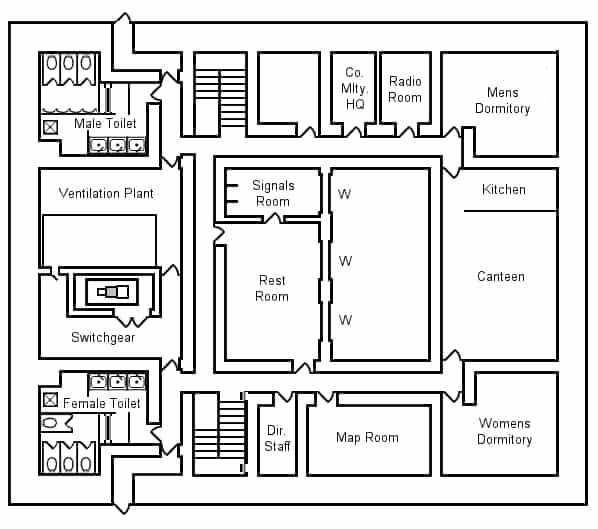
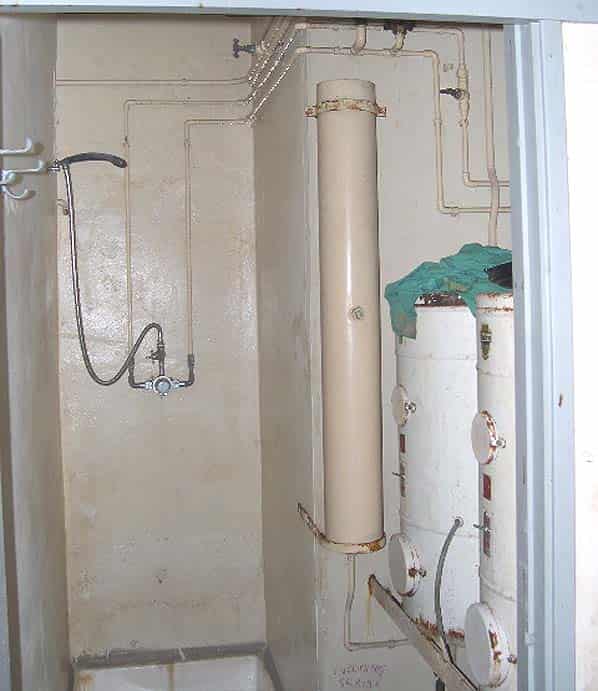
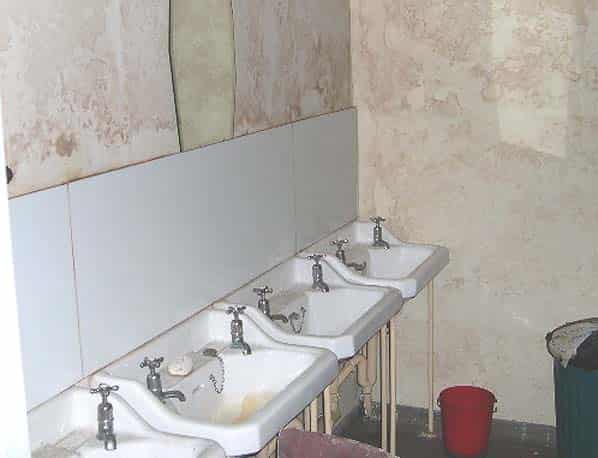
We entered through the wooden door in the west wall which has now has a steel grille added in front of it for extra security. Beyond this there is a dogleg and a heavy steel blast door giving access to the upper ring corridor. The first room on the right is the male toilet with three WC cubicles, four hand basins four urinals, a shower and two hot water heaters.
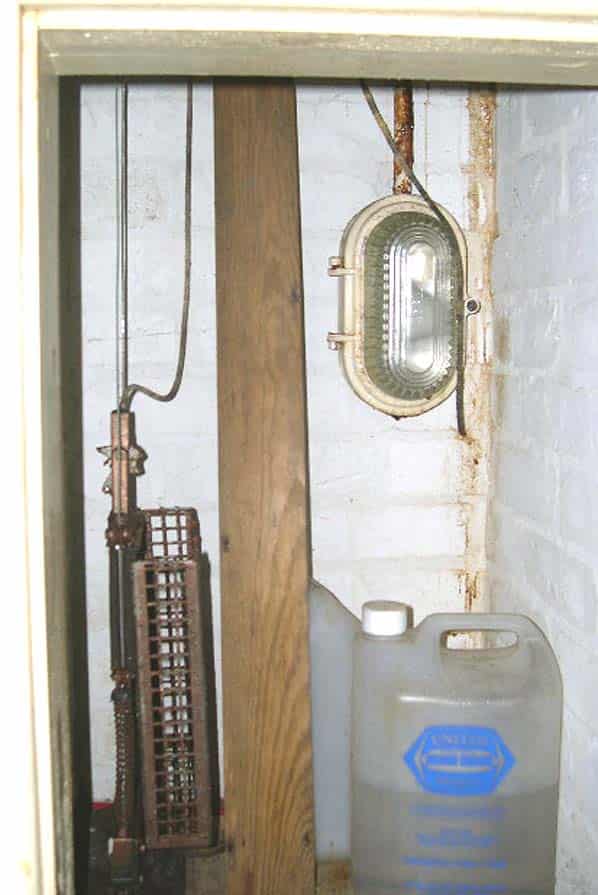
Moving round the ring corridor in a clockwise direction (left) there are stairs down to the lower floor with a double water tank above. The first room on the left contains cable hauled message basket system down to the floor below; unfortunately the mechanism for this is now broken and the basket is resting at the lower level. The mechanism consists of a wire basket and a system of ropes and pulleys for lowering the basket to the lower corridor. The basket locks in position in the upper room but can be released by pulling on the rope from below. The system is manufactured by Lamson who are better known for the ‘Lamson Tube’ a pneumatic message handling system used in many government buildings and still used in some department stores. Similar message baskets still exist at the Bristol, Leeds & Birmingham war rooms.
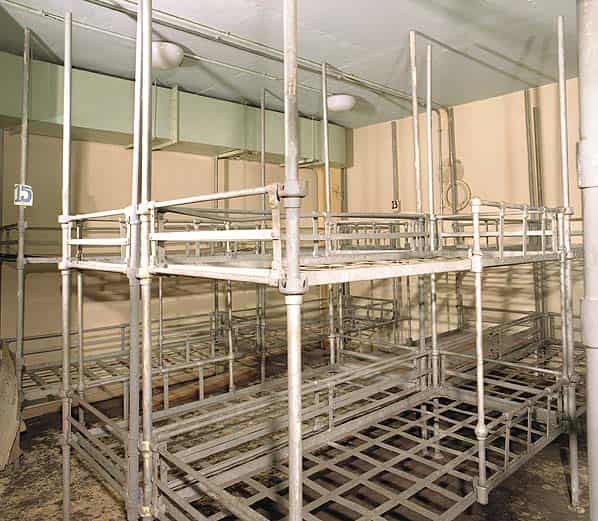
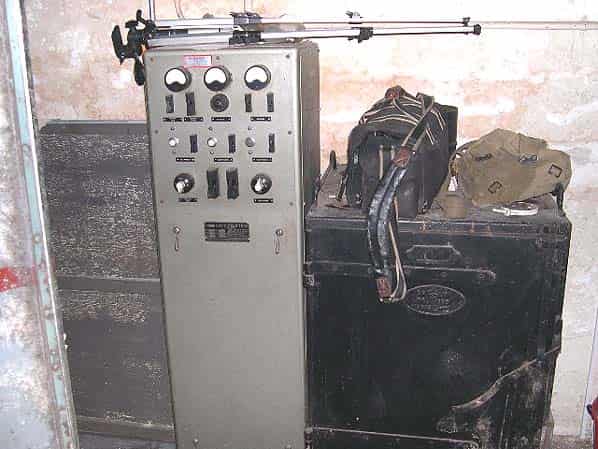
Beyond this is the ‘County Military Headquarters’ with the floor now strewn with wooden debris and wire mesh. The third room on the left is a radio room with two heavy duty cables going out through the roof and a radio workbench across the far wall. Ventilation trunking enters this room from the adjacent room and then runs down through the floor to the lower level. The next room at the corner of the ring corridor is the mens dormitory with four rows of two double bunks and an electric heater on the wall. There is a very narrow walkway beween the rows of bunks and no lockers or space for them.
The corridor now turns to the right into one of the largest rooms in the bunker, the canteen and kitchen. There is a large serving counter and food preparation table a few feet in front of the near end wall, there are five open bays beneath it. Behind this is a Belling electric cooker and oven and next to it a mini Belling oven and a Creda water heater. There’s a Butler sink with a wooden draining board on each side and a wooden plate rack above it.
In the canteen area there are tables and chairs, a double metal cupboard, six hay boxes (containers for delivering trays of hot food). There are also a large number of cooking pots and pans on the floor and a four shelf glass fronted bookcase containing recreational books and some civil defence books.
Beyond the canteen is the women’s dormitory with four rows of four bunks with three extra bunks dismantled and leaning against the wall. The ring corridor now turns to the right. And the next room on the left is the map room now full of waterlogged maps. The next room on the left has a paper label on the door marked ‘Directing Staff’. There’s only a wooden cupboard in this room, even the clock has been removed leaving a tell tale wooden ring on the wall where it was mounted, this is seen in most of the rooms throughout the bunker. Beyond this room is the second staircase down and the corridor turns to the right passing the rear exit which is a mirror image of the front. Beyond this the corridor turns to the right passing the female toilet with four WC cubicles, four hand basins and two hot water heaters. Beyond the mens toilet are the plant rooms, which are divided into three rooms, electrical switchgear and batteries, generator and ventilation plant with another door back into the spine corridor.
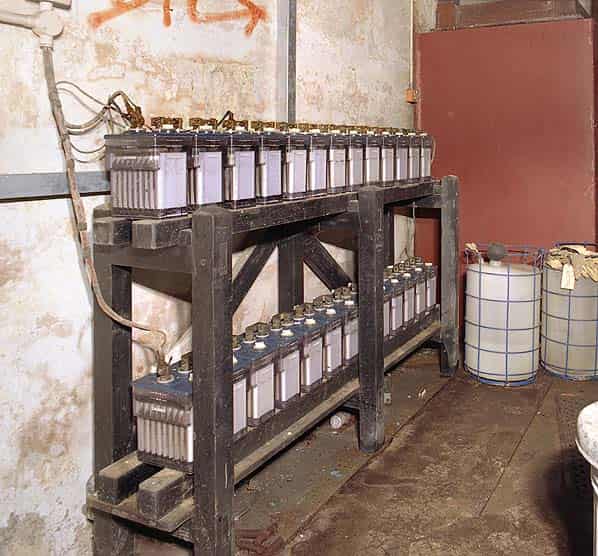
The first room is the switchgear room with the control cabinet for the generator, a bank of lead acid batteries for running the bunker in the event of a generator failure and a large floor standing battery charger and rectifier unit. At the back of the room there are two diesel tanks and a narrow walkway at the back of the generator room with a low door into a filter chamber with a bank of filters still in place along one wall. The Ruston Hornby 6YE diesel generator is in a small room within the switchgear room. The generator appears in good order and could probably be started.
The connecting door to the ventilation plant room was locked, as was the door back into the spine corridor. It was, however, possible to get in to the room by climbing a ladder on the wall behind the generator and through an inspection hole onto the top of the intake fan. All the ventilation plant is in good order. There is Dexion racking along one wall still stacked with spares, lubricants, filters etc.
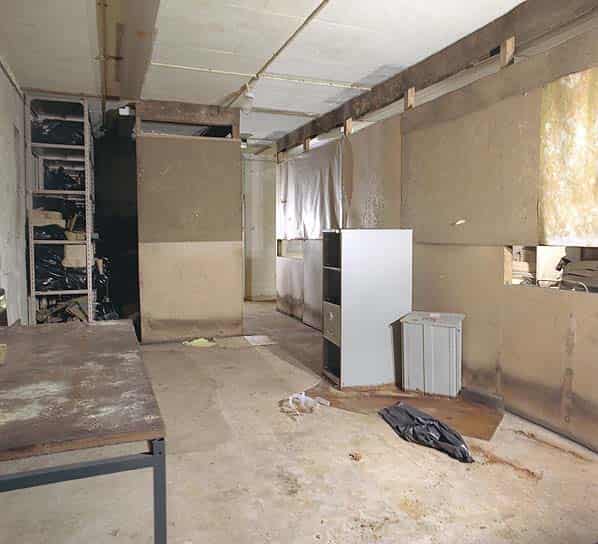
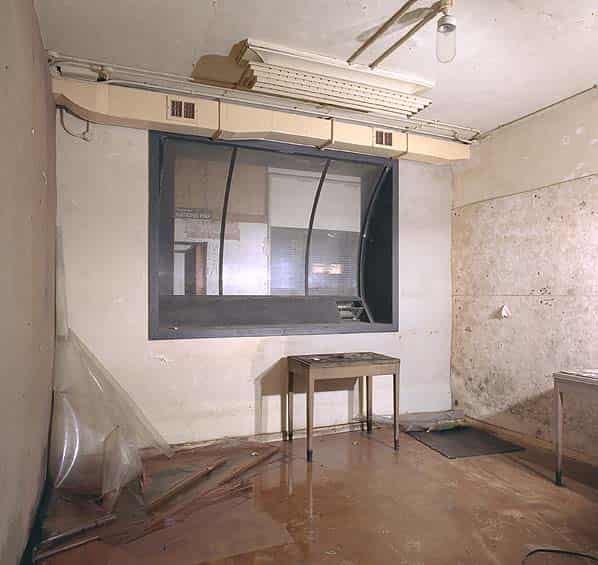
Opposite the ‘Directing Staff’ office is a room with two curved Perspex windows overlooking the operation room in the ‘well’ below. There is an electric heater and a number of tables and chairs indicating it was used as a rest room. At the rear of the room a door leads into a storeroom stacked with furniture, stationery and a large number of boxed filters and at the back of this room are three more acoustic telephonists' booths. The curved window overlooking that operations room is still in place but it has been boarded over on the inside.
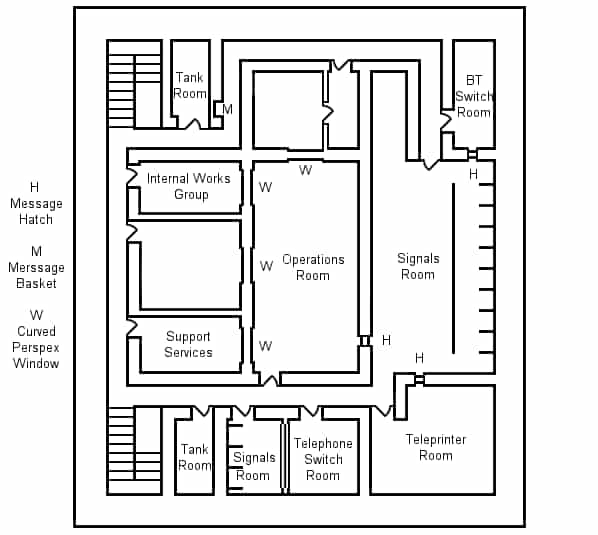
On the lower floor there is another ring corridor with three rooms accessed from the inner side of the ring with curved Perspex windows looking into the operations room. The first of these rooms is the ‘Internal Works Group’ with three tables, a wallboard and a filing cabinet; there are also wallboards on both sides of the ring corridor at this point. The second room has three wooden tables, a pile of stacking chairs and a wallboard. The third room looking into the operations room is for ‘Support Services’. This has a pegboard on the left, coax cable going out through the wall. There are two piles of stacking chairs.
The ring corridor now turns to the right. There is a tank room on the left and then a dogleg to the left with a small alcove in the wall for the bottom station of the message basket. The corridor doglegs to the right with a room on the right with a curved Perspex window looking into the operations room. The door to this room was locked but it was possible to see through the window that it was stacked with paraffin heaters.
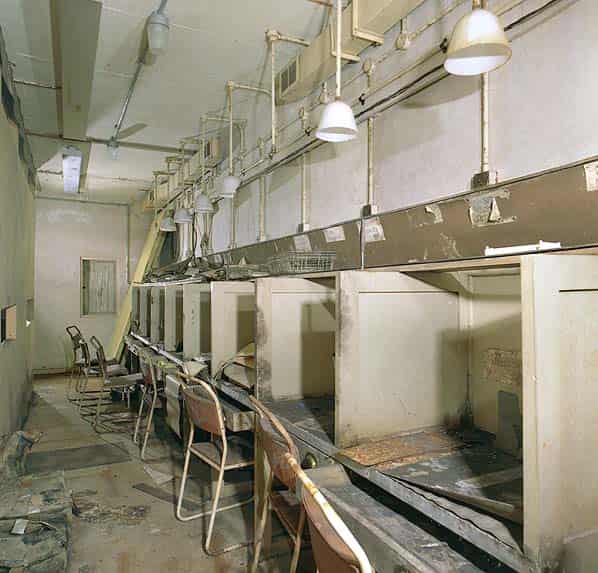
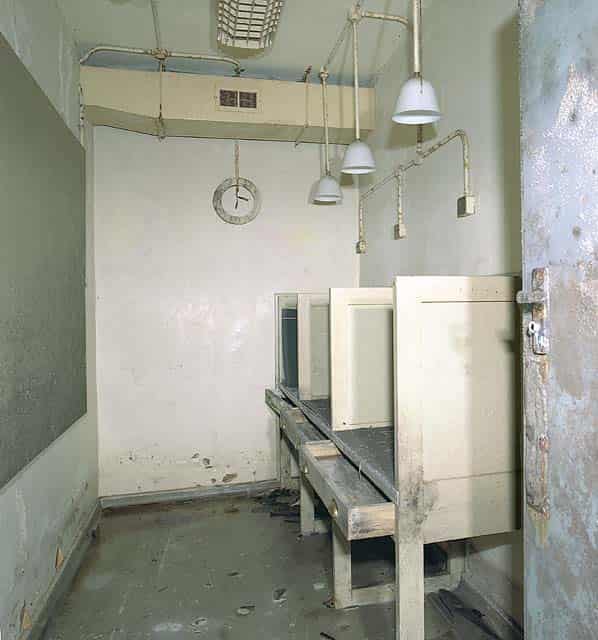
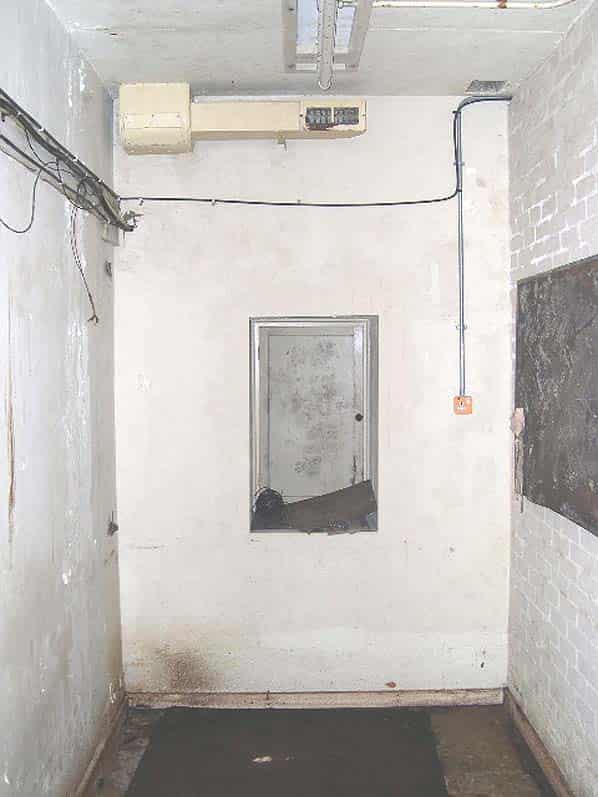
Beyond this room the ring corridor turns to the right passing a small BT switch room on the left with cables running into the adjacent signals room and a message passing hatch between the two. The BT room has been altered with a brick partition reducing it to half its original (war room) width. The other section of room now forms the corridor and the original corridor has been blocked at one end forming a long storage alcove in the Signals Room which has also been altered with a wooden partition down the middle. There are eight acoustic booths on the left-hand side, each with a lamp above and drawers underneath and labeled ‘out message’. There are three oblong hatches in the partition wall into the main body of the room. The main part of the room has racking and tables and a filing cabinet in one corner. There are stacks of papers in the alcove including the county war plan and a large amount of very damp stationery. There is a large message window into the operation room with a hinged Perspex tray at the bottom. There is a similar hatch into the adjacent teleprinter room on the corner of the ring corridor.
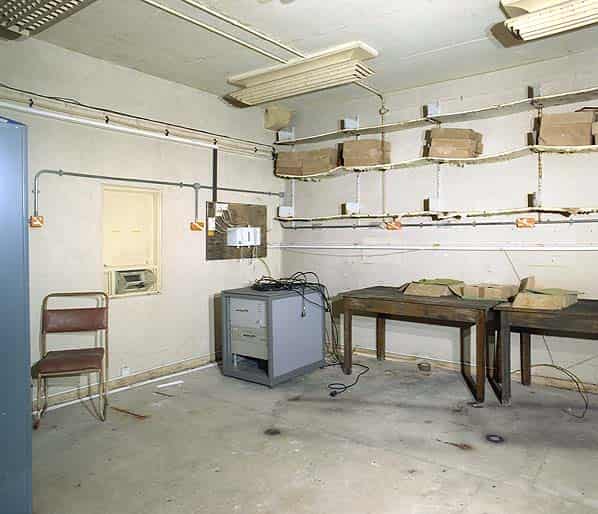
This room has five wooden teleprinter tables with a BT junction box on the wall with five incoming lines. There is a large office cabinet and three wooden shelves; an Autex teleprinter control unit stands on the floor. There are boxes of unused files and a stack of crockery on the floor.
There are three more rooms along the final left-hand side of the ring corridor, the first is the ‘Telephone Switch Room’ which is empty apart from two BT junction boxes on the wall. Next to that is another small signals room with three acoustic booths with lamps above them. The final room is the second tank room with stairs up to the top level alongside. A small recess under the stairs is for janitorial supplies.
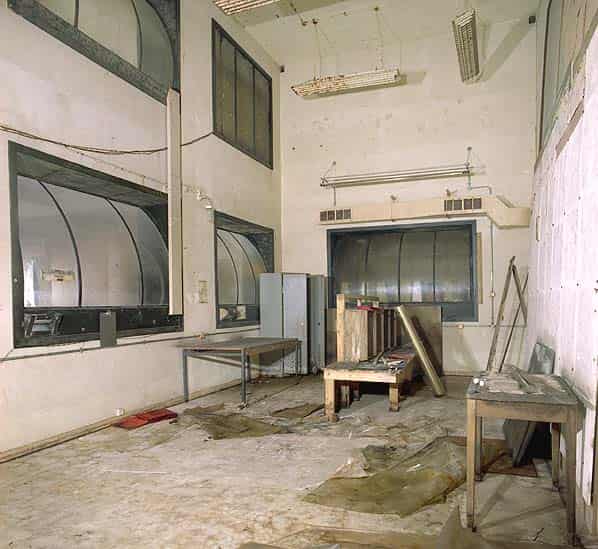
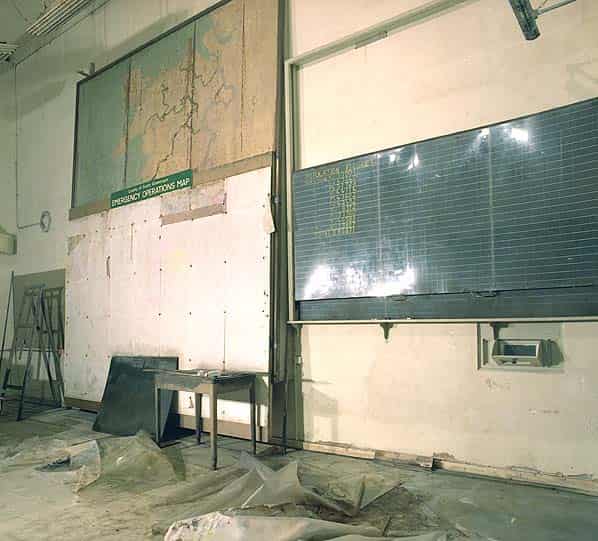
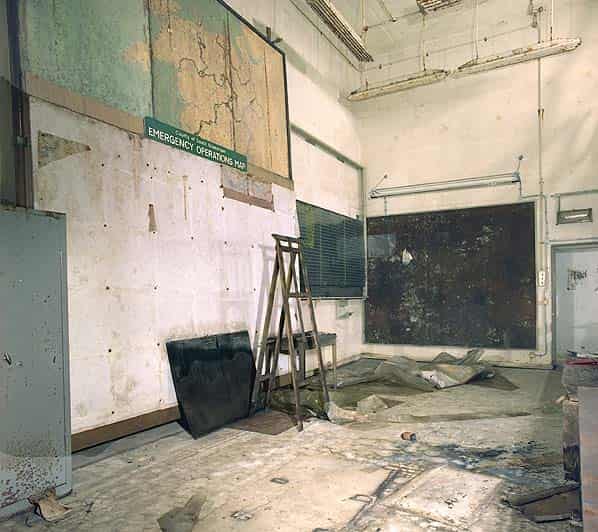
On the opposite side of the corridor is the operations room, the largest room in the bunker spanning both levels. There are three curved Perspex windows into rooms on the left-hand side and a fourth window in the end wall; each of these windows has a small message hatch in the bottom left hand corner. There are a further three windows from the rooms above on the left hand side.
On the right hand wall is the ‘County of South Glamorganshire Emergency Operations’ map spanning the height of both floors. Furniture includes three large wooden tables, two blackboards and an easel
Those taking part in this visit were Nick Catford, Keith Ward, Robin Ware, Bob Jenner, Nick McCamley, Keith Ward, Pete Turier and Bob Clary.
Sources:
- Bob Jenner