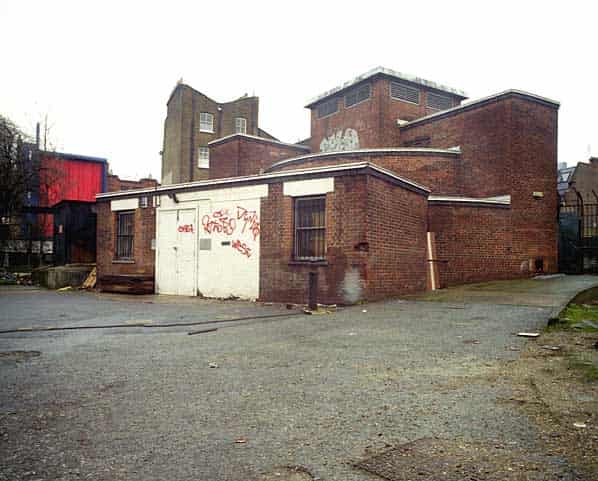
There are two entrances at Camden Town shelter, one in Buck Street, N.W.1. adjoining the covered market (this is now only used as and emergency exit), and the other in Underhill Street, N.W.1, behind the Marks and Spencer car park.
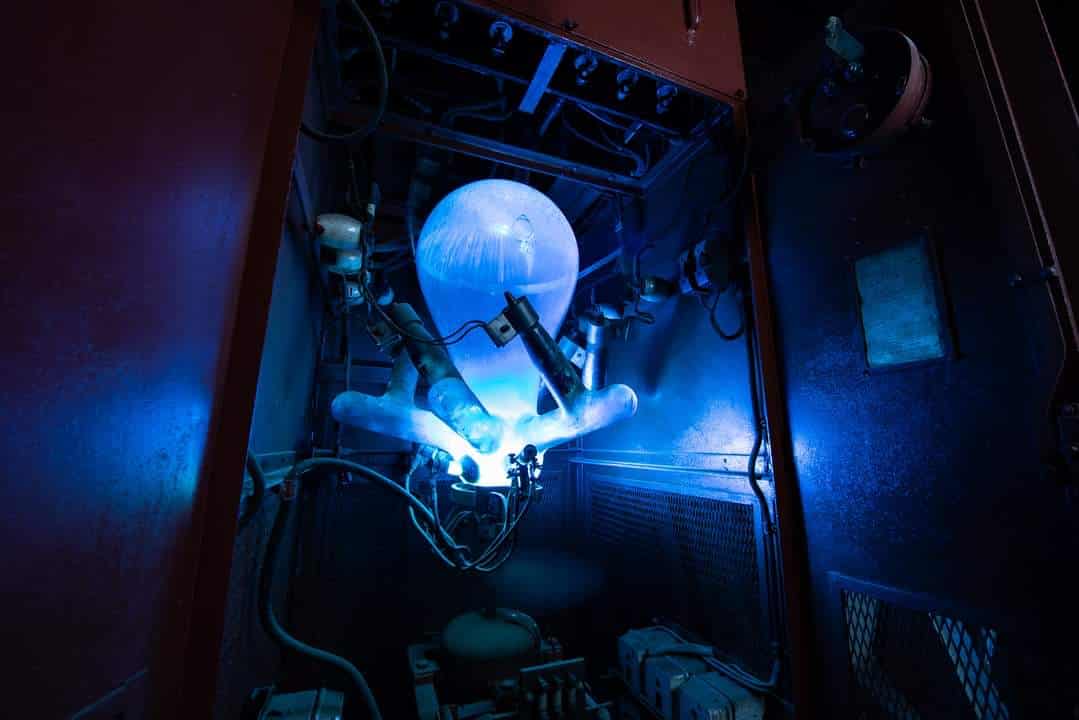
Just inside the main entrance there are a number of small rooms now used as an office by the archive company who rent the shelter. A few yards inside the door is the top of the lift shaft with twin spiral staircases around it, one to each of the lower levels. There is a map on the wall titled ‘Camden Town deep shelter’ showing the layout. Adjacent to the lift shaft a door leads into a small room housing the transformer for powering the lift, (manufactured by Hackbridge of Walton on Thames) and a metal cabinet that had originally contained a mercury arc rectifier. According to one of the staff the rectifier has now been removed, the room was full of junk so we couldn’t get across to it. We descended to the upper landing, approximately 50 feet below the level of the northern line. The lift opened into a well lit curving passage. Immediately there was a door on the right which opened into a long room containing the fan which was of a different design to that at Belsize Park. Beyond the fan was a rusty and rotten grill in the floor leading to the sump. The ladder was still in place but having descended into the sump at Belsize Park we decided not to on this occasion.
Beyond the sump, another door led into a switch room with a lot of electrical boxes on one wall and two floor standing cabinets containing rheostats for controlling the speed of the fan. None of this equipment appeared to be operational. There was a large schematic diagram of the switch gear on the back of the door labelled ‘Home Office deep shelter’
We returned to the main passage which soon straightened out. On our right were a male and female toilet block, each with a wall in front of the open entrance for privacy. Both rooms have been stripped of all fittings and contain ‘dexion’ shelving and are used for storage. Evidence of the positions of WC’s, urinals and sinks were visible. Beyond the toilets is a crossroads where the entrance tunnel meets the main shelter tunnel approximately one quarter along its length. Unlike Belsize Park where the two shelter tunnels are fairly close together, at Camden they are separated by about 150 feet. We moved on to the second shelter tunnel at a second crossroads. There is a long room straight ahead which originally housed a medical post. We turned left along the main two level tunnel which is lined along both sides with shelving containing cardboard boxes. Some of the shelving is modern dexion while other shelving is made from original bed frames. Approximately half way along the tunnel a wide stairway leads down to a lower cross passage and the lower deck. A few yards along the cross passage a door leads to steps up 50 feet, originally connecting to the northern line platforms at Camden Town Station. There is some shelving along one side of the stairs but nothing is stored there yet. Climbing the stairs the atmosphere becomes very humid with the temperature steadily climbing. At the top of the stairs are some original air filtration units and a sliding metal grill giving access to the northern line platforms. They way through has been bricked up.
Returning to the upper landing, a second narrow stairway again leads down to the lower landing with a second parallel cross passage containing two toilet blocks. Back on the upper level the next section of passage contains all its original bunks on both sides, as yet not used for storage. On the right hand side there is a single bunk almost at floor level, a twin bunk above it, one half hinged, and another single bunk above that. On the opposite side the bunks are at right angles to the main passage which is divided into bays. Each bay contains six bunks, two stacks of three singles. There are two original signs lying on the floor in this area. One has an arrow pointing to ‘Underhill Street entrance’ and the other has an arrow pointing to ‘Buck Street entrance’.
About three quarters of the way along the tunnel is another cross roads, left to the parallel bore and right to another male/female toilet block followed by a door on the left to the Buck Street lift and a door straight ahead leading to another fan and another switch room, similar in design to the Underhill Street end. There is a Ministry of Works notice on the wall stating that any staff caught smoking will be dismissed. The lift is operational with twin spiral staircase going around it. We went up in the lift to the Buck Street entrance. At the top of the lift is another Ministry of Works sign and room containing an original Hackbridge transformer for powering the lift and another metal cabinet that would have housed the mercury arc rectifier. The cabinet door was jammed but none of the equipment appeared to be working. Round the other side of the lift shaft was the motor room. The motor appeared to be a more recent addition. Steps lead up to a winding passage leading to the emergency exit. This passage is rubbish strewn and appears to be little used.
Returning to the main tunnel, we are now in the final quarter of the shelter. At the far end, there is a door in the end wall with a final cross passage to the parrallel tunnel and a steps down to the lower landing at each end.
Most of the tunnels and cross passages, toilet areas, medical room, wardens post etc. are in use for document / computer tape and video tape storage. Unfortunately, because of the use that the shelter is now put to we had to limit the party to three (Nick Catford, Dan McKenzie & Tony Page).